


Automation in Electronics Manufacturing: Concepts, Classifications and Solutions
01-09-2025 425
Automation in electronics manufacturing is becoming an inevitable trend in the era of industry 4.0, when businesses increasingly require high precision, speed and efficiency in all production processes.
The electronics manufacturing industry, which is characterized by small components that require high precision, is witnessing a strong transformation thanks to modern automation solutions. Let's explore the details with Intech Group in the article below.
1. What is automation in electronics manufacturing?
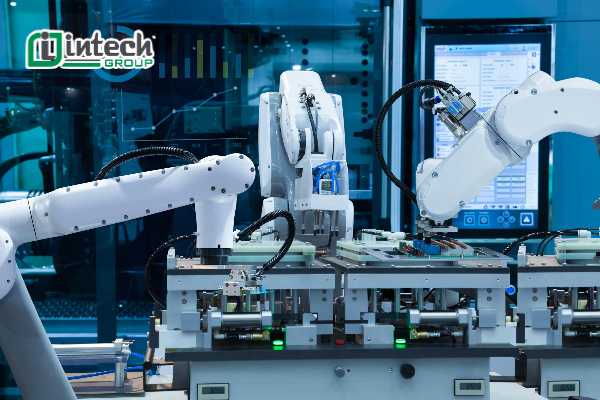
Automation in electronics manufacturing is the process of applying advanced technologies and automatic control systems to the production line of electronic devices. Commonly used technologies include industrial robots, CNC precision machining, PLC programming control systems, smart sensors and MES production management software. The goal of automation is to replace or support humans in stages such as assembly, inspection, component welding, packaging, etc. to ensure efficiency and high precision throughout the entire production process.
2. Classification of automation in electronics manufacturing
Automation in electronics manufacturing is not just about replacing humans with machines, here is a common classification of automation in electronics manufacturing:
Classification of automation by process
- BPA (Business Process Automation): Is a form of automation of complex business processes, helping to comprehensively transform digitally, optimize production and management activities in electronics factories.
- RPA (Robotic Process Automation): Using software robots (bots) to simulate and perform repetitive tasks such as data entry, information checking, and digital document processing.
- IPA (Intelligent Process Automation): Is a higher level of process automation, integrating artificial intelligence (AI) so that systems can learn, improve and make smart decisions in real time.
Classification of automation by production type
- Fixed Automation: Applied in large-scale electronic production lines, fixed and rarely changed. Suitable for highly repetitive products such as circuit boards and standard equipment.
- Programmable Automation: Can customize the production line for each order. Often applied in small-batch electronic manufacturing factories with flexible product design requirements.
- Flexible Automation: An ideal solution in a diverse electronic manufacturing environment. The system can automatically recognize and process many different types of products without stopping the machine to reprogram.
Classification of automation by level
- Basic level: The system automatically performs simple, repetitive tasks such as picking up components, labeling or preliminary inspection.
- Process level: Machines can perform multi-step process chains such as electronic component assembly, quality inspection, packaging, etc. through the integration of automatic control systems.
- Smart level: Integrate artificial intelligence (AI) and Machine Learning so that the system can self-learn, analyze past data, thereby optimizing performance and automatically adjusting the production process in real time.
3. Benefits of automation in electronics manufacturing
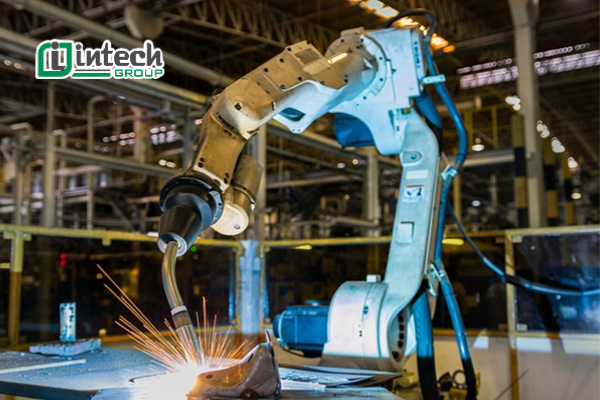
- Increase productivity and accuracy: Help the production line operate continuously 24/7, increase output while ensuring high accuracy, minimizing product errors due to human factors.
- Reduce long-term labor costs: Repetitive steps are handled by machines, businesses can significantly reduce labor costs in the long term while maintaining stable work performance.
- Effective quality control: Pre-programmed automatic systems help ensure that the production process is carried out synchronously, thereby improving the quality of output products, reducing the rate of defective goods and returned goods.
- Increase market response speed: Shorten production time, quickly respond to large orders or changing market needs.
- Improve labor safety: Replace humans in dangerous or toxic processes, thereby reducing labor accidents and improving working conditions.
4. Challenges of automation in electronics manufacturing
Automation in electronics manufacturing also faces many challenges, requiring businesses to consider carefully before implementing.
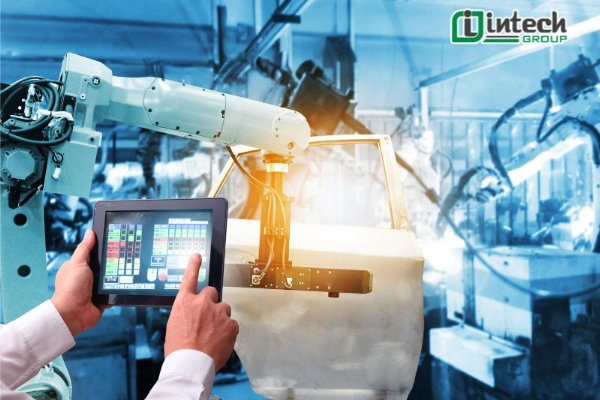
- Large initial investment costs: Businesses must invest a significant amount in modern machinery, industrial robots, sensor systems, control software and training personnel to operate, monitor and maintain the system.
- Demand for highly skilled human resources: Need for human resources with deep expertise in the fields of mechatronics, programming, automatic control and data analysis, recruiting high-quality engineers and technicians is a difficult problem for many businesses.
- Risks of depending on technology: A small technical problem can also cause serious production disruptions. Maintenance costs, repairs, and recovery times for automated systems are often much higher than for traditional production lines.
- Impact on employment: Replacing manual labor with smart machines is narrowing job opportunities for unskilled workers, shifting the labor structure and requiring difficult training strategies.
5. Automation technologies in electronics manufacturing
Integrating advanced technologies helps improve performance, increase accuracy, and reduce production costs. Below are the most popular and effective automation technologies being applied in this field.
Industrial robots, autonomous vehicles
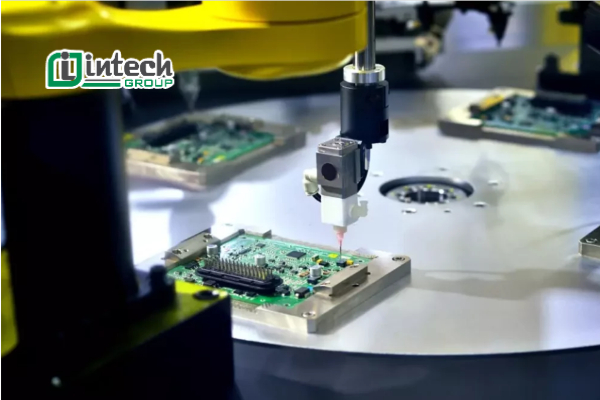
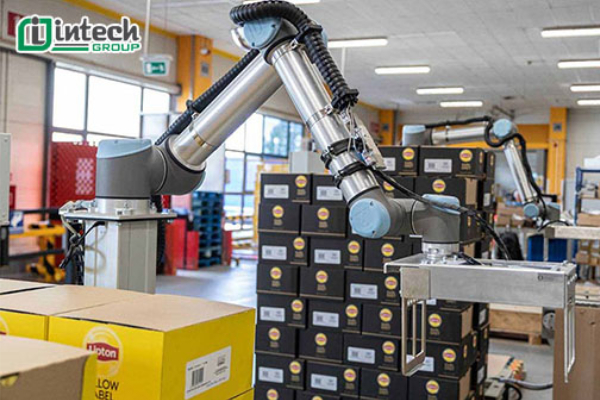
Industrial robots integrating sensors, machine vision, and artificial intelligence (AI) are designed to perform tasks requiring extremely high precision such as component assembly, microchip soldering, and product inspection.
Common types of robots in electronics manufacturing:
- Pick and place robots: Responsible for picking up small components (SMD, DIP, etc.) from trays and placing them precisely in position on the PCB board.
- Soldering robots: Solder components on circuit boards with high precision and stability.
- Inspection robots: Equipped with machine vision systems to detect assembly errors, incorrect component positions, or unsatisfactory solder joints.
- Scara Robot: Often used in assembling large parts such as outer shells, screens, batteries, control panels, etc.
For example: Samsung Electronics Vietnam uses thousands of industrial robots in the AMT line to check cameras, package components, reducing the error rate to less than 0.001% to meet strict standards for global export products.
Computer vision and artificial intelligence (AI)
Computer vision combined with AI helps to check product quality through images, detecting microscopic defects that cannot be seen with the naked eye.
-
Kiểm tra vị trí linh kiện, mối hàn và lắp ráp trên PCB.
-
Nhận diện lỗi sản phẩm, đọc mã vạch, QR code.
-
Phát hiện vết xước, sai lệch màu sắc, lỗi in ấn...
Ví dụ: Sony Corporation ứng dụng thị giác máy tính kết hợp AI trong kiểm tra chất lượng bảng mạch và cảm biến hình ảnh. Việc ứng dụng này giúp Sony giảm 50% thời gian kiểm tra chất lượng và nâng độ chính xác phát hiện lỗi lên 99.8%.
Internet vạn vật công nghiệp (IIoT – Industrial Internet of Things)
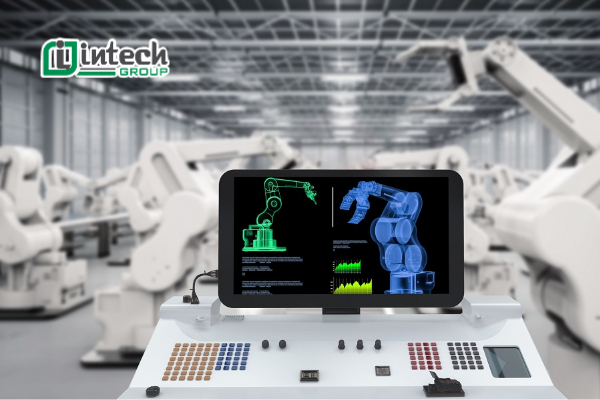
Computer vision combined with AI helps to check product quality through images, detecting microscopic defects that cannot be seen with the naked eye.
- Check the location of components, solder joints and assembly on PCBs.
- Identify product defects, read barcodes, QR codes.
- Detect scratches, color deviations, printing errors...
For example: Sony Corporation applies computer vision combined with AI to check the quality of circuit boards and image sensors. This application helps Sony reduce quality inspection time by 50% and increase the accuracy of error detection to 99.8%.
Automatic assembly system
Technology: The combination of robots and smart conveyor belts helps to fully automate the assembly process of electronic devices with high speed and stable accuracy. Production lines for phones, televisions, tablets, headphones and smart home appliances.
For example, LG uses an automatic assembly system to produce TVs, reaching a speed of 500 products per hour. Optimizing assembly speed, saving labor costs, and easily expanding production scale.
Automatic Conveyor and Material Handling Systems
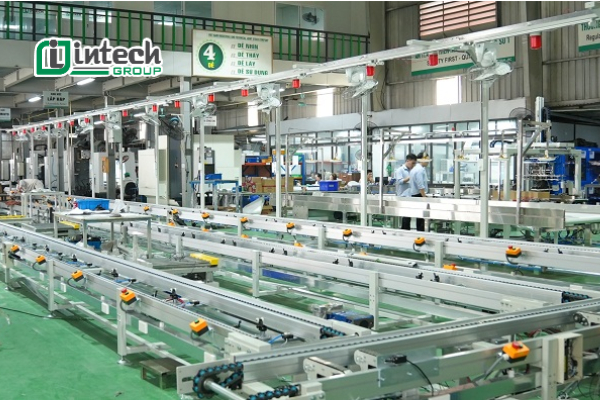
- Automatic Conveyor: Transports PCBs and components between stages.
- AGV, AMR Autonomous Robots: Transports components, materials and finished products without human intervention.
- AS/RS Autonomous Storage and Retrieval System: Optimizes storage, retrieval and inventory management in the factory.
For example: Since 2013, Vinamilk has implemented an automated production system with AGV autonomous robots and automated production lines. Production has grown, helping the Vietnamese dairy brand Vinamilk reach out to the world.
Manufacturing Execution System
MES is software that operates and controls the entire electronics manufacturing process in real time.
-
Monitor machine performance, product quality, production schedules.
-
Analyze data to optimize processes, reduce downtime and avoid material waste.
-
Support quick and accurate decision making for management.
-
Increase transparency, comprehensive quality control and improve production management efficiency.
Electronics manufacturing automation solutions from Intech Group
Understanding the needs of the market, Intech Group is a leading unit in the field of industrial automation solutions, providing advanced automation systems, lines and technologies, helping businesses transform production in a modern and intelligent direction.
Electronic Circuit Board (PCB) Assembly Line
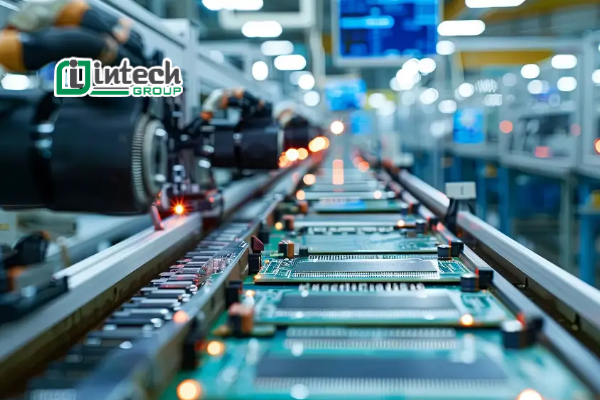
Intech Group provides PCB assembly lines with a high level of automation, integrating modern technologies such as Pick & Place machines; reflow soldering machines; automatic optical inspection systems (AOI), operating tables, etc.
PVC conveyor system in electronic component assembly line
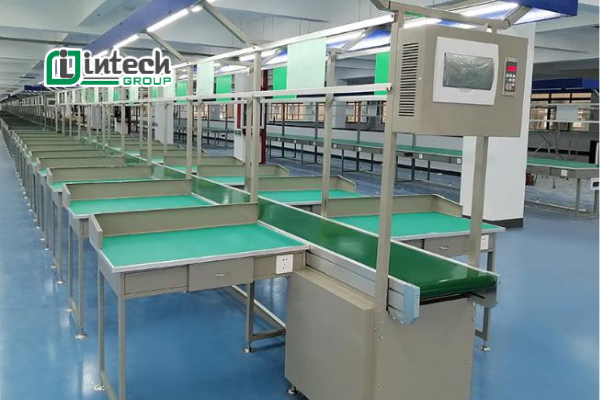
The PVC conveyor system designed by Intech Group helps to connect component assembly stages seamlessly and optimize operations. With flexible design according to each factory space; easy to integrate sensors, classification systems, collaborative robots and machine vision cameras; increase product transmission speed, reduce waiting time, improve line efficiency.
This is an ideal solution for medium and large-scale electronic factories that are aiming for full automation. Detailed operation video provided by Intech:
Specialized electronic component assembly line
Intech Group develops electronic component assembly lines customized for each product type, including semi-automatic or fully automatic workstations; robot systems, machine vision positioning mechanisms; precision mechanical mechanisms for stages such as: assembly, screw tightening, inspection, packaging, etc. This is a solution to help businesses optimize labor costs, ensure international quality standards and increase product consistency.
Cost of automation lines in electronics manufacturing
The cost of automation lines in electronics manufacturing depends on many factors such as factory size, level of automation, type of equipment used and specific technical requirements of the product. Typically, implementation costs can be divided into 4 main groups:
Human resource costs: Including the cost of recruiting, training and maintaining a technical team capable of operating, monitoring and improving the automation system. This is a necessary factor to ensure stable and high-performance operation of the line.
Data costs: Including control software, data analysis platforms, IoT systems and digital tools for management, monitoring and optimization of production.
Equipment costs: Investment costs in machinery, industrial equipment and automation systems such as conveyor belts, actuators, sensors and control cabinets.
Robot costs: Including industrial robots, robotic arms, automatic stackers... integrated into the process to replace or support humans in repetitive steps or requiring high precision.
Long-term investment, optimizing production costs: The initial investment cost for an automation system can be high, but in the long term, businesses will save significantly on labor costs, reduce error rates, increase productivity and better control the use of raw materials.
With experience in the field of automation, Intech Group is proud to be a trusted partner of hundreds of domestic and foreign enterprises, providing effective automation solutions, optimizing costs and improving productivity. Contact Intech Group immediately via hotline 0966.966.032 - 0983.113.387 for detailed advice and the most suitable quote for the automation line in electronics production, meeting the exact needs and budget of your business.
