


Automation with robots is the technology priority of the future
20-09-2021 521
Tự động hóa sản xuất với Robot là ưu tiên hàng đầu cho các nhà máy, dây chuyền lắp ráp, kiểm tra ô tô, xe máy và linh kiện điện tử trong thời đại công nghiệp 4.0.
Mục lục
Today, most robots are used in production activities to replace humans in simple to complex processes that require high precision; boring, repetitive and potentially hazardous operations, or in the harsh environment or working conditions.

Benefits of using robots in production automation
Reducing operating costs
- Robotic automation allows reducing direct costs as well as operating costs of production systems, making a big difference to the competitiveness of enterprises.
- Robots can also eliminate most of the costs associated with manual labor, minimizing labor costs and labor-related costs.
Ensuring uniformity and increasing product quality
The application of robotic automation can produce products in bulk, with higher uniformity and quality, because machines always operate with precision, continuous repetition, and no distractions, boredom, fatigue, attitude... like using human labor.
Using industrial automation robots to increase productivity
The ability of the robot to work at all times, durable, without rest is the optimal solution to increase production output. The production cycle is optimally programmed, the robot's operation is continuous without interruption, which human labor cannot compare.
Increasing production flexibility
Industrial production lines with the application of robotic automation are programmed through the controller, so they easily switch from one mode to another, easily change processes and product categories, and optimize operations.
Saving raw materials and lowering product costs
Robotic production automation helps to reduce defective and damaged products. The production stages always ensure the accuracy and standards, so the waste of raw materials and spillage is greatly limited.
Improving the efficiency of business investment
- Robot application means optimizing the production process, saving space, thereby reducing the need for land, reducing investment costs in infrastructure and factories.
- Normally, the application of robots will increase the initial equipment investment costs, but reduce the costs of factory infrastructure investment. Also, robotic application optimizes operations, then increasing the efficiency of investment capital.
- The above benefits will improve the overall efficiency of the investment project.
Improving brand reputation and increasing business competitiveness
Robotic automation with a series of benefits mentioned above will help businesses meet exactly the progress and product quality required by customers. The production operation process minimizes errors, thereby helping businesses improve brand reputation and increase competitiveness.
Applications of robots in production automation
Using Robots capable of “seeing” in assembly – Robotics Vision
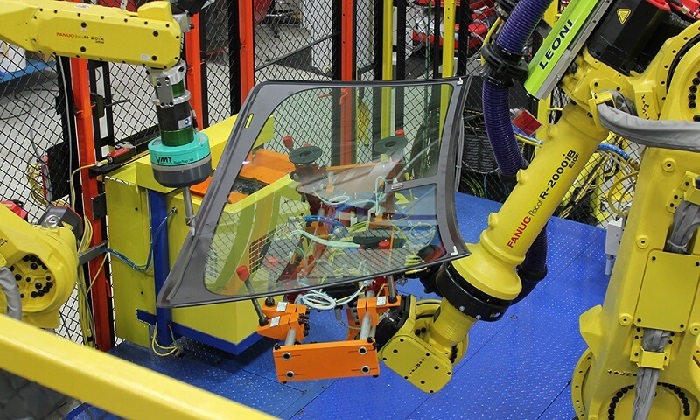
A lightweight industrial robotic arm with “eyes” can do the job more precisely because it can “see” what it is doing. The robot wrist carries a laser beam and a camera array that helps the machine respond immediately to the images it receives thanks to the signal transmitted to the controller.
The robot can now make appropriate compensation when a certain part or component is installed. Because they know where it is. The installation of door panels, windshields and fenders is more precise with the Robotics Vision than with conventional robotic arms.
Spot and body welding with robotic arms - Spot and Arc Welding

The body of a car is a very important part in manufacturing and assembly. Welding seams that require high quality and aesthetics are easily solved by robotic arms.
Large industrial robots with long arms and higher load capacity handle spot welding on heavy body panels. Smaller robots weld lighter components like brackets. Inert gas “robot welders” (TIG, MIG welding) can position the torch in the exact same direction every cycle. Maintaining high welding standards in every manufacturing process is possible because distances, speeds and repeatable arcs are calculated and set in the precise movement of the robot arm.
Large industrial robots with long arms and higher load capacity handle spot welding on heavy body panels. Smaller robots weld lighter components like brackets. Inert gas “robot welders” (TIG, MIG welding) can position the torch in the exact same direction every cycle. Maintaining high welding standards in every manufacturing process is possible because distances, speeds and repeatable arcs are calculated and set in the precise movement of the robot arm.
Assembly robotics application –Assembly robotics
In most car factories, lightweight robotic arms assemble smaller components such as motors and pumps at high speeds. Other jobs such as feeding and shooting screws, installing wheels, installing windshields are all done by the robot arms.
Painting, Sealing and Coating
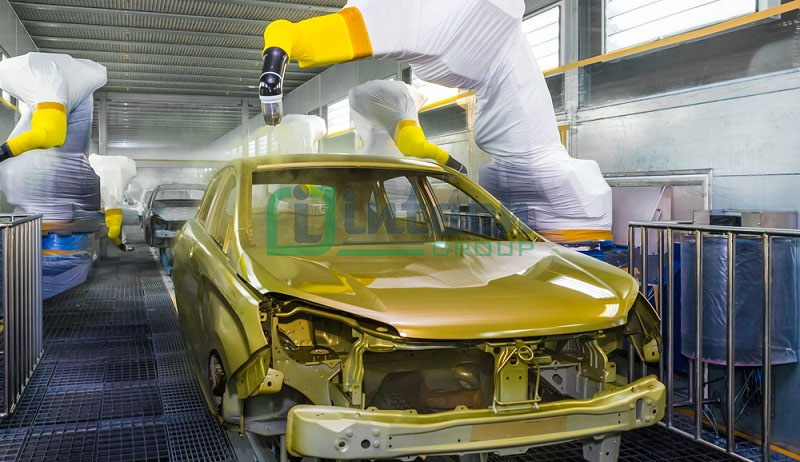
The job of an auto painter is not easy and this is very hard and toxic work. Labor shortages also make it harder to find professional, skilled painters. Robotic arms can fill in the gaps because the job requires consistency for each coat of paint. Robots can follow a programmed path, always covering large areas and minimizing waste.
With the robotic arms involved in the painting process: primer, base coat and top coat, the heavy and technically demanding job has been handled perfectly.
With the paint robots, the thickness of each layer of paint is set and the actual coating is accurately applied at every position because the distance between the nozzle tip and the product surface is always controlled. This is very difficult to maintain, even with a skilled painters.
The painting stage is calculated with the trajectory to move the nozzle to avoid wasting paint and bring the best quality.
With the robotic arms involved in the painting process: primer, base coat and top coat, the heavy and technically demanding job has been handled perfectly.
With the paint robots, the thickness of each layer of paint is set and the actual coating is accurately applied at every position because the distance between the nozzle tip and the product surface is always controlled. This is very difficult to maintain, even with a skilled painters.
The painting stage is calculated with the trajectory to move the nozzle to avoid wasting paint and bring the best quality.
Feeding workpieces to machines -Machine Tending and Part Transfer
Feeding workpieces to CNC machines and pouring molten metal in a foundry are dangerous jobs, bringing high risks to people. They are the perfect application for large industrial robots. Using robotic arms makes the manufacturing process safer, more precise and more productive.
Materials Removal with robots –Materials Removal
Robots can follow a complex trajectory many times without failure, making it the perfect tool for cutting and machining jobs. Lightweight robots with load cell technology are better suited for this type of work. The jobs include grinding plastic molds, polishing molds and cutting fabrics for the sewing line of seat covers and car interiors.
Internal transportation in the factories –Internal Logistics
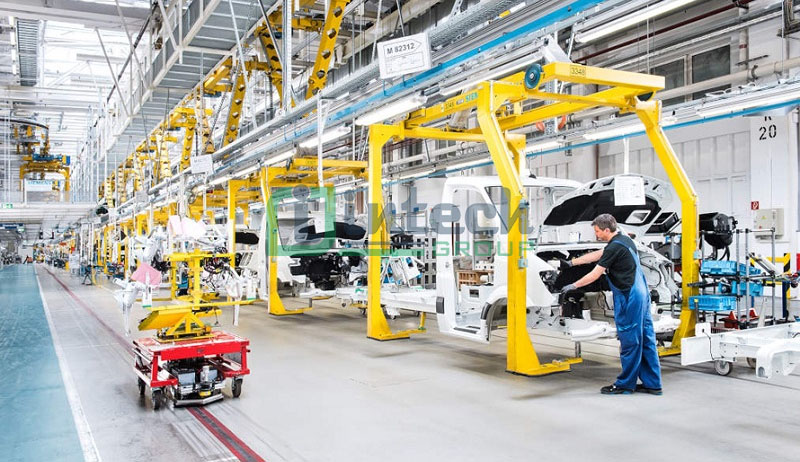
Mobile robots, Automation Guided Vehicle AGVs, and other autonomous vehicles, such as forklifts, can be used in factories to move raw materials and other parts and products from storage areas to the lines in the factory.
The productdesigns are an important aspect of robot assembly. Assembly methods suitable for humans are not necessarily suitable for robots. For example, using screws and nuts as the tightening method, is easy to do in manual assembly, but the same operation is extremely difficult for a one-handed robot.
The designs in which components and machine parts are added from the same direction using couplings and other one-step tightening processes allow for much easier job completion using automated and robotic assembly methods.
Precision is another area of factory activity in which the use of robots is increasing. In a typical precision job, the robot places a sensor on the work piece and determines if the part conforms to quality specifications.
In most industrial robotics applications, robots provide an alternative to human labor. There are certain characteristics of human-performed industrial jobs that define the job as a potential application for robots:
The productdesigns are an important aspect of robot assembly. Assembly methods suitable for humans are not necessarily suitable for robots. For example, using screws and nuts as the tightening method, is easy to do in manual assembly, but the same operation is extremely difficult for a one-handed robot.
The designs in which components and machine parts are added from the same direction using couplings and other one-step tightening processes allow for much easier job completion using automated and robotic assembly methods.
Precision is another area of factory activity in which the use of robots is increasing. In a typical precision job, the robot places a sensor on the work piece and determines if the part conforms to quality specifications.
In most industrial robotics applications, robots provide an alternative to human labor. There are certain characteristics of human-performed industrial jobs that define the job as a potential application for robots:
- Repetitive activity, involving the same basic work movements in each cycle.
- Activities that are hazardous or uncomfortable for workers (e.g., spray painting, spot welding, arc welding, and some machinery handling).
- The task requires a piece of work or a tool that is heavy and difficult to handle.
See more: Solutions of smart warehouse and smart factory
