

Between vertical conveyor warehouse and vertical lift warehouse: Which smart warehouse is right for you?
11-10-2025 116
Vertical conveyor warehouses optimize the continuous movement of items on the line, suitable for high-speed processing. In contrast, vertical lift warehouses utilize vertical space, ideal for maximum storage of low-moving items. Careful consideration of space, processing speed, and type of goods will help you make the most appropriate decision.
What is a Warehouse Conveyor System?
Conveyor systems are a modern, cost-effective and efficient solution for moving goods in warehouse facilities. Without the need for manual labor, they can handle thousands of items per hour at virtually unlimited speeds, creating outstanding performance in transporting and handling materials.
Warehouse conveyor systems are designed to handle a wide variety of items, depending on the needs and characteristics of the operating process. For example, belt conveyors and flexible conveyors are suitable for moving small, uneven items, or when height adjustment is required. Meanwhile, roller conveyors are ideal for larger items. Deciding factors include processing speed, space available and the type of items being transported.
When choosing a conveyor system, availability, accuracy and long-term service life are factors that cannot be overlooked. Furthermore, system visibility enhances support levels while providing a foundation for routing decisions, minimizing the risk of bottlenecks in warehouse automation systems.
.jpg)
How do vertical conveyor and vertical lift smart warehouses store goods?
Vertical conveyor smart warehouses are designed with fixed racks on chain drives, operated by control motors. The racks move in a circular motion along the rails, allowing goods to be transported continuously in both forward and backward directions, similar to the mechanism of a Ferris wheel.
Vertical lift smart warehouses include two columns of storage trays and a mechanical pick/drop unit in the center. This unit moves vertically between the trays, automatically positioning and picking up goods when needed, like an elevator system with doors opening at both the front and back, helping to optimize the handling process.

Outstanding benefits of vertical automated warehouses
- High density storage: A 6m high warehouse can provide 5,000 - 7,000 storage locations, making the most of the vertical space.
- Automated delivery: The system automatically delivers goods to the access window, helping the picker to operate easily at the optimal height, increasing labor productivity.
- Optimal security: The system is enclosed and only allows access by authority, ensuring the safety of goods.
- Saving floor space: Vertical automated warehouses optimize storage space in a compact area, suitable for factories with limited space.
With flexible storage and operation capabilities, both of these smart warehouse systems are ideal solutions for businesses that want to optimize modern warehouse management processes.
Which smart warehouse is right for you: VLM or VLC?
The difference between Vertical Lift Modules (VLM) and Vertical Carousel Modules (VLC) lies in the structure, operation and ability to handle goods. Below are the features to help you choose the right solution for your warehouse.
Vertical Lift Modules (VLM)
VLM is suitable for:
- Warehouses with ceiling heights up to 20m.
- Various product sizes and weights.
- SKUs change frequently.
VLM uses a system of trays that are automatically positioned and operated. The trays can be customized to handle heavy goods with a maximum load of up to 2,200 pounds per tray. This makes VLM an ideal choice if you need to store large and heavy products.

Vertical Carousel Modules (VLC)
VLC is suitable for:
- Warehouses with ceilings under 7.5m.
- Goods of uniform size.
- Lightweight items that can be picked by hand.
VLC operates based on the circular movement of shelves, like a Ferris wheel, allowing for quick handling of goods. The maximum load of VLC is 1,430 pounds per shelf, suitable for lighter products or products that often need to be picked by hand.
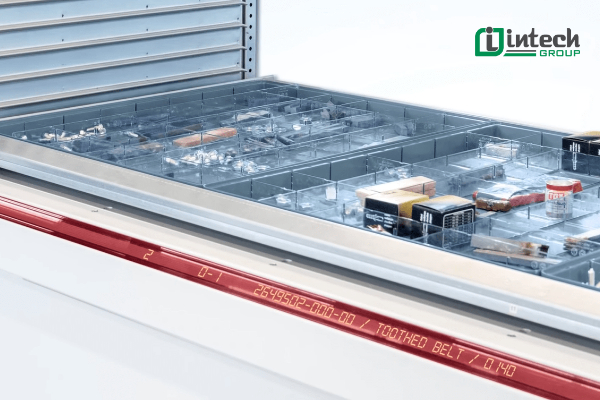
Differences Between Vertical Lift Modules (VLM) and Vertical Carousel Modules (VLC)
Compare Size and Height
- Size: VLMs have greater depth than VLCs, allowing for higher density storage while taking up less floor space. Standard VLMs range from 5-15 feet wide and 7-10 feet deep, while VLCs range from 6-13 feet wide and 4-5 feet deep.
- Height: VLMs can reach up to 98 feet, significantly taller than VLCs, with a maximum height of 32 feet. However, taller systems can reduce picking speeds, so a trade-off between height and performance is necessary.
Efficiency and Picking Speed
Both systems are capable of high picking speeds, depending on configuration:
- VLC: Maximum speeds up to 400 items/hour.
- VLM: Maximum throughput rate of approximately 350 items/hour (depending on configuration).
Support technology such as Pick-to-Light is integrated into both systems, making it easy for operators to locate goods, increasing speed and accuracy.
Smart storage organization to optimize speed
- An efficient system requires organizing goods based on frequency of use.
- VLM: Store the most popular items near the access door to reduce travel time.
- VLC: Place frequently used products next to each other so that the drive chain only needs to travel a short distance.
Vertical Conveyor vs. Vertical Lift: Which Technology is Right for You?
When choosing between Vertical Lift Modules (VLM) and Vertical Carousel Modules (VCM), important factors to consider include the size, weight, and frequency of change of stored products. Each system has a different way of storing and handling products, which will determine which system is best suited to your needs.
- Choose VLM if you need to store large, heavy goods and have a warehouse with high ceilings.
- Choose VLC if you prioritize the quick handling of small, light items in a space with limited height.
Choosing the right system will not only help optimize storage space, but also increase operational productivity and reduce long-term costs.

Vertical lift warehouses (VLMs) use height sensing technology to measure the dimensions of the products stored in each tray. As the goods are stored, the integrated software system processes this data and dynamically adjusts the storage location, keeping a gap of only about 1 inch between trays to optimize storage density. For example, if the tallest product on a tray is 6.2 inches high, the VLM will store it in the 7-inch space. When this product is picked and the remaining product is 3.5 inches high, the system will automatically adjust and store it again at a height of 4 inches, making the most of the storage space.
Vertical conveyor warehouses (VCMs) operate differently, with transport modules placed in fixed positions. The shelves in each module can be adjusted up or down, but this adjustment must be done manually. This makes VCMs suitable for storing products that are uniform in size and have little variation. Vertical conveyor warehouses can be further subdivided into modules to optimize storage density, but this adjustment requires manual intervention, which can be a time-consuming task. Therefore, VCM is the ideal choice when you need to store products that are relatively stable in size and do not change frequently.
Intech Group - Smart Warehouse Solution Provider
Intech Group is always at the forefront of providing smart warehouse solutions, helping businesses optimize space and improve warehouse efficiency. We provide smart warehouse products that suit the specific needs of each business, including:
- Smart warehouse IT-WH-SC
- Smart warehouse IT-WH-SR
- Smart warehouse IT-WH-SSC
- Smart warehouse IT-WH-FR
- Smart warehouse IT-WH-DCR
- Intech automatic warehouse
With 10 years of experience in the field of technology and automation, Intech Group is proud to be one of the prestigious suppliers, bringing added value through each product and service. We are committed to bringing customers the most optimal smart warehouse solution, along with a team of professional, experienced consultants and flexible, fast, and accurate after-sales support policies 24/7.
For more information, please visit Intech group website or contact hotline 0966 966 032 / 0986 448 456.
