


Explore the cosmetic production line operation process
06-10-2025 86
The strong development of the beauty industry places strict requirements on product quality and production processes. Owning a modern cosmetic production line that meets international standards such as CGMP and ISO 22716 not only helps businesses optimize costs but also enhances brand reputation.
Explore the operation process of cosmetic production lines
The strong development of the beauty industry places strict requirements on product quality and production processes. Owning a modern cosmetic production line that meets international standards such as CGMP, ISO 22716 not only helps businesses optimize costs but also enhances brand reputation. Join Intech Group to learn in detail about cosmetic production lines and important factors that help ensure product quality!
What is the concept of cosmetic production lines?
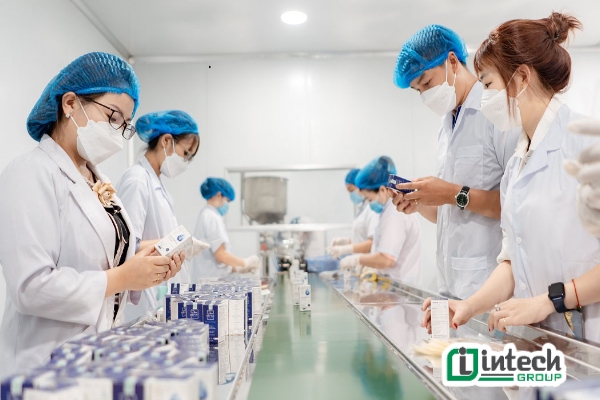
Cosmetic production lines are systems and production processes designed to create products that are consistent in quality, safety and effectiveness. A modern production line not only helps optimize performance and save costs but also meets strict international standards such as CGMP, ISO 22716.
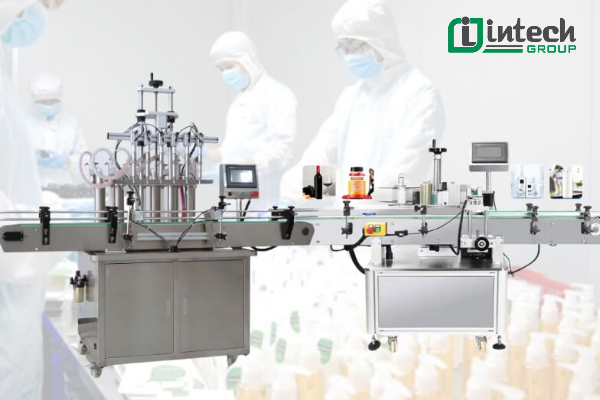
GMP standard cosmetic production line
Cosmetic production process
The standard cosmetic production process usually includes four stages:
Step 1: Raw material preparation, in which input ingredients are received, inspected and processed to ensure quality and safety before being put into production.
Step 2: Mixing and combining raw materials, where ingredients such as emulsifiers, moisturizers, and fragrances are mixed using specialized machinery to create a product with a stable and uniform texture.
Step 3: Moving to the filling and packaging stage, in which cosmetics will be filled into packaging (bottles, tubes, jars) with precise dosages, ensuring aesthetics and hygiene.
Step 4: Strict quality control before being released to the market, ensuring that all standards of safety, effectiveness and durability are met.
A standard cosmetic production line not only helps businesses ensure consistent quality, but also helps optimize costs, increase productivity and create competitive advantages in the market. Compliance with international standards such as CGMP, ISO 22716 will help brands build trust with customers.
Classification of cosmetic production lines
In the cosmetic industry, production lines are classified based on the state and properties of the product. Currently, there are three main types of lines:
1. Wet cosmetic production line
This line is applied to liquid, lotion, emulsion, aerosol cosmetics, including:
- Liquid cosmetics: A homogeneous mixture of soluble ingredients, commonly found in shower gel, shampoo, facial cleanser.
- Emulsion/cream cosmetics: Contains insoluble ingredients, requiring emulsification to create a stable texture. This form is often used in lotions, sunscreens, makeup, hair care.
- Lotion cosmetics: Has a light texture, often used in skin care products, body lotions, hair care.
- Equipment used in wet cosmetic production lines: Emulsifying mixers, cosmetic filling machines, thermo-vacuum systems, etc.
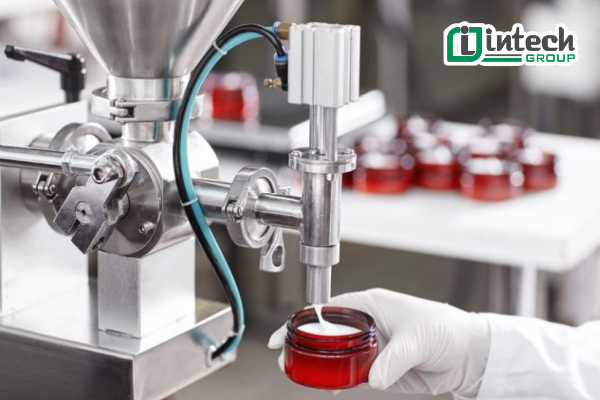
2. Dry Cosmetic Production Line
This line produces cosmetics in the form of powder, wax, tablets, capsules, specifically:
- Tablet/Capsule cosmetics: Applied in dietary supplements, beauty functional foods. The production process includes mixing and shaping, requiring special equipment to ensure accuracy.
- Powder cosmetics: Commonly found in baby powder, makeup foundation. Solid materials are finely ground and mixed to create a smooth texture.
- Stick/Wax cosmetics: Including lipstick, deodorant wax, lip balm. The production process requires heating the raw materials, mixing well, then pouring into molds to shape the product.
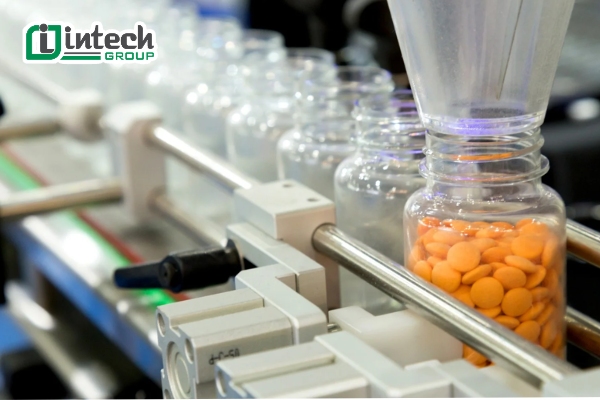
3. Ointment production line
This line is applied to skin care products, hair dyes, and special cosmetics. The characteristics of ointments are that they do not contain water, are not sticky, and have a high degree of dryness.
Equipment used in the ointment production line: mixer, raw material heater, product filling machine, jar filling machine, packaging machine, etc.
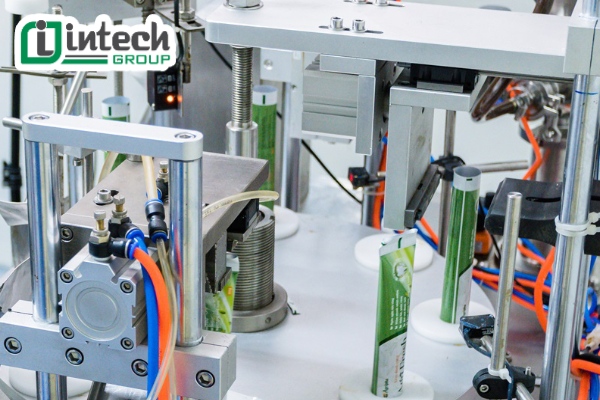
Important machinery in the cosmetic production line
In the cosmetic production line, machinery plays an important role in ensuring product quality, production capacity and consistency. Three indispensable groups of equipment include:
1. Raw material mixer
The raw material mixer is the core equipment that helps blend ingredients such as water, oil, emulsifiers and special active ingredients. Mixing ensures that the product is homogeneous, stable and meets quality standards.
Heating and cooling system: Controlling the temperature during mixing, especially important for sensitive products such as creams and serums.
Vacuum emulsification technology: Eliminates air bubbles, giving the product a smooth, sustainable texture.
The mixer is suitable for a wide range of cosmetics, including creams, lotions, gels, serums and hair care products.
2. Filling and packaging machine
After the raw materials are mixed evenly, the filling machine helps to put the product into the packaging with the correct dosage, uniformity and hygiene. The packaging machine continues to complete the packaging, ready to be put on the market.
Some modern machines can simultaneously fill, label, seal and print the expiry date.
Increase production speed, minimize errors and optimize labor costs.
Accurate quantification, avoid wasting raw materials.
Ensure hygiene, prevent contamination during the production process.
Meet CGMP and ISO 22716 standards, helping the product to meet international quality.
3. Quality control system
Before the product is put on the market, the quality control system helps to evaluate factors such as uniformity, viscosity, color, aroma and pH. At the same time, the machine also checks for packaging errors such as open lids, skewed labels or product leaks.
Optical sensors: Check product errors quickly and accurately.
Artificial intelligence (AI): Detect the smallest errors, helping to improve product quality.
Eliminate defective products, protect brand reputation.
Minimize risks, save costs due to early error detection.
Increase reliability, help products meet international quality standards.
4. Optimize cosmetic production lines
Investing in modern machinery, automating processes and choosing reputable suppliers will help businesses:
Optimize production costs, improve productivity.
Ensure consistent cosmetic quality.
Meet safety and hygiene standards, helping products easily access international markets.
In short, raw material mixers, filling and packaging machines and quality control systems are three important equipment that help create a professional, modern and efficient cosmetic production line.
How to choose the right machinery for your cosmetic production line
Choosing the right machinery for your cosmetic production line not only helps optimize the production process but also ensures high-quality products that meet safety standards.
1. Understand production needs
Before choosing machinery, businesses need to clearly define production requirements, including product type (cream, serum, lotion, etc.), raw material characteristics (viscosity, compatibility) and production scale. Careful assessment helps to choose equipment with appropriate capacity, avoiding wasted investment costs.
2. Prioritize hygiene and safety standards
Hygiene and safety are mandatory factors in cosmetics production because the product comes into direct contact with human skin. When choosing equipment, it is necessary to ensure that the machinery complies with CGMP, ISO 22716 hygiene standards, using safe materials such as AISI 316L stainless steel, helping to limit cross-contamination and easy cleaning. Some modern machines are also equipped with a self-cleaning system (CIP/SIP) to save cleaning time, ensuring a sterile production environment.
3. Flexibility and scalability
It is advisable to choose equipment that can handle a variety of ingredients, from light lotions to thick creams, and that can be expanded in capacity when needed. Solutions such as vacuum emulsifiers help improve mixing quality and support large-scale production while ensuring stable performance.
4. Advanced mixing technology
The quality of cosmetics depends largely on mixing technology, which determines the uniformity and stability of the product. Modern mixers integrate advanced emulsification technology, which helps to increase the efficiency of dispersing ingredients, limiting the phenomenon of separation and clumping. In addition, some machines also have temperature and pressure control systems, helping to optimize the emulsification process for sensitive products.
Investing in modern production technology not only helps businesses optimize processes, minimize costs, but also enhance brand reputation. Building a standard cosmetic production line is the key to business success in today's fiercely competitive cosmetic market. Contact Intech Group now for advice on automation solutions in factories and warehouses via Hotline: 0966.966.103 / 0966 966 032.
