


How does a robotic loading station work?
28-08-2025 65
Robotic loading stations are one of the most advanced technologies in the field of robotics, creating a strong change in the world of automation. With the ability to safely cooperate with humans thanks to a sensitive sensor system, robotic loading not only increases productivity but also ensures a safe working environment, limiting the risk of accidents.
Unlike traditional industrial robots that are bulky, expensive and only suitable for large-volume production, the robotic loading and unloading station is highly flexible and easily adapts to diverse and mixed production models.
Components of the loading and unloading robot station
To meet the needs of loading and unloading goods quickly, accurately and safely, the loading and unloading robot station is designed with an optimal structure and intelligent operating principle. Below are the main components in the loading and unloading robot system:
Robot arm
This is the central part, usually designed with 6 - 7 degrees of freedom to simulate the flexible movement of the human hand. The robot arm uses lightweight materials such as aluminum alloy, high-strength steel or composite to reduce weight, while ensuring durability and accuracy. With its compact size, the robot can easily operate even in limited factory spaces.
Drive unit
Includes servo motors or stepper motors, providing force and movement to the robot joints. The system is also integrated with force/torque sensors, helping the robot accurately adjust the impact force, ensuring safety when working near humans.
Sensor system
- Force and torque sensors: Helps detect abnormal forces, promptly stopping the robot when encountering obstacles.
- Vision System: Applying cameras and 3D sensors to identify the location, size and shape of products.
- Distance sensor: Ensures safety when humans or objects enter the work area.
Controller
Considered the "brain" of the robot, the controller is responsible for processing data from sensors, programming movements and coordinating all operations. This system integrates intuitive programming software, a friendly HMI interface and the ability to connect to the production management system (MES, ERP).
End Effector
Is the part that directly contacts the goods. Depending on the type of product, the robot can use a pneumatic gripper, a servo gripper or a vacuum mechanism. The flexible design allows the robot to handle a wide range of goods, including packages weighing up to 60kg.
Safety system
Includes devices such as interlocks, emergency stop buttons and safety sensors. When a collision or accident is detected, the robot will stop working immediately to protect people and goods.
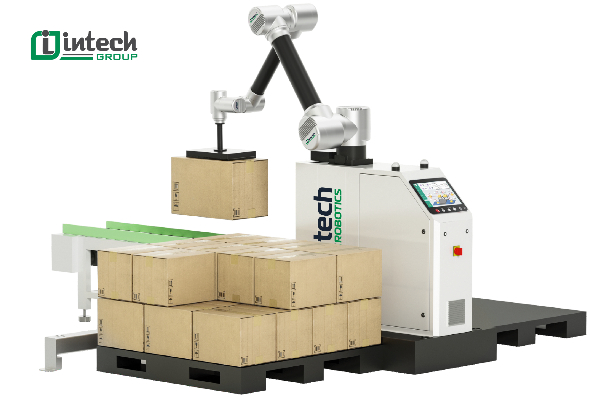
Operating Principle of the Robotic Loading Station
The Robotic Loading Station is designed to operate in a closed cycle, ensuring accuracy, safety and flexibility when working with humans. The basic operating principle of the system includes the following steps:
Step 1: Programming
The robot is installed with a pre-programmed program or easily adjusted through an intuitive programming interface. This allows the robot to perform loading and unloading tasks according to the specific requirements of each business.
Step 2: Sensor confirmation
The force sensor system, distance sensor and visual sensor help the robot "understand" the working environment. They detect the location, size of goods and the presence of humans or obstacles to ensure safety.
Step 3: Information processing
Step 4: Control
The controller transmits commands to servo motors and actuators, adjusting the force and direction of movement precisely so that the robot can lift, pick up or arrange goods quickly.
Unlike traditional industrial robots, cobots in the loading and unloading robot station are capable of working collaboratively. Thanks to the modern sensor system, the robot can stop or change operations immediately when detecting the risk of collision, ensuring absolute safety for the operator. With this intelligent operating principle, the loading and unloading robot station not only optimizes logistics and production processes, but also brings peace of mind when deployed in a working environment that combines humans and machines.
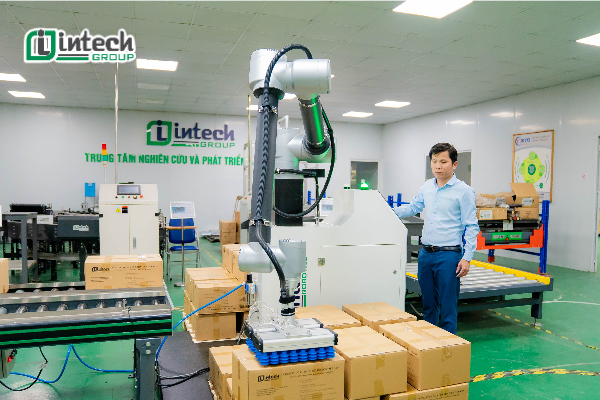
Understanding how a robotic loading station operates helps businesses realize the huge benefits that this technology brings in optimizing production and reducing operating costs. In the context of Industry 4.0, investing in robotic loading is not only a trend but also a sustainable solution to improve competitiveness. Intech Group is proud to be the leading unit in Vietnam in the field of automation solutions, specializing in providing industrial robots and conveyor systems, conveyor belts and many other modern industrial equipment. With experience implementing hundreds of projects, Intech is committed to bringing businesses optimal solutions, quality and long-term efficiency. Contact Intech Group now for advice and implementation of the most suitable robotic loading station solution for your production line.
