

Motorcycle assembly line? Raw materials & Motorcycle production and assembly process
17-10-2025 495
Motorcycle assembly line is a specialized production system designed to automate the entire assembly process, from engine, frame to final inspection. The application of modern lines helps businesses increase productivity, ensure accuracy and maintain consistent quality for each product.
Thanks to the integration of automation and smart control technology, the motorcycle assembly line not only shortens production time but also reduces labor costs, improving factory operating efficiency.
Materials used in motorcycle production
Each motorcycle line from popular motorcycles, scooters to high-end sports cars - uses different groups of materials, depending on design requirements, costs and brand positioning. The main materials in the motorcycle assembly or production line are divided into three large groups: metal & alloy materials, non-metallic materials - composite - polymer and new materials.
1. Metal and alloy material group
This is the main material in every motorcycle assembly line. Metal parts are responsible for the entire chassis and transmission system of the vehicle.
Steel and steel alloys
- Carbon structural steel and alloy steel are used to manufacture the vehicle frame, front and rear swingarms, shock absorbers, axles - wheels, brake levers, gears and gearboxes.
- High-strength steel and hardened steel are used in bearings, camshafts, crankshafts, pistons and connecting rods.
- Stainless steel (Inox) is used in details exposed to the outdoor environment such as brake discs, exhaust shields, exhaust covers, turn signals, metal fenders, helping to increase durability, prevent corrosion and maintain a shiny appearance.
Aluminum alloy
- Aluminum and aluminum alloys (Al-Si, Al-Mg) are increasingly used in high-end cars and sports cars to reduce vehicle weight.
- Common applications in cast rims (wheels), handlebars, footrests, headlight clusters, car fairing brackets and all-aluminum frames in some modern cars.
- Copper and zinc alloys
- Copper is the main material in the electrical system used to manufacture electrical wires, stator-rotor coils, carbon brushes and electrodes.
- Copper-zinc alloy (brass) is used for connectors, screws, locks, valve mechanisms, carburetors because of its good electrical conductivity, corrosion resistance and mechanical strength.
Other metal materials
- Magnesium alloy is lighter than aluminum, has good heat dissipation, is used in engine parts and high-end wheels.
- Titanium only appears in sports cars, racing cars - used for screws, exhaust valves, exhaust pipes, helping to significantly reduce weight while still ensuring durability.
- Zinc and nickel are used in electroplating, polishing surface details to increase rust resistance and aesthetics of the car.
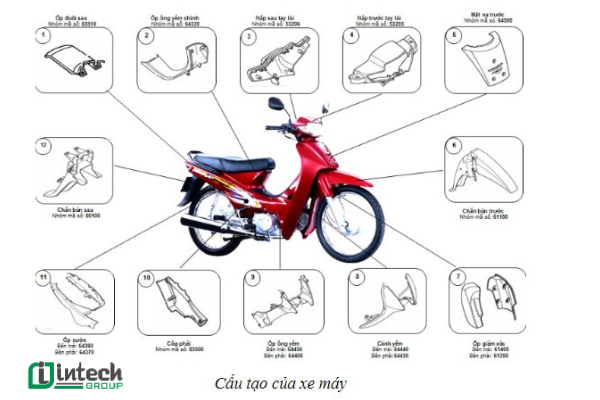
2. Non-metallic, composite and polymer materials
In the motorcycle assembly line, parts made from this material are often assembled at the final stage (finishing the exterior and utility details).
Rubber
- Natural and synthetic rubber (NBR, EPDM, SBR) are widely used in tubes, tires, gaskets, pipes, saddles, footrests, handlebar knobs, and drive belts.
- Rubber helps reduce shock, insulate, increase friction, and create a smooth feeling when operating.
- In high-end car models, manufacturers often use high-quality vulcanized rubber to extend the life and resistance to abrasion.
Hard plastic
- ABS (Acrylonitrile Butadiene Styrene): a popular plastic material used for car bodies, fairings, headlights, and side panels, thanks to its impact resistance and scratch resistance.
- PC (Polycarbonate): used for headlights, clock faces, signal light covers, because of its transparency and good heat resistance.
- PP (Polypropylene): used for protective covers, inner fairings, fenders, with good bending resistance and light weight.
- Hard plastic helps reduce vehicle weight, is easy to shape, reduces production costs, and increases design flexibility.
Flexible plastics and insulating materials
- PE (Polyethylene) and PVC (Polyvinyl Chloride): used in wire covers, fuel lines, brake lines and throttle cables, with good insulation and oil resistance.
- Fiberglass reinforced composite (FRP): used in exhaust covers, fairings, or decorative parts, with high mechanical strength, light weight and good heat resistance.
3. New material group
Technological developments and environmental protection requirements are pushing car manufacturers to apply new environmentally friendly materials in motorcycle assembly lines.
Recycled and biological materials
- High-quality recycled polypropylene (PP): In 2023, Yamaha Motor announced the development of recycled PP material for sports motorcycle bodies, ensuring durability while reducing virgin plastic emissions.
- Bio-plastic: researched to replace traditional plastic parts in the future, helping to reduce carbon footprint.
Lightweight, high-strength materials
- Aluminum-magnesium alloy and carbon fiber (CFRP): appear in sports car frames and high-end body parts, helping to reduce vehicle weight by up to 30% while still ensuring stiffness and durability.
- Energy-absorbing materials (EPP, PU foam): used in saddles, shock absorbers, impact protection systems, improving safety for the driver.
Coating and surface treatment materials
- Powder coating and nano ceramic coating: help increase gloss, protect against UV rays and limit dirt.
- Multi-layer electroplating (Cr–Ni–Zn): improve rust resistance, ensure long life for metal parts in harsh environments.
Steps in the motorcycle manufacturing and assembly process
Below are the basic steps in the motorcycle manufacturing and assembly process, helping you understand how a complex mechanical product is created from the manufacturing stage to the final operation.
Step 1: Manufacturing and processing parts
Motorbikes are made up of thousands of different components, including the engine, frame, electrical system, body, brakes, shock absorbers, bolts, screws, wires, etc.
These parts are manufactured using many precision machining methods such as turning, milling, drilling, stamping, casting, forging or surface machining (grinding, polishing, painting). After completion, each part is strictly checked for size, error, gloss and hardness to ensure it meets technical standards before moving on to the assembly stage.
Step 2: Assemble the chassis
Steel or alloy bars are welded, bolted and reinforced to form a complete frame structure. The chassis is then painted with anti-rust paint, surface treated and quality checked before being put into the next stage.
Step 3: Install the engine and transmission system
The engine is assembled and tested separately before being fixed to the chassis. Along with that, the transmission system, gearbox, exhaust pipe, carburetor or electronic fuel injection (FI) are installed synchronously to ensure stable operation, fuel economy and environmental friendliness.
Step 4: Install the electrical system and wiring
The electrical system has the role of starting, lighting, signaling and operating the sensors in the vehicle. The wires, batteries, headlights, turn signals, display clocks, ECU are arranged in the correct design position on the chassis, ensuring safety and high aesthetics.
Step 5: Complete motorcycle assembly
This stage includes assembling the plastic shell, fairing, saddle, wheels, suspension, rearview mirrors and surface details. The entire process is carried out on an automatic conveyor belt, helping to move the vehicle through each assembly station smoothly, saving time and labor.
Step 6: Final inspection and testing
Before being released to the market, each motorcycle must undergo a series of operational tests, power measurement, brake testing, electrical system testing, fuel and noise tightness testing.
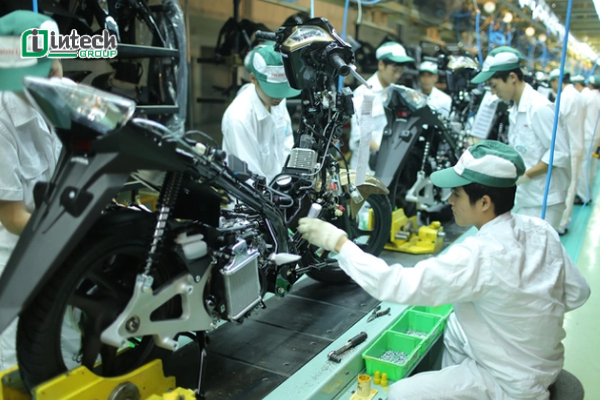
At Intech Group, we provide smart motorcycle assembly line solutions designed according to the specific needs of each factory, including:
- Automatic assembly conveyors with integrated sensors and loading robots, supporting precise, stable and safe operations.
- Automatic error checking system using AI cameras and industrial sensors, helping to detect errors right at the production stage, ensuring the quality of output products.
- Production management software (MES/ERP) allows monitoring progress, controlling productivity and tracing product origin in real time.
- Pick-to-Light picking solution supports workers in selecting and picking components accurately, minimizing manual errors.
- Integrated industrial robot solutions for welding, screwing, gluing, assembling and automatic quality inspection stages, helping to increase productivity and standardize production processes.
Thanks to the combination of automation and smart technology, Intech's motorcycle assembly line helps businesses increase productivity, reduce operating costs and ensure consistent product quality.
Benefits of motorcycle assembly lines in modern production
The application of modern motorcycle production lines helps factories optimize processes, minimize manual errors, and ensure consistency in each product detail.
Increase production productivity
Motorcycle assembly lines help businesses increase productivity thanks to the continuous operation mechanism, with high synchronization between stages.
Instead of discrete manual operations, automatic conveyor systems and assembly robots support workers to perform quickly and accurately.
Increase product quality
The ability to control quality at each stage, when the production process is standardized, helps detect technical deviations early, ensuring that every detail from the engine, frame to the electrical system meets strict technical standards.
Optimizing production costs
With an automated motorcycle assembly line, businesses can significantly reduce labor costs, management costs, and maintenance costs. Automation helps limit waste of raw materials, reduce product defects, and optimize resource utilization.
Shorten delivery time
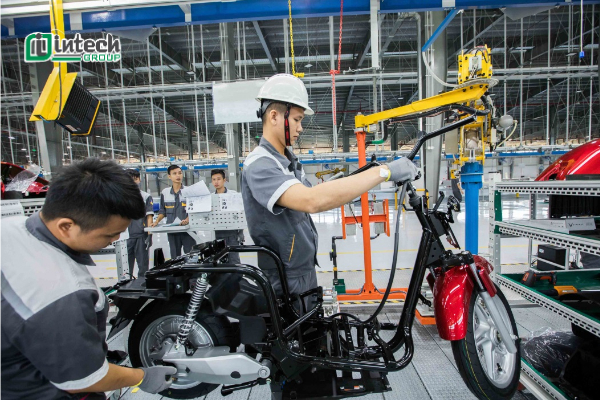
When the production process is optimally designed and operated continuously, the time to assemble and complete the motorbike is significantly shortened. The automated line helps eliminate bottlenecks in the production process, ensuring that the finished product is on schedule.
Flexibly respond to market needs
The motorbike market is always changing rapidly with many models, versions and changes in consumer demand. Thanks to the modular and customizable design, the motorbike assembly line can flexibly change to meet new product lines without interrupting production.
Ensuring synchronization in production
The entire motorbike production line is designed to operate in a chain from processing, assembly, inspection to completion to ensure the connection and synchronization between parts. Each stage is controlled by sensors, production management software and automatic systems to minimize errors, delays or missing components.
In the context of modern production, investing in a smart motorcycle assembly line combining automation - digital technology - smart management software is the key for motorcycle factories to make a breakthrough in the era of industry 4.0.
If your business is looking for a comprehensive, efficient and optimal motorcycle assembly line solution according to production reality, contact Intech Group immediately. With more than 10 years of experience in implementing automation solutions, production lines and smart robot systems, Intech Group is committed to providing effective operational solutions, increasing productivity and moving towards sustainable smart production.
Contact Intech Group now for free consultation and receive the most suitable solution for your factory!
