


What is a load cell? Structure and operating principle of load cell
07-10-2025 212
Loadcell is one of the most important components in the electronic weighing system, ensuring high accuracy and performance in weight measurement.
So, what is a force sensor? What is the structure and operating principle of Loadcell in electronic scales? Let's find out with Intech Group through the article below.
What is a force sensor?
A force sensor, also known as a Loadcell, load sensor, or load sensor, is a device used to convert force or weight into an electrical signal. When an object exerts force on the sensor, the change in force will lead to a change in the inductive resistance in the resistor bridge, creating a voltage signal proportional to that force.
This voltage signal is then transmitted to the signal processor, where the signal is converted and displays the exact weight of the object on the electronic scale screen.
The force sensor, also known as a load transducer, plays an important role in providing accurate and fast measurement results. This is the reason why electronic scales using Loadcells are increasingly popular in industry, manufacturing and commerce.

Structure of Loadcell force sensor
Loadcell force sensor is composed of two main components:
Strain Gauge (Resistive bridge):
- Is a special type of resistor, capable of changing the resistance value when subjected to force.
- Strain Gauge is powered and operates based on the change in inductive resistance when force is applied.
Load (Load-bearing metal bar):
- Is a highly elastic metal bar, usually made of aluminum alloy or steel.
- Strain Gauge is glued directly to the surface of the Load to measure deformation when force is applied.
This structure helps Loadcell convert mechanical force into electrical signals, creating accurate data on weight or force.

Operating principle of Loadcell force sensor
The force sensor operates on the principle of mechanical deformation:
- When a force acts on the Loadcell, the metal bar (Load) will be deformed very slightly.
- This deformation changes the resistance value of the Strain Gauge.
- The change in resistance is converted into a voltage signal proportional to the applied force.
- This electrical signal is processed by the amplifier and displays the force or weight value on the screen.
This principle helps the Loadcell measure force in the form of: tension, compression, shear, or a combination of force forms.
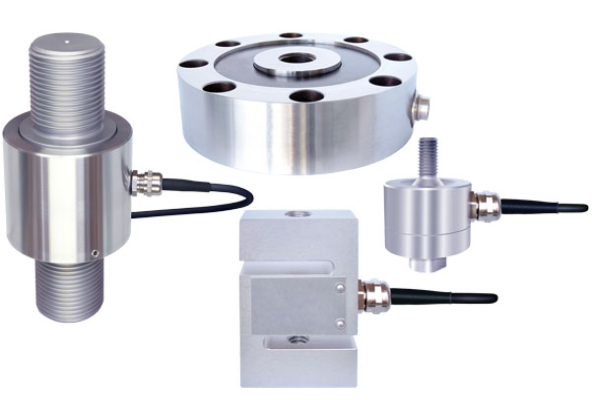
Common types of force sensors
Strain Gauge Loadcell:
- Converts the deformation of the structure due to the applied force into an electrical signal.
- Widely used due to its high accuracy, reliability and flexibility.
Piezoelectric force sensor:
- Generates an electric charge when a force is applied.
- Suitable for measuring dynamic forces with fast and accurate response.
Capacitive force sensor:
- Based on the change in capacitance when a force is applied.
- Effective in measuring small forces, suitable for applications requiring high sensitivity.
Optical force sensor:
- Measures changes in light (intensity, frequency, phase) under the influence of force.
- Ideal for applications requiring high accuracy in sensitive environments.
Magnetic force sensor:
- Measures changes in magnetic fields due to force.
- Good for environments with magnetic interference because it is not affected by these interferences.
Applications of force sensors
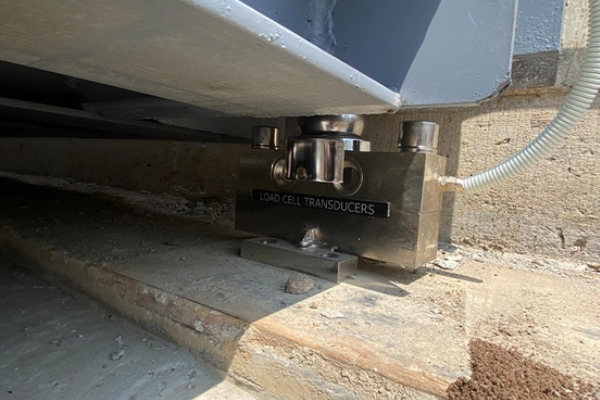
Loadcells are important components in many industries, providing accuracy and efficiency in operation. Some prominent applications include:
Robotics: Force sensors provide the ability to sense force, helping robots perform tasks such as sensing, grasping, and manipulating more accurately.
Medical field: Used in devices such as blood pressure monitors and diagnostic aids to ensure accuracy and reliability.
Automotive industry: Used in quality control and safety systems such as airbags, which require fast and accurate response to force impacts.
Electronics industry: Supports quality inspection of devices such as switches, buttons, and touch screens to ensure products meet standards.
Manufacturing industry: Tracks and monitors force during machine operation, ensuring accuracy and stability in the production line.
Aerospace and Defense: Integrated into force measurement and control devices in harsh environments, requiring high reliability.
Consumer Electronics: Common applications in smart home appliances, electronic scales, and home automation systems.
How to choose the right force sensor
To choose the optimal force sensor for each application, you need to consider important factors such as:
- Type of force to be measured: Tensile, compression, shear or combination of forces.
- Force range: Determine the maximum and minimum force that the sensor needs to measure.
- Required accuracy: Depends on the sensitivity level and allowable error in the application.
- Environmental conditions: Temperature, humidity, and environmental impact need to be considered.
- Installation space: Choose a sensor with the right size for the installation location.
Loadcell force sensors play an important role in measuring force and weight with high accuracy. The diversity in types of force sensors helps Loadcell meet many different needs and conditions of use, from industrial to scientific research.
To choose the right force sensor, it is necessary to carefully consider the specific requirements of the environment, force level, and accuracy. Let Intech Group explore more optimal solutions for your electronic weighing system! For more information, please contact hotline: 0983 113 387 - 0966 966 032 for advice and support 24/7.
