


What is a PID controller?
07-10-2025 424
PID controller, also known as PID is a process control technique that engages in proportional, integral and derivative processing actions.
The PID controller is an important tool in modern industrial control systems. However, many people still do not fully understand how this controller works, as well as its applications and advantages. Let's learn more about the PID controller through the article below by Intech Group.
What is PID?
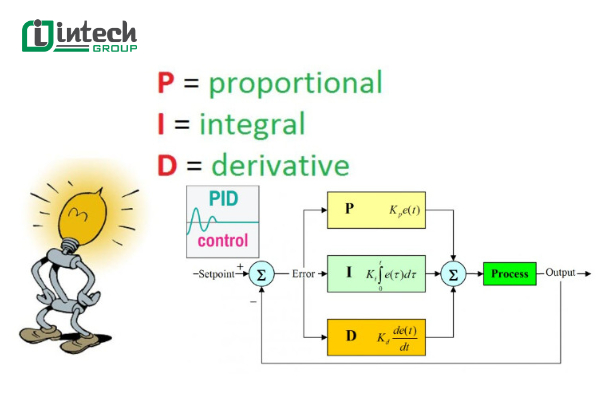
PID stands for Proportional Integral Derivative, which is a feedback controller with three components: proportional (P), integral (I), derivative (D). The PID controller is mainly used in closed-loop control systems, where there is a feedback signal to maintain a stable control value.
The main task of the PID controller is to calculate and adjust the error between the measured value and the desired set value. When this error appears, the controller will adjust the input value to minimize the error, thereby helping the system achieve the desired operating efficiency.

PID controllers use three main methods to adjust and control errors in the system:
- P (Proportional): Proportional control generates a correction signal proportional to the current error. The larger the error, the stronger the correction signal. This helps to reduce the error quickly, but may not reach the correct value if using this method alone.
- I (Integral): Integral control reduces the error gradually over time. It works by aggregating the error over time, helping to reduce the long-term deviation. The smaller the correction time, the stronger the integral correction, helping the system achieve better stability.
- D (Derivative): Derivative control adjusts the signal according to the rate of change of the error. When the error changes rapidly, the correction signal will also be stronger. The larger the time, the stronger the differential correction, making the system respond faster to changes.
PID Classification
PID controllers can be customized according to the characteristics of the system they control. Adjusting the P, I, D parameters helps the PID controller operate effectively and suit each specific system requirement. PID configurations can be divided into the following types:
- Classical PID: Uses three components P, I, D in a standard form, suitable for simple systems or basic tuning requirements.
- Auto-Tuning PID: PID parameters are automatically adjusted to optimize system performance without manual intervention.
How PID Controllers Work
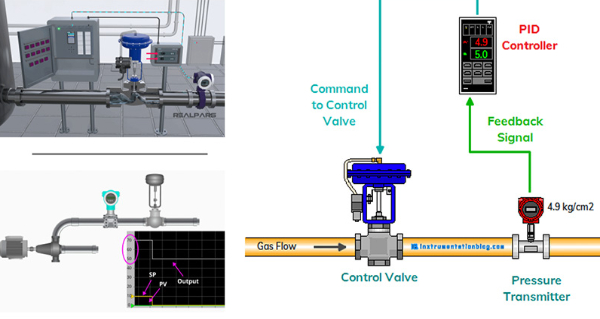
PID controllers are widely used in industrial control systems, ensuring efficiency and accuracy in maintaining parameters such as temperature, pressure, or flow. A control system using a PID controller usually includes the following basic devices:
-
Actuators: Devices that perform control actions, such as heaters, valves, or motors.
-
Control devices: Usually HMI or PLC (Programmable Logic Controller) screens, helping the operator set and monitor system parameters.
-
Feedback devices: Including sensors such as temperature, pressure, flow, etc., to collect data and send information back to the controller.
Once the PID controller has received the set value (set point or SV), it will send control signals to the actuators in the system. At this point, the PID algorithms will be activated to adjust the input value so that the error between the measured value and the set value is minimized.
Illustrative Example
For example, in a temperature control system, the set point is 200°F. The PID controller maintains the temperature at this level by adjusting the actuators. When the temperature exceeds 202°F or falls below 198°F, the controller triggers the heating device to open or close to bring the temperature back to 200°F.
During this process, the PID controller continuously makes adjustments, changing the on/off time according to the system needs, and based on the error between the measured value and the target value. The system can adjust quickly or slowly depending on the requirements and the nature of the control process.
Why use a PID controller?
PID (Proportional-Integral-Derivative) controllers are widely used in industrial systems today, providing superior efficiency in controlling important parameters such as temperature, pressure and flow. Today, PID controllers have replaced this manual method, providing superior efficiency. PID controllers use electronic temperature measuring devices combined with electric control valves. The measured temperature sensor transmits signals to the PID controller, helping to compare the actual temperature value with the initial setpoint value. Thanks to that, the control process becomes more accurate and automatic, much superior to the manual method.

How to tune PID controller parameters
Tuning a PID controller is not a simple task, even though you have mastered the 3 basic parameters (P, I, D). However, to optimize the performance, you need to understand how to tune the following parameters:
Optimizing behavior: This is the process of changing the setpoints or processes of the PID to achieve stable results. To do this, you need to adjust the deviation and stability during operation. However, these adjustments depend on many factors such as settling time and machine start-up time. It is important to optimize the energy consumption to achieve the highest efficiency.
Ensuring stability: To ensure high stability during control, it is necessary to minimize hysteresis and oscillation. This helps the system operate stably without encountering problems with disturbances or errors in control.
What are the calibration steps of PID?
The PID (Proportional-Integral-Derivative) controller consists of three main stages, each of which plays an important role in regulating the system. These stages are the proportional stage, the analytical stage, and the derivative stage. Here are the details of these correction stages:
1. Proportional Stage
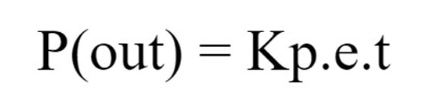
The proportional stage in the PID helps to adjust the output based on the current error. The gain of this stage is proportional to the error value, i.e. the difference between the desired value (setpoint) and the actual value (process variable). The proportional stage will change the output value directly and proportionally to the error.
The formula for calculating the proportional stage:
Where
Pout: output proportional factor.
- Kp: Proportional factor, adjustment parameter.
- e: Error.
- t: Time or instantaneous time (present).
The proportional term helps to reduce the error quickly, but if only this term is used, the error may never be zero, because of the residual error that may occur.
2. Analytical Term (Integral)
The analytical (integral) term sums the error over time and helps to eliminate the residual error (offset) from the proportional term. It will continue to adjust the system until the error is zero. As the error persists, the analytical term accumulates and adjusts continuously.
The integral term is given by:
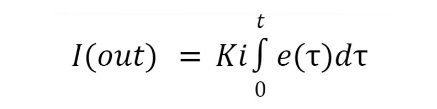
- Iout: Integral factor of output
- Ki: Integral gain, 1 adjustment parameter
- e: Error = SP-PV
- t: Time or instantaneous time (present)
- t : An intermediate integral variable
3. Derivative Term
Formula for calculating the derivative term:
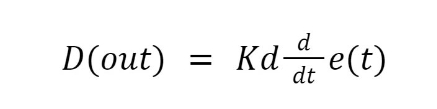
- Dout: differential factor of the output.
- Kd: Differential gain, a control parameter.
- e: Error = SP-PV.
- t: Time or instantaneous time (current).
The derivative term helps to limit overshoot and makes the system more stable. However, if the derivative parameter is too large, the system can become sensitive to noise.
Applications of PID (Proportional Integral Derivative) controllers
1. Inverter control
PID controllers are used in electrical and electronic equipment to form control inverters. Inverters help regulate motor speed, bringing high energy efficiency and reducing equipment wear.
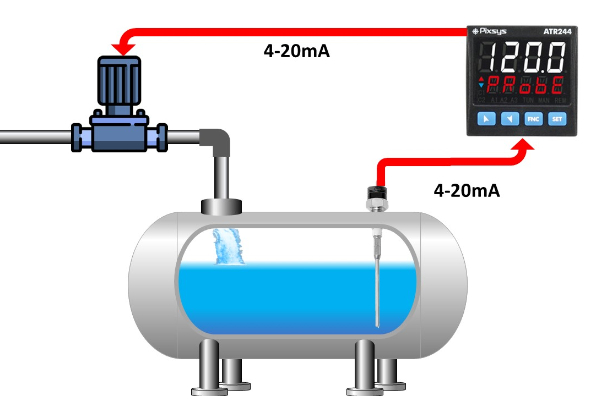
2. Water level control
PID controllers can automate electrical devices, sensors and valves in water level control systems. These devices help maintain stable water levels and automatically adjust, ensuring performance and accuracy in production processes.
3. Application in PLC systems
PID controllers are integrated into PLC (Programmable Logic Controller) systems to control factors such as temperature, pressure, flow, and many other parameters. PID functions can be pre-designed in the system, helping to optimize industrial processes automatically and accurately.
4. Water flow control
PID is also used to control water flow through pipe sensors. This application provides precise and stable control, helping to optimize irrigation, cooling, or water treatment systems.
5. Optimize system performance
The operating principle of the PID controller not only helps maintain the stability of system parameters but also optimizes performance. With proportional, integral and derivative algorithms, PID is capable of accurately adjusting important factors such as temperature, pressure, flow, helping industrial processes to be highly efficient and reliable.
The PID controller is an extremely important tool in modern industrial systems. With the ability to adjust and optimize important parameters, PID helps to increase performance, reduce errors and stabilize the production process. The application of PID in fields such as frequency converters, water level control, PLC systems and water flow control brings many benefits, helping businesses improve productivity and operational efficiency.
