


What is a relay? Classification and application of relays in practice
01-10-2025 467
Relay is an intermediate device that helps switch electric current safely, especially when it is necessary to control large power consuming devices from small current control signals.
In this article, Inetch Group will help you explore in detail what a relay is, its operating principles, common types of relays and practical applications in production and life.
What is a relay?
A relay is a type of electromagnetic switch that allows controlling large currents with a small electrical signal. This device operates based on the principle of a magnetic field generated from an electric coil, also known as an electromagnet. When the current runs through the coil, the relay will create a magnetic attraction to close or open the contacts, thereby turning on or off the current to the output device.
With an important role in protecting and controlling devices, relays are widely used in systems such as PLCs, sensors, temperature controllers, etc. Thanks to their ability to amplify control signals, relays help the system operate more safely, efficiently and flexibly in industrial and civil applications.

What is the structure of a relay?
Each part plays a role in the control process, the structure of the relay consists of 3 main parts:
Receiving block: This is the first part to receive the input electrical signal, usually a small current from control devices such as PLC or sensor. The task of this block is to convert the input signal into a suitable form for further processing.
Intermediate block: Is the bridge between the input and output signals. Here, the electromagnetic coil creates a magnetic field when an electric current passes through, activating the mechanical mechanism to close or open the contacts.
Execution block: The execution block will perform the operation of closing/opening the contacts, thereby controlling the on/off of devices using larger currents.
Thanks to such a clearly divided structure, the relay can operate accurately and durably in many different industrial environments.

Types of Relays on the Market
Relays are classified based on many different criteria such as operating principles, technical characteristics and connection methods in the electrical system. Understanding each type of relay will help users choose the right product for their intended use.
Classification by operating principles
Thermal relay: Works based on the thermal expansion phenomenon of amphoteric metal strips. When the temperature increases, the metal strip will bend, leading to closing or breaking the circuit. This type of relay is often used to protect the motor from overheating.
Electromechanical relay: Uses coils and electromagnet attraction to open/close contacts. This is the most popular type of relay thanks to its stability and large load capacity.
Solid State Relay (SSR): Uses semiconductor components such as transistors, thyristors or optocouplers instead of mechanical contacts. The advantages are fast switching, no sparks and high durability.
Hybrid relay: A combination of electromechanical relays and solid-state relays. This type is designed to take advantage of both high-strength and high-load relays suitable for special control systems.
Classification by input parameter characteristics
Current relays: Divided according to the rated current that can be handled, including low, medium and high current relays. Used in overload protection systems or current-based device control.
Voltage relays: Operate based on the input voltage level. There are types such as low voltage relays (below 24V), medium and high voltage relays (above 220V). Suitable for voltage control requirements in civil and industrial electrical systems.
Resistive relays: Based on the coil resistance inside the relay to classify. Often found in the design of fine-tuning circuits or protection of electrical equipment.
Classification by the connection mechanism
Primary relay mechanism: Connected directly to the main circuit. When the current or voltage exceeds the threshold, the relay will act immediately to close/open the circuit. Suitable for simple systems or systems requiring quick response.
Secondary relay mechanism: Connected indirectly through a current transformer (CT) or a measuring transformer (VT). This type is commonly found in medium and high voltage electrical systems, helping to increase accuracy and safety in operation.

How to determine the status of the Relay
To determine whether the relay you are using is a high-level or low-level type, you can apply the following methods:
Method 1: Ask the supplier or relay seller directly.
Method 2: Supply power to the relay's control pin and observe the relay's voltage level to determine the relay type.
Method 3: Search for product code information (model) on Google to look up technical specifications to clearly identify whether the relay uses NPN or PNP transistors.
Distinguishing the correct type of relay not only helps the system operate stably but also avoids unwanted control errors.
Relay Module Specifications
Here are some important parameters to note:
Optimum Trigger Voltage: For example, if you use a light sensor with an operating voltage of 5V - 12V to control a 220V device, you should choose a relay with a corresponding trigger level of 5V or 12V to ensure the relay turns on/off accurately.
Maximum load voltage and current: The relay only operates safely within certain voltage and current limits. These parameters are usually printed directly on the relay body, making it easy for users to check before use.
Examples of some common parameters:
- 10A – 250VAC: Relay with maximum load of 10A with AC voltage of 250V
- 10A – 30VDC: Relay with maximum load of 10A with DC voltage of 30V
- 10A – 125VAC: Relay with maximum load of 10A with AC voltage of 125V
- 10A – 28VDC: Relay with maximum load of 10A with DC voltage of 28V
- SRD-05VDC-SL-C: This relay has an optimal trigger voltage of 5V, suitable for control circuits using low power sources.

Relay Operation Principle
Relay operates based on electromagnetic phenomena. When current flows through the relay coil, the following steps will occur:
Step 1: The current activates the coil, generating a magnetic field.
Step 2: The magnetic field attracts the armature (reed), changing the contact state.
Step 3: The contact opens/closes to conduct current to devices such as lights, fans, motors, etc.
Step 4: When the current is interrupted, the magnetic field disappears, the armature returns to its original position, disconnecting.
This mechanism allows the relay to operate as an automatic switch, acting as an intermediary between the control system and the load device.
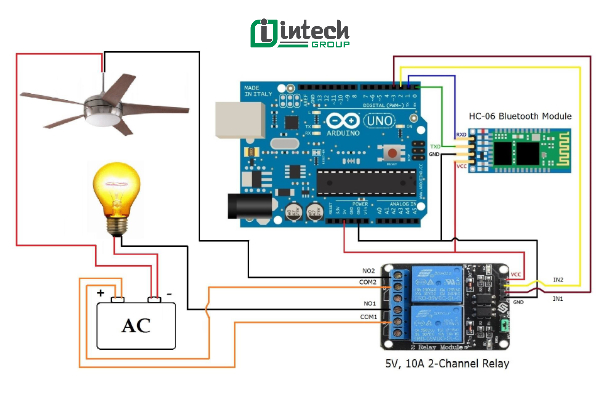
Application of relays in practice
Relays are devices that play an important role in both industry and life thanks to their ability to automate and effectively control electrical systems. Here are the most common applications of relays:
- Industrial safety system monitoring and protection: Used to cut off power in case of an incident, helping to protect equipment and people from the risk of fire or electrical overload.
- Switching and switching on and off circuits in control cabinets and industrial electrical cabinets: Acts as an automatic switch, helping to control the current to different devices in electronic and industrial electrical systems.
- Applications in automation systems: Combined with sensors such as temperature, pressure, humidity or water level sensors... to control machines according to input signals, improving flexibility and operational efficiency.
- Integrated in display and control devices: Mounted in the output of control screens, touch switches or signal converters, helping the system operate more smoothly and accurately.
- Application in production and processing lines: Plays a role in automatically controlling stages based on signals from sensors, supporting continuous monitoring and operation of processes, improving productivity and safety.

Relay is an indispensable device in electrical systems from civil to industrial thanks to its ability to control large currents safely and effectively. Intech has provided information to help you understand what a Relay is, its structure, operating principles and practical applications. Hopefully the above information will help you choose and use the relay that suits your needs. Contact Intech Group immediately for advice and support.
