


What is a welding robot? Outstanding advantages of industrial welding robots
11-10-2025 88
In the rapidly developing economy in Vietnam, industrial robots are increasingly becoming indispensable tools, especially in optimizing production and improving operational efficiency. One of the most advanced and popular applications of robots is industrial welding robots, which play an important role in many manufacturing fields.
What is a welding robot?
A welding robot is a type of industrial robot specially designed to perform automatic welding operations, ensuring high precision and superior quality. The use of welding robots helps businesses save labor, shorten production time and bring consistent products that meet strict technical standards.
.jpg)
Features and classification of welding robots
Welding robots are pre-programmed to fully automate the mechanical welding process. Depending on the purpose of use, the market today offers many types of industrial welding robots, each suitable for a specific welding method:
- Spot Welding Robot: For spot welds, popular in the automotive manufacturing industry.
- Arc Welding Robot: Applied in products that require continuous and strong welds.
- Resistance Welding Robot: Suitable for fast and precise metal connections.
- Laser Welding Robot: Used in jobs that require absolute precision and high aesthetics.
Robot welding technology - Comprehensive solution
Welding robots are programmed to perform complex welding processes accurately and efficiently. Like an "automatic welder" with high-level manipulation capabilities (level 4F, 6G), welding robots do not need to rest and ensure stable product quality.

Fully automated:
With modern technology, welding robots can self-program based on 3D CAD files, minimizing human intervention in the production process.
Meeting difficult technical requirements:
Programmers can teach robots to perform complex welding processes that could only be done manually in the past.
Main structure of industrial welding robots
Industrial welding robots are made up of important parts that help optimize the welding process:
1. Welding robot arm
The robot arm can move flexibly on multiple axes, simulating closely the human arm.
Easily change the welding gun angle and moving position to access difficult welds.
2. Welding power source
Provide current with appropriate voltage to optimize welding performance.
Automatic arc welding machines require more complex power sources to accurately control the welding process.
3. Arc Welding Gun
Function: Conducts the electrode to the weld, transmits the current, and creates a protective environment for the weld.
Depending on the welding process, the welding gun can be water- or air-cooled, with a straight or curved design for easy access to the weld.
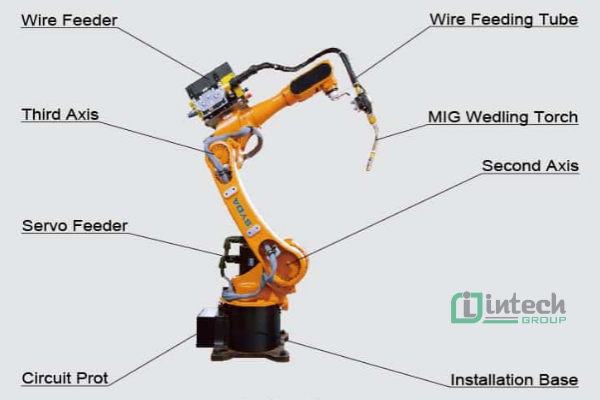
4. Wire feeder
- Responsible for adding metal during the automatic welding process.
- Flexible in adjusting the wire feed speed to meet the requirements of each production line.
5. Positioning and fixing the welding work
Helps to accurately align and hold the welding work firmly in position throughout the welding process.
The design allows the welding gun to freely access difficult welds without obstruction.
6. Welding gun cleaning unit
Ensure the welding gun operates accurately and reliably by cleaning it continuously during use.
Challenges in manual production
Robotic welding technology is a pioneering solution to help manufacturing enterprises overcome difficult problems of efficiency, cost, and product quality. Especially for large-scale manufacturing industries with repetitive welding details such as electrical cabinets, car frames, or elevators, the use of welding robots is an important step to optimize the production process.
1. Increase productivity and consistent quality:
When the production process is stable, the biggest problem for businesses is how to increase output while ensuring product quality remains constant. Manual welding is easily affected by the welder's skills, leading to inconsistent products.
2. Difficulties in human resource management:
Unstable workforce: Young employees often do not stay long-term, while experienced welders are not willing to work overtime.
Recruitment and training costs: Training a good welder takes a lot of time and resources. In many cases, if the welder quits or demands a high salary, it is very difficult for businesses to find a replacement.
3. Unstable performance:
Product output and quality depend too much on human factors, making it difficult to ensure production accuracy and efficiency.
Outstanding advantages of industrial welding robots
Industrial welding robots are not only a modern solution but also bring many practical values, helping businesses solve problems from labor costs, productivity to labor safety. Below are the outstanding benefits of this technology.
1. Easy operation
Today, welding robots have become familiar tools in production. Thanks to the user-friendly control interface design, most welding robots use easy-to-understand English. With just a few instructions, operators can program and control robots easily, ensuring efficiency and accuracy.
2. Reasonable investment costs
With the popularity of welding robots, the supply market is increasingly diverse in brands and prices, helping businesses easily find products that suit their financial conditions.
When comparing the depreciation cost of robots with long-term labor hire, welding robots bring outstanding economic efficiency. Business owners do not have to pay additional toxic allowances and robots can work continuously and more durably than humans, thereby saving a significant amount of money.
3. Outstanding productivity and working capacity
Welding robots do not need to rest and can work continuously in difficult positions that are difficult for humans to access. The products produced are always uniform, of stable quality, and are not affected by toxic environmental factors such as welding gas.
4. High precision
Welding robots are programmed with detailed working paths, ensuring accurate and uniform welds. Therefore, welding robots are the top choice in the automobile and motorbike manufacturing industry, or industries that require high product uniformity.
5. Increased labor safety
Traditional welding work can easily cause health problems due to smoke, welding slag and arc light. Welding robots completely eliminate this risk, especially in dangerous welding positions where humans cannot ensure safety when performing. This is an important factor that helps businesses minimize labor risks.
6. Solving the problem of lack of skilled personnel
Finding experienced, skilled welders is a big challenge for businesses. Welding robots help businesses completely solve this problem, ensuring stable productivity and eliminating the worry of a shortage of skilled workers.

The presence of welding robots in production lines not only helps reduce dependence on manual labor but also improves productivity and economic efficiency.
Over the past 50 years, the automobile manufacturing industry has continuously innovated to achieve the modern look it has today. Major car manufacturers such as Ford, Mercedes, Toyota, Honda, and Nissan have pioneered the application of automated production and assembly lines, in which welding robots account for more than 40% of the production process.
The popularity of welding robots in the automobile industry not only promotes productivity but also ensures consistent product quality, minimizes errors, and optimizes production costs.
Welding robots are not only a production support tool but also an important step forward in the process of industrial automation. With the ability to improve performance, enhance product quality, and minimize operating costs, welding robots are becoming an indispensable solution for modern manufacturing enterprises.
Is industrial robot welding toxic?
Welding robots not only help increase efficiency but also protect workers' health. Toxic agents such as welding fumes and metal vapors can seriously affect the nervous system, kidneys and stomach. Thanks to the support of welding robots, workers no longer have to come into direct contact with dangerous factors, ensuring a safer and healthier working environment.
Welding robot technology is gradually becoming the future of the manufacturing sector, bringing comprehensive benefits from economic efficiency, health protection to product quality assurance.
If your business is looking to buy welding robots, contact Intech Group immediately, a leading supplier of mechanical welding robots with over 10 years of experience. We provide a variety of automatic robot systems that ensure competitive prices and professional services. With a team of dedicated and experienced engineers, we will definitely help businesses optimize their production lines and increase profits.
