


What is KPI? Steps to build an effective set of KPIs for each employee
19-09-2025 420
Measuring work performance is becoming a vital factor for every organization. However, many businesses today are still applying KPI (Key Performance Indicator) in a formal way, lacking connection with the core success factors of the organization, leading to an ineffective measurement system and not creating real value in the decision-making process.
Peter Drucker, the “father of modern business management”, once said: “What cannot be measured cannot be managed. What cannot be measured cannot be improved.” This further affirms the essential role of KPI in all organizational models, especially in the era of digital transformation and operational optimization.
What is KPI?
KPI in English: Key Performance Indicator is an index that measures work performance, helping businesses quantitatively evaluate the level of goal completion. Thereby, organizations can monitor work progress, determine whether individuals, departments or the entire business are on the right track or not.
KPIs are applied to many different fields and departments, with indicators such as: revenue, profit, number of products sold, average annual cost ratio, conversion rate, customer satisfaction level, etc. Periodic KPI analysis provides an overview, helping businesses accurately assess operational efficiency and quickly make appropriate adjustments.

How to calculate KPIs for employees effectively and transparently
Establishing and managing KPIs properly helps businesses measure work performance, improve competitiveness and create a solid foundation for sustainable development. Depending on the model and operating goals, each business can choose the appropriate way to calculate KPIs for employees. There are 3 common ways to calculate KPIs as follows:
1. How to calculate KPIs based on component performance
Formula: Component KPI performance = (Actual results / Target set) × Weight
This method helps measure each specific work item, with each task assigned an appropriate weight depending on its level of importance.
2. How to calculate KPIs based on total performance
Formula: Total KPI performance = Sum of component KPI performances
This method is suitable for evaluating overall work performance during the assessment period, often used to summarize results for the entire month or quarter.
3. How to calculate KPIs based on time periods
For example: Quarterly KPIs will be calculated based on the average KPI score of the months in that quarter. This approach is suitable for businesses that want to continuously monitor performance over a long period of time.
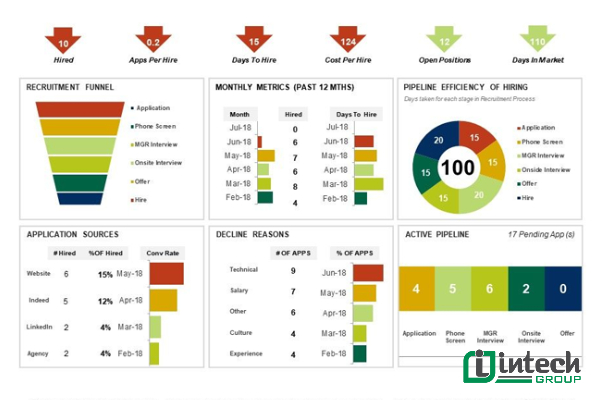
The Role of KPIs in Connecting Human Resources and Departments
In the corporate environment, connecting departments and human resources to a common goal is always a big challenge for managers.
1. Connecting departments and human resources to a common goal
The sales department focuses on finding and converting customers; the product development team prioritizes technological innovation and launching new products; the human resources department focuses on recruiting and team building. Applying KPIs helps businesses connect all departments with a specific system of measurement goals. KPIs play a guiding role so that each individual understands how their contribution is serving the common goal.
2. Linking individual work to the strategic goals of the business
Through measurement indicators, employees can clearly understand “why” they work, “for what” and “how that work performance contributes” to the overall success of the organization. Thanks to KPIs, employees avoid ambiguous working conditions and instead have clarity in goals, responsibilities and career development paths.

Comparison between KPI and OKR
In goal management and performance measurement, the two most mentioned terms are KPI - Key Performance Indicator and OKR - Objectives and Key Results, both aiming to improve work performance and optimize strategy. However, KPI and OKR have completely different approaches, structures and goals. Here is a specific comparison table:
| Criteria | KPI (Key Performance Indicators) | OKR (Objectives and Key Results) |
| Purpose | Measure work performance through specific quantitative indicators | Set goals and measure progress through key results |
| Focus | Current performance, manage and monitor activities | Achieve strategic goals, promote improvement and innovation |
| Structure | Include specific, measurable indicators, linked to periodic activities | Include directional goals (Objective) and 2–5 key results (Key Results) |
| Time of application | Periodic monitoring: monthly, quarterly, annually | According to a fixed cycle: usually quarterly or semi-annually |
| Scope of application | Scope of application | Applicable at all levels: individual, group, department |
| Relationships | KPI can be a measurement tool in OKR | OKR can integrate KPI as key results to track progress |
| Flexibility | Relatively fixed, little change over time | Flexible, easy to adjust when strategy or priorities change |
Should choose KPI or OKR?
- KPI is suitable when you need to measure the effectiveness of specific activities and maintain stability in management.
- OKR is suitable when businesses need to promote change, innovation and shape long-term development strategies.
5 steps to build effective KPIs for each employee
Currently, thanks to support tools, managers can easily set up appropriate KPI targets for each department and each job position through the basic 5-step process below:
Step 1: Identify the department or person responsible for building KPIs
Enterprises can choose one of the following two popular methods:
Method 1: Assign the head of the department/functional department to build KPIs
They can establish a KPI system that closely follows reality. For large departments, this should be delegated to smaller management levels to ensure detail and accuracy.
Method 2: Assign the human resources department or senior management to build KPIs
In reality, KPI indicators may be unrealistic because they do not fully reflect the specifics of the job. Therefore, these KPIs need to be evaluated and commented on by the relevant functional departments themselves, avoiding imposition and lack of feasibility.
Step 2: Identify KPIs
Indicators for evaluating work performance, identifying the correct KPI for each position is the most important step. Each position in the enterprise has its own responsibilities and roles, so KPIs need to accurately reflect the department's goals and be linked to the overall goals of the enterprise.
Applying the SMART criteria in determining KPIs
To ensure KPIs are clear, effective and easy to evaluate, apply the SMART model - a popular standard framework in goal management. Specifically:
S – Specific: Specific, easy to understand, clear goals
M – Measurable: Can be measured with actual data
A – Attainable: Can be achieved with available resources
R – Relevant: Suitable for the role, job function
T – Time-bound: Has a clear completion time
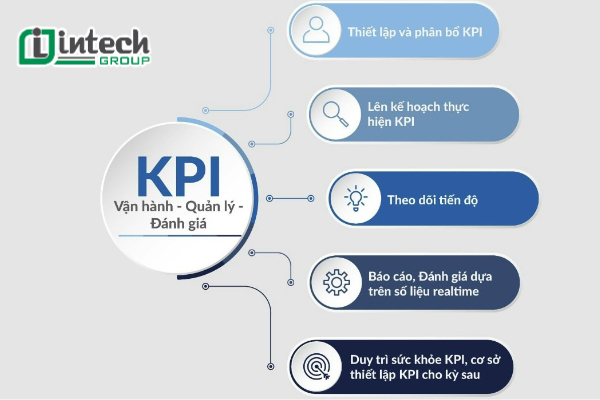
Step 3: Evaluate the level of KPI completion of employees
After clearly defining KPIs for each job position, to ensure fairness and reasonableness, specific jobs are divided into three main KPI groups:
Group A: Jobs that take a lot of time to perform and have a big impact on the overall goals of the business.
Group B: Jobs that take little time but have a big impact, or/and take a lot of time but only have a medium impact on the overall goals.
Group C: Jobs that take little time and have a low impact on the overall goals.
Each group of KPIs will be assigned different weights to reflect their importance, for example: Group A: 50%, Group B: 30%, Group C: 20%
Step 4: Link KPI assessment with compensation
Next, the KPI system directly links the KPI completion level and the compensation regime, each KPI completion level corresponds to a different bonus/salary level determined by senior management, direct management of the department, the department that builds the KPI system, or agreed upon by employees and managers from the beginning.
Step 5: Adjust and optimize the KPI system
The KPI system needs to be monitored and adjusted periodically to ensure it is consistent with the actual work and strategic direction of the business. At the beginning, KPIs should be reviewed and re-evaluated regularly to ensure feasibility, measurability and suitability.
Once KPIs have stabilized and proven effective, businesses should maintain the system for at least a year, then evaluate it overall to continue adjusting if necessary.
6. Types of KPIs for each production sector
Business KPIs
Business KPIs are performance indicators that help evaluate the level of completion of long-term business goals, helping businesses identify strengths and weaknesses in operations, thereby adjusting strategies and improving growth efficiency. Some business KPIs such as:
- Revenue Growth Rate - Revenue Growth Rate
- Customer Acquisition Cost - Customer Acquisition Cost
- Customer Retention Rate - Customer Retention Rate
- Customer Lifetime Value - Customer Lifetime Value
- Gross Profit Margin - Gross Profit Margin
- Inventory Turnover - Inventory Turnover Rate
- Return on Investment - ROI - Return on Investment
- Lead Conversion Rate - Lead Conversion Rate
Financial KPIs
Financial KPIs are indicators such as the organization's ability to generate revenue, profit and cost management that are often monitored by the board of directors and the finance department. Some financial KPIs such as:
- Profit Margin - Profit Margin
- Gross Margin - Gross Profit Margin
- Return on Investment (ROI) - Return on Investment
- Cash Flow - Cash Flow
- Accounts Receivable Turnover - Accounts Receivable Turnover
- Accounts Payable Turnover - Accounts Payable Turnover
- Working Capital Ratio - Working Capital Ratio
- Debt-to-Equity Ratio - Debt-to-Equity Ratio
- Gross Profit - Gross Profit
- Net Profit - Net Profit
- Earnings per Share - EPS - Earnings per Share
Sales KPI
Sales KPI is an index that reflects monthly sales results and helps businesses evaluate the effectiveness of the business strategy used by the sales team. Some common sales KPIs include:
- Sales Revenue - Sales
- Sales Growth Rate - Sales Growth Rate
- Customer Acquisition Cost - Cost of acquiring new customers
- Customer Conversion Rate - Customer Conversion Rate
- Average Order Value - Average Order Value
- Sales Pipeline Conversion Rate - Conversion rate of each step in the sales process
- Customer Retention Rate - Customer Retention Rate
- Upsell Rate - Rate of increasing sales through selling additional products/services
Marketing KPIs
Marketing KPIs are marketing performance metrics that help the Marketing department track performance across all communication channels, giving businesses an overview of the effectiveness of marketing campaigns and the contribution of each marketing activity. Some common marketing KPIs include:
- Brand Awareness - Brand Awareness
- Website Traffic - Website Traffic
- Click-Through Rate (CTR) - Click-Through Rate
- Social Media Engagement
- Conversion Rate - Conversion Rate
- Customer Acquisition Cost - Cost of Acquiring New Customers
- Cost per Lead - Cost per Lead
- Marketing Qualified Leads - MQLs - Marketing Qualified Leads
- Sales Qualified Leads - SQLs - Sales Qualified Leads
- Social Program ROI (By Platform) - Social Media ROI by Platform
- Return on Ad Spend - ROAS - Return on Ad Spend
- Return on Investment - ROI - Return on Investment
- Customer Lifetime Value - Customer Lifetime Value
HR Department KPIs
KPI helps HR Department evaluate and improve improve work processes, develop human resources and create the best working environment. Some common HR KPIs include:
- Employee Turnover Rate - Employee Turnover Rate
- Average Time to Hire - Average Recruitment Time
- Absenteeism Rate - Absenteeism Rate
- Training Participation Rate - Training Participation Rate
- Employee Satisfaction Index - Employee Satisfaction
- Employee Retention Rate - Employee Retention Rate
- Recruitment Success Rate - Recruitment Success Rate
- Average Cost of Hire - Average Recruitment Cost
- Workforce Stability Index - Employee Stability
Accounting KPIs
Accounting KPIs are indicators that help measure the efficiency and performance of the accounting department, and reflect the level of completion of financial goals in the business. Monitoring accounting KPIs not only helps control risks but also supports quick and accurate decision making in Financial Management. Some common KPIs for the accounting department:
- Financial Reporting Lead Time
- Tax Submission Compliance
- Cash Flow Management Efficiency
- Timely Processing Rate
- Accounting Cost as a Percentage of Revenue
- Accuracy of Financial Forecasting
- Accounting Standards Compliance Rate
- Accounting Process Automation Efficiency
Project Management KPIs
Project management KPIs are indicators that help track progress, evaluate the level of goal completion and implementation effectiveness of a project. Project managers use these KPIs to monitor work performance and promptly adjust plans when necessary. Some common project management KPIs include:
- Project Completion Time - Project Completion Time
- Cost Performance Index - CPI
- Schedule Performance Index - SPI
- Earned Value - Earned Value
- Project Scope Change Rate - Project Scope Change Rate
- Defect Density - Defect Density
- Resource Utilization - Resource Utilization
- Customer Satisfaction - Customer Satisfaction
- Team Morale Index - Team Morale Index
Some frequently asked questions about building and implementing KPIs
Question 1: What is running KPI?
Running KPI is a common term in the business environment to refer to the process of making efforts to implement and achieve key performance indicators KPI (Key Performance Indicators). These are quantitative indicators that help measure the work efficiency of individuals, groups or the entire organization based on specific goals set.
However, "running KPI" sometimes has a negative connotation, when the implementer only focuses on completing the numbers while ignoring the actual quality or using non-transparent measures to achieve the KPI target. Therefore, businesses need to build KPIs reasonably, linked to business and production efficiency.
Question 2: What are KPI evaluation criteria?
KPI evaluation criteria depend on the field, function and specific goals of each organization. Some common criteria include:
- Measurability
- Linkage to goals
- Feasibility
- Timeliness
For example, financial KPIs often include indicators such as revenue, net profit, profit margin, return on investment, etc.
Question 3: What is KPI sales?
KPI sales are indicators that measure the sales performance of individuals, teams or sales departments. Sales KPIs are often directly linked to revenue targets, number of contracts, customer conversion rates, etc. to evaluate sales results by specific timeline
Question 4: Which KPI tracking tools and software are effective for businesses?
To effectively manage KPIs, businesses can use the following supporting tools and software:
KPI management software helps support setting up, monitoring and analyzing KPIs. For example: KPI Fire, BSC Designer, ClearPoint Strategy
Enterprise performance management (EPM) system helps analyze data, make financial plans, and evaluate comprehensive KPIs. For example: Oracle EPM Cloud, IBM Planning Analytics, SAP BPC
Online dashboards help visualize KPI data in real time, making it easy for managers to monitor performance. For example: Power BI, Google Data Studio, Tableau
Project management tools help track KPIs in specific projects, control progress and quality. For example: Asana, Jira, Trello
CRM (Customer Relationship Management) system helps monitor KPIs related to sales, marketing and customer care customers. Examples: Salesforce, Zoho CRM, HubSpot
HR management systems that help measure employee performance based on individual or team KPIs. Examples: BambooHR, Zenefits, Workday
