

What is OKR?
16-09-2025 233
OKR (Objectives and Key Results) là một phương pháp quản trị mục tiêu hiện đại, giúp doanh nghiệp định hướng rõ ràng và đo lường kết quả cụ thể trong từng giai đoạn phát triển.
Widely applied by leading corporations such as Google, Intel or LinkedIn, OKR not only helps organizations improve work performance but also increases transparency and commitment from all levels of personnel. Intech Group will help you learn what OKR is, the structure of the OKR model and how to apply it effectively to create breakthroughs in business management.
What is OKR?
OKR stands for Objectives and Key Results, a modern goal management method that is widely applied around the world. OKR helps individuals, teams and businesses identify what is most important, track progress clearly and measure specific results. The highlight of OKR is the ability to create focus, transparency and promote work performance through setting inspiring goals and measurable key results. The OKR structure consists of two main parts:
- Objective: Is the direction or destination that an individual or organization wants to achieve. The goal should be concise, challenging and inspiring.
- Key Results: Are specific indicators used to evaluate the level of goal completion. They need to be clearly quantified, have a specific deadline and be easy to track.
The origin of OKR comes from the Management by Objectives (MBO) model introduced by Peter Drucker in 1954. Then, Andrew Grove - CEO of Intel - developed and perfected it into OKR in 1968. In 1999, John Doerr brought OKR to Google, where this model became the management key that helped Google grow rapidly and sustainably.

OKR Classification
After understanding what OKRs are, the next step to effective implementation is to identify two common types of OKRs: commitment OKRs and stretch (aspirational) OKRs. Each type has its own goals and is suitable for each stage of development of the organization, team or individual.
Commitment OKRs
Commitment OKRs are mandatory goals that require 100% achievement. These are often goals tied to work performance, KPIs or results that directly affect business operations. Implementing commitment OKRs helps ensure focus, clarity of responsibility and promote operational efficiency in the organization. To build effective commitment OKRs, ask yourself:
- Is the goal really important and urgent?
- Can it be achieved within a specific time frame?
- Are the key results measurable, trackable and verifiable?
Commitment OKRs require Key Results to be 100% complete to be considered a success. If not, the plan needs to be adjusted or continued to improve in the next cycle.
Aspirational OKRs
In contrast to commitments, aspirational OKRs are strategic, innovative goals that often go beyond current capabilities. While not necessarily 100% complete, extended OKRs encourage creativity, continuous improvement, and major breakthroughs within the organization. When building extended OKRs, consider:
- Is the goal groundbreaking and inspiring?
- Can it be achieved if the entire team goes above and beyond?
- Does this goal create significant value or link to other core goals?
Extended OKRs typically aim for success when they are around 70% complete. However, the impact they create can far exceed initial expectations.

Outstanding benefits of applying the OKR model in businesses
After clearly understanding what OKR is, businesses need to grasp the specific benefits that this model brings. According to John Doerr - who brought OKR to Google - this goal management method not only helps organizations operate effectively but also creates a foundation for sustainable development. The 5 core benefits of OKR are summarized in the acronym "FACTS": Focus - Alignment - Commitment - Tracking - Stretching.
1. Focus - Focus on the important thing
Each OKR cycle usually includes only 2-5 main goals, each goal has a maximum of 5 key results, helping to avoid resource dispersion. Thanks to that, the entire organization can focus on the truly important and decisive tasks.
2. Alignment - Create organizational alignment
One of the greatest values when understanding and implementing OKR is the ability to link goals from leaders to employees. All departments and teams work towards a common vision, eliminating fragmented work or conflicting goals. This close connection contributes to building a synchronous and effective working culture.
3. Commitment - Strengthening commitment and responsibility
OKR encourages employees to directly participate in the goal setting process, creating a sense of ownership and responsibility for the output results. When individuals commit to their own proposed goals, their proactive spirit and work productivity are also significantly improved.
4. Tracking - Transparent progress tracking
OKR is not only about setting goals but also a clear progress tracking system. Thanks to regular and periodic updates, businesses can detect barriers early, make timely adjustments and ensure everyone is always on track. This helps avoid the situation where goals are forgotten until the end of the cycle.
5. Stretching – Encourage Breakthrough Thinking
A unique feature of OKR is that it encourages setting challenging “stretch” goals that may not be 100% complete. However, it is this stretching thinking that creates breakthrough progress. Even if only 60–70% of the aspirational OKR is achieved, businesses can still achieve significant results, far beyond the traditional way of doing things.

Example of OKR model in technology business
To better understand what OKR model is and how to apply it in practice, below is a specific example of how to set up OKR for a business operating in the technology field.
Company-level OKR
Goal: Become the leading technology company in the software field.
Key results: Increase revenue growth by 20%, increase the number of new customers by 10%, develop 3 new products.
Department-level OKR
Goal: Develop new features for product A.
Key results: Complete new feature S within 2 months and increase customer satisfaction with feature S to 5/5 stars.
Personal OKR
Goal: Develop new features for product A.
Key results: Complete new feature S within 2 months and increase customer satisfaction with feature S to 5/5 stars..
Comments on the OKR example
In the above example, OKR is implemented synchronously from the company, department to individual levels. Each level is aimed at a common goal, ensuring connection and mutual support during the implementation process. This clearly demonstrates the role of OKR in creating consensus and increasing business operational efficiency.
SMART criteria for effective OKR
To build effective OKR, businesses should ensure that each goal and key result follow the SMART criteria:
-
Specific: Not vague, clearly what the goal needs to do.
-
Measurable: Has specific indicators to evaluate progress.
-
Achievable: Challenging but within the ability to implement.
-
Relevant: In line with the overall strategy of the organization.
-
Time-bound: Attached to a clear time frame to create motivation for completion.
Core principles in the OKR model.
After understanding what OKR is, mastering the basic principles will help organizations deploy this model more effectively, avoiding errors in the actual application process. Below are important principles to remember when using OKR in the enterprise.
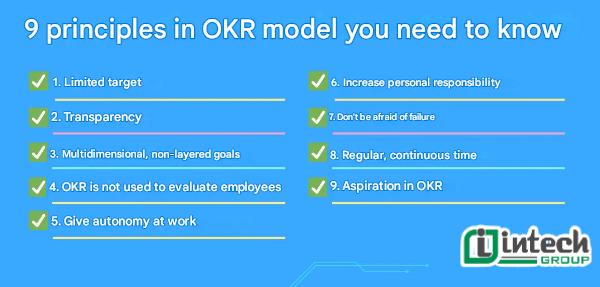
1. Limit the number of goals
Each individual should only set a maximum of 3–5 goals, and each goal should only have 3–5 key results. This limitation helps increase clarity, avoid overload and dispersion of resources. Goals must be challenging but achievable, if they are too easy, they will not create motivation, and if they are too difficult, they will easily cause discouragement.
2. Transparency
All OKRs from the company level to the department and individual level - should be publicly disclosed internally. This helps all members understand the common direction and coordinate more smoothly. At the same time, the progress of OKR implementation also needs to be updated regularly for timely adjustments when needed.
3. Set multi-dimensional goals
The OKR model encourages two-way communication, allowing employees to discuss and set goals that are appropriate for their roles. This helps increase initiative and responsibility in the organization.
4. Do not use OKR to evaluate employees
Employees are entitled to build goals, choose implementation methods, while managers play a supporting role as a coach. This empowerment helps promote capacity, enhance responsibility and better connect employees.
5. Empowerment principle
Employees are entitled to build goals, choose implementation methods, while managers play a supporting role as a coach. This empowerment helps promote capacity, enhance responsibility and better connect employees.
6. Clear personal responsibility
This spirit helps organizations dare to think big, try new things and learn from unsuccessful experiences. It is from these controlled failures that businesses can learn lessons and create breakthroughs.
7. Not afraid of failure
This spirit enables organizations to think big, try new things, and learn from unsuccessful experiences. It is from these controlled failures that businesses can learn lessons and create breakthroughs.
8. Flexible and regular OKR cycle
The common OKR cycle is quarterly (3 months), including the stages of setting up, implementing and evaluating. However, depending on the size and nature of the business, it can be shortened (1 month for startups) or extended (6–12 months for large enterprises). Regularly repeating the cycle helps OKR stay updated and adapt to the actual situation.
9. Aspiration
The ideal OKR is a "difficult but achievable" goal, with a breakthrough nature, forcing the organization to strive to achieve new and more valuable results. This is the factor that makes OKR a powerful goal management tool, helping businesses rise and differentiate themselves in the market.
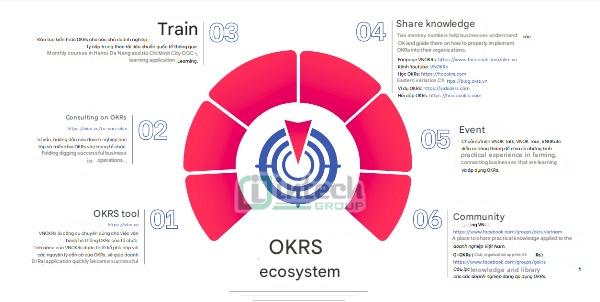
Building an OKR ecosystem in the business
After understanding what OKR is, the next important step is to effectively deploy this model in the business. OKR is not just a theory but a goal management tool that requires a specific process and synchronous coordination from leaders to each employee. Below are the steps to implement OKR in practice:
1. Identify clear goals
Every OKR system starts with identifying the Objective - the overall goal. The goal needs to ensure the following factors: specific, measurable, feasible, relevant and time-bound (SMART). Senior management will set strategic goals based on the vision and mission of the business, then allocate them to each department level to build appropriate OKRs.
2. Identify Key Results
Key Results là thước đo cho sự tiến bộ của mục tiêu. Mỗi mục tiêu nên đi kèm từ 3–5 kết quả then chốt, được thiết kế định lượng, có mốc thời gian cụ thể và liên kết logic để tạo nên một bức tranh toàn diện. Key Results không phải là nhiệm vụ, mà là kết quả mong muốn cần đạt được.
3. Set up an OKR management system
Key Results are a measure of the progress of the goal. Each goal should be accompanied by 3-5 key results, designed quantitatively, with a specific timeline and logically linked to create a comprehensive picture. Key Results are not tasks, but the desired results to be achieved.
4. Disseminate OKRs to management levels
Organize meetings with department heads and division heads to disseminate strategic directions and high-level OKRs. During the meeting, it is necessary to ensure that all middle managers clearly understand what OKRs are, their importance, principles and specific implementation methods. At the same time, the leadership should collect feedback to adjust OKRs to suit the reality of each department.
5. Discuss and establish individual OKRs
After agreeing on department-level OKRs, managers will work directly with each employee to establish individual OKRs. This process should take place in the form of two-way negotiations - helping employees understand the direction of the organization, while expressing their aspirations and ability to contribute. Individual OKRs must be consistent with the overall goals but still promote individual strengths.
6. Internal communication and public OKRs
Transparent communication of OKR sets within the organization helps increase connectivity and transparency. All members need to clearly understand what they are aiming for, how to achieve the big goal together. OKRs should be made public internally, helping teams coordinate more effectively and avoid conflicting goals.
7. Continuous monitoring and evaluation
OKRs need to be monitored periodically on a weekly or monthly basis, not just waiting until the end of the cycle to evaluate. Regular updates help detect problems early, adjust strategies, and create an environment for continuous feedback and learning.
8. Repeat and upgrade the OKR cycle
The OKR process is an iterative cycle. After each cycle (usually 3 months), businesses need to evaluate the effectiveness, learn from failures, and continue to build OKRs for the next cycle with a higher level of challenge. Gradual upgrades help the team continuously develop, innovate, and create breakthrough results.
Which businesses have successfully applied the OKR model?
After understanding what OKR is, many managers will ask: Is this method really effective in practice? The answer is yes. In the world and in Vietnam, many leading businesses have implemented OKR and achieved impressive results. Here are some typical examples:
1. VNG – Pioneer in applying OKR in Vietnam
As one of the largest technology corporations in Vietnam, owning products such as Zalo, Zing MP3, VNG Games..., VNG has started applying OKR since 2014. Thanks to the OKR system, VNG has:
-
Shortened the decision-making process at many levels
-
Increased transparency throughout the organization
-
Improved management efficiency and product/service performance
The implementation of OKR at VNG not only helps improve operational capacity, but also creates a solid foundation for continuous innovation.
2. Grab – Accelerating growth thanks to OKR
As the leading "technology unicorn" in Southeast Asia, Grab has applied OKR since 2014 to manage goals across Singapore and other countries. The results include:
- Rapid growth in both scale and market share
- Significantly improving user experience
- Enhancing engagement and initiative among internal teams
OKR has helped Grab maintain a high-speed and agile culture in a constantly changing technology environment.
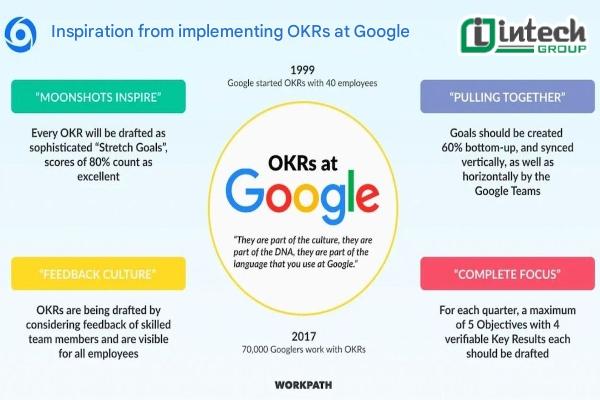
3. Google - The global symbol of OKR
It is impossible to talk about OKR without mentioning Google, which has made this model a global management standard. In 2000, John Doerr - who had approached OKR at Intel - introduced this system to Google's founders. Since then:
- Google sets OKRs annually and quarterly
- All OKRs are shared publicly internally
- Each individual and department proactively builds OKRs in line with the company's strategy
The clarity and consistency in OKRs have contributed to Google's "lightning-fast" growth rate from the very beginning.
4. Intel – The cradle of modern OKR
OKR originated from the management philosophy of Andy Grove, the legendary CEO of Intel. He officially applied OKR in 1975, when Intel was transforming its strategy from memory to microprocessors. Thanks to OKR:
- Intel has successfully transformed its business
- Increased efficiency and inter-departmental coordination
- Established a transparent and effective management culture
OKR at Intel is not only a management tool but also a catalyst to help businesses reshape the entire strategy.
How to get started with the OKR model?
The OKR system launch should be prepared at least 6 weeks before the start of a new quarter or year to ensure that all levels understand it correctly and operate synchronously. Here is a roadmap and specific steps to get started with OKRs:
1. Define company-level Objectives and Key Results
The first step is to define 3–5 key objectives (Objectives) for the entire company. These objectives should come from the mission, vision, or strategic indicators that the leadership team is aiming for, for example: “Grow revenue by 200%” or “Use 100% renewable energy”.
Next, define Key Results for each objective – specific, measurable and verifiable results. For example: “Hire 5 more Account Executives”, “Increase the number of new customers to 1,000 people/quarter”, etc.
3. Disseminate OKR to middle managers
Whether you are a small business or a large corporation, managing OKRs will be easier when using the right tools. Some businesses use Excel, Google Sheets, or specialized software such as Base Goal, Perdoo, Lattice... Most importantly, this system needs to be prepared in advance so as not to interrupt the workflow when implementing OKR.
3. Phổ biến OKR tới quản lý cấp trung
Organize a meeting with department heads to:
- Introduce what OKR is, its role, benefits, and how it operates.
- Discuss established company-level OKRs.
- Guide to building OKRs for each department based on common goals.
After the meeting, the department head will have enough information to work with the team to build OKRs suitable for the specific nature of the job.
4. Disseminate OKRs to the entire business
Next, disseminate OKRs in a company-wide meeting. Here, employees at all levels need to clearly understand:
- Why does the business apply OKR?
- How will OKRs impact work and personal goals?
- What is the process and frequency of tracking OKRs?
Good internal communication helps employees to be more committed to the goals and minimizes misunderstandings during the implementation process.
5. Department heads work with individuals to set personal OKRs
This is a two-way interactive process. Managers and employees will discuss to set personal OKRs that are both in line with the organization's direction and reflect their personal development capabilities and aspirations. The result is that each employee has clear, measurable and realistic goals.

6. Connect, stratify and present the OKR system across the organization
After individual and department OKRs are built, the leadership needs to synthesize and stratify OKRs vertically (from individual to company) and horizontally (between departments) to ensure that there is no overlap or conflict of goals. The final OKR will be presented and agreed upon in a general meeting, opening a new OKR cycle.
7. Monitor and manage OKRs throughout the cycle
During the implementation process (usually quarterly), managers need to regularly monitor the progress of OKR implementation. Can organize:
- Mid-Quarter Check-in
- Continuous feedback to adjust if necessary
- Summary of the assessment at the end of the cycle to gain experience and upgrade the next goal
Getting started with OKRs is not difficult if the business has a clear process and consensus from leaders to employees. Most importantly, once you understand what OKR is, apply it correctly to maximize the benefits that this model brings: from increasing performance, promoting innovation to building a goal-oriented and transparent organization.
