


What is Robot and Bowl Feeder? Structure and specific advantages
18-10-2025 125
In the era of increasingly strong automation, the application of Robots and Bowl Feeders (vibrating hoppers for feeding blanks) is becoming an inevitable trend to help businesses optimize production processes, providing more stable, precise and flexible operation than traditional manual methods.
The combination of Robot and Bowl Feeder not only helps businesses save labor costs, minimize production errors, but also opens up an important step in the journey of automation and comprehensive digital transformation. Join Intech Group to learn in detail the outstanding advantages that Robot and Bowl Feeder bring in the article below!
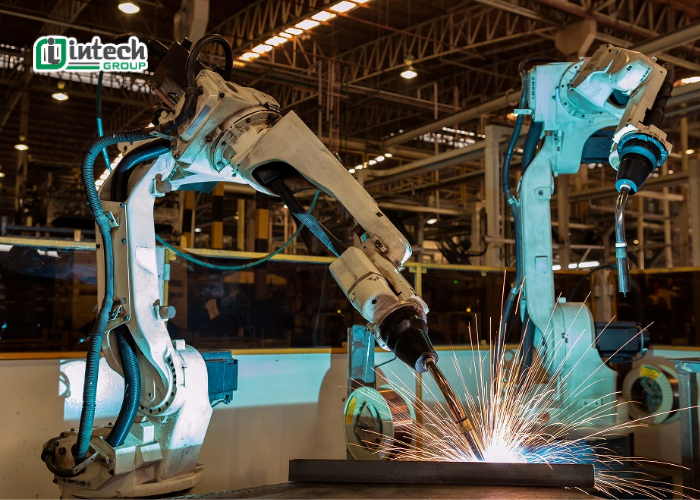
Industrial Robots in Production
Industrial robots are mechanical arms designed to simulate human movements, capable of performing a series of tasks with almost absolute precision. They are flexibly programmed to undertake tasks such as picking up components, welding, painting, assembling or checking product quality, contributing to optimizing the entire production line.
Structure of industrial robots
An industrial robot is usually made from sturdy materials such as cast iron or steel, ensuring load-bearing capacity and stable operation in harsh environments. The basic structure includes 3 main parts:
Robot arm: Is the part that performs the main movement, including many joints that allow the robot to move flexibly at many different angles, similar to a human hand.
Control system: Considered the "brain" of the robot, responsible for processing data, calculating and sending accurate commands to the motors.
Operating system: Usually programmed and monitored via computer, helping the robot operate smoothly, interacting accurately with other devices in the Robot and Bowl Feeder chain.
Advantages of industrial robot arms
The application of industrial robot arms brings many outstanding benefits to modern manufacturing enterprises:
- Safety in labor: Industrial robots help replace humans in heavy, toxic or dangerous jobs such as loading and unloading goods, welding and cutting metal, spraying paint, or working in high temperature environments.
- Increased productivity and high accuracy: Robots are capable of working continuously 24/7 with stable speed and almost absolute accuracy. This helps the production process take place faster, minimize errors and improve the quality of output products.
- Long-term cost savings: Although the initial investment cost is high, the use of robots helps reduce labor costs, production time and material loss in the long term. Businesses quickly recover capital thanks to operational efficiency.
- Flexibility in production: Industrial robots can be programmed to perform many different tasks and easily change the program when the product or production process changes.
- Easy integration with automation systems: Industrial robots can be combined with vibrating feeders (Bowl Feeder), conveyors, sensors or machine vision systems (Vision System) to form a complete automatic production line, towards the model of a smart factory (Smart Factory).
Bowl Feeder or Automatic Vibrating Feeder
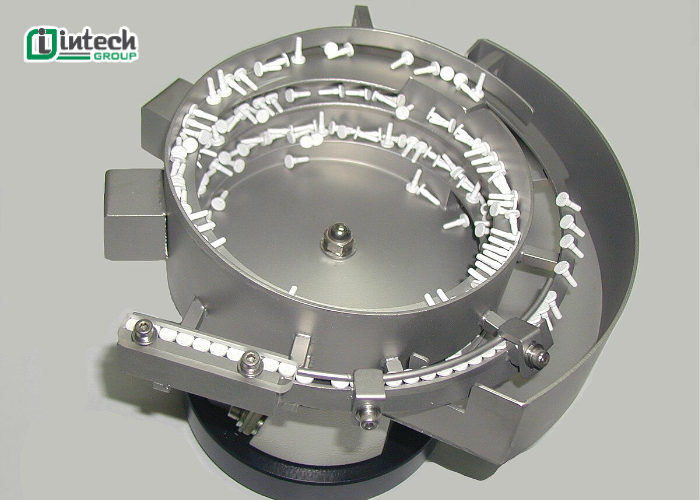
Bowl Feeder or Automatic Vibrating Feeder
Bowl Feeder (vibrating feeder) plays a particularly important role in the early stages of the production line, when it is responsible for arranging and automatically feeding workpieces to industrial robots or assembly equipment.
The vibrating feeder is designed to arrange components accurately, helping the feeding process to take place continuously, stably and uniformly. Thanks to that, businesses can minimize dependence on manual labor, while ensuring high accuracy in each production stage.
Structure of the vibrating feeder
A standard Bowl Feeder usually includes two main parts: a vibrating hopper and a vibrating base, each component has a separate structure and function, working together to ensure accurate and stable feeding.
- Vibrating hopper (Bowl): The hopper is round, designed in a spiral shape, allowing components to be placed randomly but will automatically move and orient along the available path. Depending on each type of product or component (screws, bolts, bottle caps, pills, etc.), the vibrating hopper will be customized to meet the specific orientation requirements of the business.
- Vibrating base (Base): This is the part that creates mechanical vibrations, helping the component move along the spiral path of the vibrating hopper. The vibration frequency can be flexibly adjusted from low frequency for slow speed to high frequency to help speed up the feeding process.
Outstanding advantages of the vibrating feeder
The automatic vibrating feeder brings many outstanding benefits to manufacturing enterprises, especially in the electronics, pharmaceutical, metalworking, mechanical and packaging industries:
- Stable feeding performance, high precision.
- Easy to control the speed and flow of feeding according to the requirements of the line.
- Flexible adjustment of vibration intensity according to each type of component.
- Reduce labor costs, significantly increase productivity compared to manual operations.
- High durability, low maintenance cost, stable operation for a long time.
Bowl Feeder Working Principle
The Bowl Feeder works based on the principle of mechanical vibration, helping to automatically arrange and orient components in a predetermined direction before moving to the next stage of the chain.
When the vibrating hopper is operating, random components in the hopper will be gently shaken in a spiral motion, gradually aligning and moving outward in a single direction. This process is based on the shape and center of gravity characteristics of each component, helping them to be oriented accurately (for example: bolts, screws, electronic components).
In the case of components with symmetrical shapes or requiring specific identification (color, size, rotation direction...), the system can integrate additional sensors or AI cameras to support classification and orientation.
Conclusion
In the modern production trend, Robots and Bowl Feeders are two important links that help businesses gradually move towards comprehensive automation. The robot is responsible for precise, high-speed operations, while the Bowl Feeder ensures a stable, continuous, and directional workpiece feed. The combination of these two technologies brings outstanding efficiency in increasing productivity, reducing production errors, and optimizing operating costs.
With more than 14 years in the field of automation, Intech Group is proud to be a pioneer in providing comprehensive Robot and Bowl Feeder solutions. Contact Intech now for detailed advice from our team of engineers, helping your business to be ready to enter the era of smart, efficient, and sustainable production.
