


What is SOP? Steps to build standard operating procedures SOP in production
09-09-2025 301
Trong quản lý và vận hành doanh nghiệp, việc chuẩn hóa quy trình là yếu tố then chốt để đảm bảo hiệu quả và hạn chế rủi ro. Một trong những công cụ không thể thiếu chính là SOP (Standard Operating Procedure).
So what is SOP? In this article, Intech Group will help you better understand what SOP is, its role in business operations, and how to build an effective SOP to optimize work performance.
What is SOP?
SOP stands for Standard Operating Procedure, a system of detailed instructions built to help employees perform their work consistently, effectively and according to standards. Instead of working based on intuition, SOP brings standardization to each step of operation, thereby helping businesses improve productivity, ensure quality and minimize errors in the operation process.
SOP includes specific regulations, instructions and inspection and evaluation mechanisms to ensure that all operating processes are always accurate, transparent and highly effective so that businesses maintain integrity, confidentiality as well as comply with legal regulations and internal regulations.
One of the outstanding advantages of SOP is its ability to support training new employees. When there is an SOP document, the business will save a lot of training time, while helping employees easily get acquainted with the new work and environment and quickly catch up with the general progress.
SOP has a very wide range of applications, from production, healthcare, logistics to customer service. For example, in the medical field, SOP provides detailed instructions on how to perform medical examination, surgery, treatment and patient care procedures.
SOP Formats
Depending on the complexity of the process and the management goals, there are three popular SOP formats that are widely applied:
Simple SOP Format
This is the easiest format to apply, often used for short, few-variable, and repetitive processes. Simple SOPs present each step in order of implementation, making it easy for employees to follow and apply without requiring much training time.
For example, in the process of receiving new customers, the SOP can be written into the following steps:
- Step 1: Greet the customer.
- Step 2: Record customer information.
- Step 3: Introduce products/services.
- Step 4: Guide customers to complete the procedure.
- Step 5: Thank and close.
This type of SOP is especially useful in tasks such as checking equipment, operating internal software, or performing basic technical operations.
Hierarchical SOP Format
For more complex processes that require coordination between multiple departments or require detailed explanations of each step, a hierarchical SOP is the optimal choice. The structure of a hierarchical SOP typically includes four main parts:
- Policy: Defines the scope and general regulations.
- Procedure: Describes the implementation steps in detail, along with the roles and responsibilities of each department.
- Instructions: Provides specific instructions to ensure quality work.
- Documentation: Establishes a record keeping system to track compliance.
This format helps businesses manage complex processes clearly, transparently, and easily evaluate effectiveness.
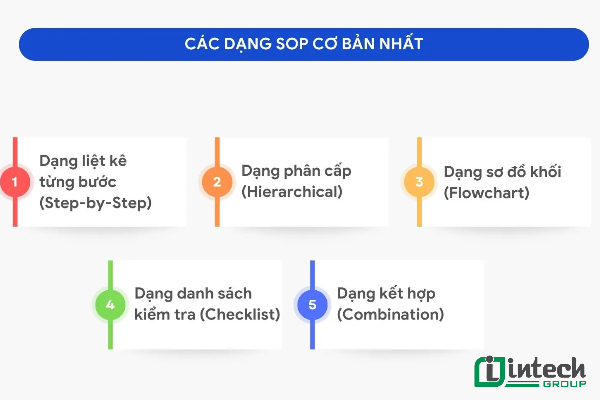
SOP by flowchart
In processes with many branches or situations, SOP by flowchart is the most intuitive and effective format. Instead of presenting in writing, this SOP uses block diagrams and arrows to describe the workflow, helping employees visualize the whole.
For example, an SOP for a purchasing process can be designed as follows:
- Step 1: Create a purchase request.
- Step 2: Send a request for quotation to the supplier.
- Step 3: Receive and evaluate the quotation.
- Step 4: Create a contract and sign.
- Step 5: Check and confirm the goods.
- Step 6: Import to the warehouse.
- Step 7: Pay and close the transaction.
SOP flowcharts not only help optimize the presentation but also help businesses quickly detect bottlenecks in the process, thereby finding timely solutions to improve. This is the ideal format for complex activities such as contract approval, customer complaint handling or supply chain management.
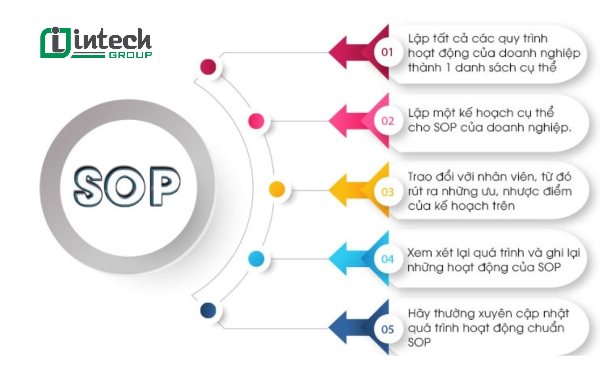
Steps to build a standard operating procedure SOP in production.
A good SOP not only helps employees understand the steps of work that need to be performed, but also points out the risks that may arise during the operation process. It is important that the instructions in the SOP are concise, easy to understand and focus on the core content. After completion, the SOP needs to be analyzed, reviewed and updated periodically from 6 to 12 months to ensure that it is always consistent with standards and actual requirements.
Before starting to write an SOP, the administrator needs to conduct a risk assessment at all steps to identify possible obstacles. Issues that need to be clarified include: Who performs what role, what each role needs to do, what the work goals of each person are and whether the steps are clear enough.
Step 1: Determine the goal of the SOP
The enterprise needs to clarify the reason why it is necessary to build an SOP and the specific goals that this process aims for. This is an important basis for shaping detailed content.
Step 2: Determine the scope of SOP application
It is necessary to determine the scope of SOP to know which activities, departments or stages in production it applies to.
Step 3: Choose the appropriate SOP format
Enterprises can choose:
- Flowchart/Workflow diagram: Displays the process with a diagram, suitable for jobs with many arising situations.
- Simple steps: Lists simple, concise, easy-to-follow steps.
- Hierarchical steps: Hierarchical form, more detailed with main steps and specific instructions.
Step 4: Determine dependent factors
Identify related factors and decide how to integrate them into SOP. At the same time, classify the applicable subjects (new employees, long-term employees, etc.) to have a suitable way to write SOP.
Step 5: Develop detailed steps and procedures
List each step in detail, ensuring it is complete and accurate so that employees can apply it consistently.
Step 6: Check and evaluate effectiveness
After the SOP is applied, it is necessary to monitor, evaluate its effectiveness and adjust it when necessary to suit the production reality.
Step 7: Approve and publish the SOP
Before issuing, the SOP must be approved by management and disseminated to all relevant employees to ensure compliance.
Step 8: Update and maintain the SOP
SOP needs to be reviewed and updated periodically to maintain accuracy, consistency and suitability with changes in the business.
Some notes when building SOP
-
Every job needs SOP to avoid errors and ensure consistency.
-
The content must be specific, clear, and easy to apply in practice.
-
SOP needs to be carefully reviewed and approved before being issued.
-
The form and content of SOP can be flexibly changed depending on each department, division or production process.
Effective SOP Operation Method
In this process, both managers and employees have their own responsibilities but must coordinate closely to ensure consistency and effectiveness.
Manager's role
Managers are the ones who directly communicate, guide and supervise the implementation of SOP. They need to master the entire work process and closely control to promptly detect errors and handle arising problems. In addition, managers also need to listen to feedback from employees to continuously improve and adjust SOP to better suit reality.
Employee's role
Employees are the ones who directly apply and comply with the processes in SOP. They need to be self-aware, complete assigned tasks correctly, and give opinions and suggestions to improve product and service quality. However, employees do not have the right to arbitrarily change SOP. Any adjustments, if any, must be proposed to the management level for review and approval before being applied. In addition, receiving objective feedback from customers is also an important source of information for employees to contribute to improving SOPs in a more practical and effective way.The above is the information that Intech Group shares
with you about what SOP is and how to build and apply standard operating procedures in the enterprise. Understanding and applying SOP correctly will help organizations improve work efficiency, minimize errors, and at the same time standardize operating procedures and improve product and service quality. For more detailed advice on implementing SOPs suitable for your business, please contact Intech Group, a trusted partner in management and automation solutions.
