


What is Work Order? Learn the concept
09-09-2025 253
Work Order is a tool that helps businesses control all activities from planning, resource allocation to monitoring progress.
So specifically, what is a Work Order, why is it considered the key to improving factory performance and what values does applying technology to production orders bring? In this article, Intech Group will explore with you in detail to clearly see the role and practical benefits of Work Orders in modern production management.
What is a Work Order?
A Work Order in production (also known as a production order or production slip) is an official document that acts as a directive or authorization to start producing a specific batch of goods. In which, the Work Order includes all the necessary information for the production process: raw materials, product quantity, implementation process, completion time and responsible person.In businesses applying a modern production management system, Work Orders play a central role, as a bridge between production plans and actual operations in the factory. It is not just a directive but also a powerful management tool, bringing many benefits:
- Convert the overall production plan into specific tasks.
- Optimize the allocation of resources (human resources, machinery, materials).
- Automatically create production orders based on orders.
- Track production progress in real time, helping managers make quick and accurate decisions.
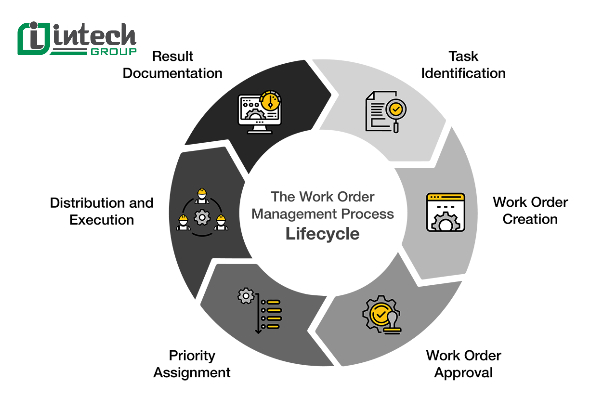
Concepts to distinguish from Work Order
- Planned Order: It is a forecast, created based on forecast demand. Meanwhile, Work Order is an official order to deploy production.
- Production Order: Usually includes many smaller Work Orders, showing detailed production stages.
- Manufacturing Order (MO): Is a general production order, different from Work Order which focuses on more detailed steps, especially in complex production environments with large product quantities.
The importance of Work Order in production management
To better understand what Work Order is, we need to look at the key role that this tool brings in production management. A production order not only helps start the process but also serves as a foundation for businesses to control, optimize and improve the efficiency of all operations in the factory. Here are the important roles of Work Order:Concepts to distinguish from Work Order
- Planned Order: It is a forecast, created based on forecast demand. Meanwhile, Work Order is an official order to deploy production.
- Production Order: Usually includes many smaller Work Orders, showing detailed production stages.
- Manufacturing Order (MO): Is a general production order, different from Work Order which focuses on more detailed steps, especially in complex production environments with large product quantities.
The importance of Work Order in production management
To better understand what Work Order is, we need to look at the key role that this tool brings in production management. A production order not only helps start the process but also serves as a foundation for businesses to control, optimize and improve the efficiency of all operations in the factory. Here are the important roles of Work Order:
- Control production progress: Work Order details the production plan into specific tasks with clear start and end times. Thanks to that, managers can monitor the progress of each stage, promptly detect delays and propose adjustment solutions to ensure the plan is completed on time.
- Effective resource management: In each production order, Work Order lists in detail the necessary materials, labor and machinery. This information helps managers allocate resources optimally, avoid waste and ensure that there is no shortage or surplus.
- Calculate production costs accurately: Work Order specifically tracks costs of materials, labor, equipment, etc., from which businesses can accurately calculate production costs for each shipment, serving financial management and optimizing product costs.
- Improve labor productivity: Work Order implementation helps standardize the production process, minimize errors and limit downtime between stages. As a result, labor productivity is significantly improved, while maximizing the efficiency of machinery and personnel use.
- Improve product quality: Each Work Order requires stages to be performed in accordance with standard processes and quality standards. This helps minimize defective products, increase the rate of meeting standards and improve customer satisfaction.
- Provide detailed reporting data: Information from production orders is an important source of data for analysis, reporting and process improvement. This data helps managers make accurate and timely decisions, thereby improving production management efficiency in the long term.

Components of a Work Order
A standard Work Order usually includes the following components:
- Product information: Clearly state the product name, product code (SKU), quantity to be produced and unit. This is the core element to accurately determine the target of the production order and avoid confusion during the implementation process.
- Raw materials: List of input materials with full information such as name, material code, quantity and unit to help control consumption rates, optimize inventory management and ensure that there is no shortage of raw materials during the production process.
- Production process: Details of stages, technical requirements, technical drawings (if any) to guide workers and technicians to follow the correct process. This part plays an important role in standardizing production and maintaining product quality.
- Completion time: Determining the start and end dates helps track actual progress against the plan, while supporting the optimization of production schedules, avoiding order delays.
- Participating personnel: Information about supervisors, workers and departments in charge. This is the basis for clearly assigning tasks, evaluating the productivity and responsibility of each individual or group.
- Machinery and equipment: List of machinery and equipment codes used in the production order. Managing this information helps ensure the reasonable allocation of machinery resources, while supporting maintenance and monitoring of equipment performance (OEE).
Work Order implementation process in production
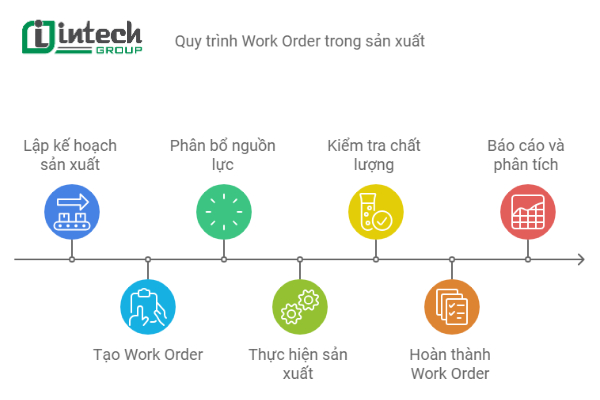
In fact, a Work Order is a series of logical steps, closely connected from the planning stage until the product is completed. Below are the steps in the Work Order implementation process in production:
Step 1. Production planning
Based on market demand, sales forecasts or customer orders, a production plan needs to be developed. This plan helps to clearly identify the quantity of products to be produced, the completion time, as well as the resources needed to meet the schedule.
Step 2. Create Work Order
After the plan is approved, the operations department proceeds to create a Work Order. Each Work Order is associated with a specific production batch, including full information about the product, raw materials, production process, implementation time, personnel and machinery needed to be used.
Step 3. Resource allocation
Raw materials are prepared and stocked in a timely manner, workers are assigned according to their capacity, and machinery is checked and maintained to ensure stable operation throughout the entire production process.
Step 4. Production Execution
When all resources are ready, the production process begins according to the instructions in the Work Order. Workers need to strictly follow the process and quality standards. In case of changes, the Work Order will be updated to ensure accuracy and consistency.
Step 5. Quality Control
In each stage, quality control activities are conducted regularly to detect and promptly correct errors. This helps ensure the quality of the output product meets the standards.
Step 6. Completion of the Work Order
After the production stages are completed, the product is inspected one last time before being put into the warehouse. When the product meets the requirements, the Work Order is considered complete.
Step 7. Reporting and Analysis
Data from the Work Order will be aggregated to report and analyze production efficiency. This is an important source of information to help businesses evaluate productivity, optimize resources and improve production processes in the future.
Summary of effective maintenance work order methods
Summary of effective maintenance work order methods
A well-written maintenance work order not only helps to minimize errors but also improves efficiency, shortens time and optimizes costs. Here are 9 important ways to write an effective maintenance work order:
- Requester information: The name, department and contact information of the requester should be clearly stated. This makes it easy for the maintenance department to exchange, confirm information and grasp the status of the incident.
- Approver information: Having someone approve the Work Order ensures accountability, while also facilitating resource allocation and reasonable maintenance scheduling.
- Detailed description of the equipment: Provide complete information about the equipment, including code number, installation location and current status. This is important data to help technicians quickly identify the equipment that needs maintenance.
- Step-by-step instructions: An effective maintenance work order should include detailed instructions on how to perform the task, even a checklist. This helps the work to be carried out correctly and reduces the risk of omission.

- Priority: Clearly define the urgency of the work (high, medium, low) to manage time and allocate human resources appropriately.
- Material and tool list: List the materials, spare parts and tools needed to avoid interruptions during maintenance.
- Illustrations: Adding pictures, diagrams or technical drawings will help technicians visualize the exact condition of the equipment and how to handle it.
- Relevant dates: Clearly state the date the Work Order was created, the expected completion date and have space to update the actual completion date. This helps manage progress and store data effectively.
- Safety notes: Always emphasize the safety measures that need to be followed during maintenance. This is an important factor to protect technicians as well as the working environment.
The above is the information INTECH shares with you to help you better understand what a Work Order is, its importance, components, implementation process as well as tips for writing an effective maintenance Work Order. Hopefully, the article will provide you with useful knowledge to apply in production practice, towards a modern and sustainable management process. For any questions, please contact hotline 0966.966.032 - 0983.113.387 for advice and support.
