


AGV Robots - Smart Transportation Solutions for Modern Factories
20-08-2025 444
AGV (Automated Guided Vehicle) is one of the leading advanced technologies in the field of automation, used to transport goods without direct human intervention.
With the ability to move precisely and safely in many working environments, AGV robots are becoming a powerful assistant for factories, warehouses, distribution centers and logistics systems.
In the following article, Intech Group will help you learn in detail about AGV self-propelled vehicles, operating principles, popular types and outstanding benefits that this solution brings to businesses.
Robot tự hành AGV vận chuyển hàng hóa
Meaning of AGV robot/ AGV self-propelled vehicle
AGV self-propelled vehicle English name: Automated Guided Vehicle is a type of unmanned robot that moves along a pre-programmed route, using modern guidance technologies such as magnetic strips, lasers or GPS positioning systems. Operated by lithium batteries and integrated with safety protection mechanisms, AGV robots are capable of stable, durable operation and are suitable for many different production environments.
In smart warehouses, AGV self-propelled vehicles play an important role in transporting materials, products, pallets, boxes or packages from one area to another. AGV applications help businesses optimize production and logistics operations by automating transportation, thereby reducing labor costs, limiting errors, increasing safety and improving productivity.
.jpg)
Structure of AGV self-propelled vehicles
AGV robot vehicles are designed with many important components, helping robots operate stably, accurately and safely in production environments, warehouses and smart warehouses. Below are the main components:
Vehicle - Vehicle frame structure
AGV frames are made to be sturdy and durable to withstand large loads and maintain stability when transporting goods. This structure often uses high-quality steel or alloys to increase durability and longevity.
Software - Control software
The server software is the "brain" that controls the operation of AGV self-propelled vehicles, ensuring smooth movement, avoiding congestion and optimizing routes. The system can automatically allocate tasks to multiple vehicles at the same time.
Central controller
Programmed to control AGVs to operate independently or in groups, this controller can also connect to the control center to receive commands and optimize operating performance.
Wireless Communication
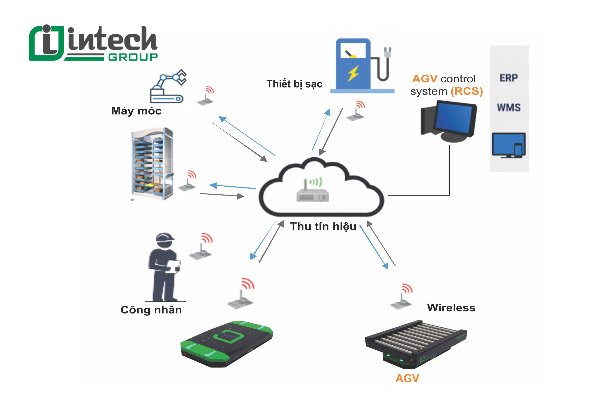
AGVs use technologies such as RF or Wifi to connect to warehouse management systems (WMS), manufacturing management systems (MES) or enterprise resource planning (ERP) systems. This allows robots to exchange data, receive tasks and report on operating status in real time.
User Interface
Allows movement requests to be managed, alarms to be handled, performance analysis reports to be generated and operations to be adjusted to improve overall productivity.
Battery / Charger
AGVs typically use batteries such as lead-acid, NiCad, lithium-ion or induction power. Batteries can be charged manually or automatically at wireless charging stations.
Data Transmitter
Helps AGVs exchange information with control centers and other devices. This system allows operators to monitor status, adjust routes and manage operational efficiency.
Cargo Connector
This is the connecting mechanism for AGV to attach or detach the cart, operate automatically or manually, suitable for diverse transportation needs.
Operating principle of AGV
AGV operates based on the smooth coordination of many component systems, to ensure the ability to move accurately, safely and efficiently in smart warehouses or production environments. AGV robots usually include the following 5 core elements.
Positioning system
The system helps AGV autonomous vehicles determine their location and move along the programmed route. Depending on the application, AGV can use navigation technologies such as lasers, magnetic strips, wires or GPS. This system processes location, speed and direction data so that the robot moves accurately to the destination.
Safety system
AGV are powered by batteries, which can be lithium-ion or lead-acid, depending on the operating requirements. The batteries are designed to be fast-charging and flexible, allowing the vehicle to operate continuously during the shift.
Motion System
Including the motor, wheels, lifting mechanism or hydraulic system, allowing the AGV to not only move but also perform loading, unloading, lifting and transporting of goods.
Vehicle Controller
AGV robot are controlled by PLCs (programmable logic controllers), which receive commands from the warehouse management system (WMS) or MES. This controller processes information, commands the moving parts and synchronizes with other automated systems in the warehouse.
What types of AGV autonomous robots are there?
Each type of autonomous vehicle is designed with its own features and tasks, meeting different transportation, storage and production optimization needs. Below are the 3 most popular types of AGV autonomous robots today:
AGV trolley
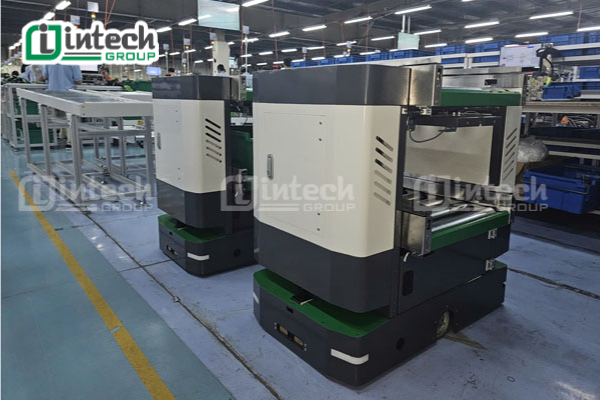
AGV trolleys are the most basic type of autonomous vehicles, equipped with navigation systems ranging from simple ones like magnetic tapes to advanced navigation technology using AI sensors, which can transport a variety of goods, from small components to large-load pallets. AGV trolleys often appear in sorting, warehousing or assembly applications, where precision and continuity are required.
AGV forklifts
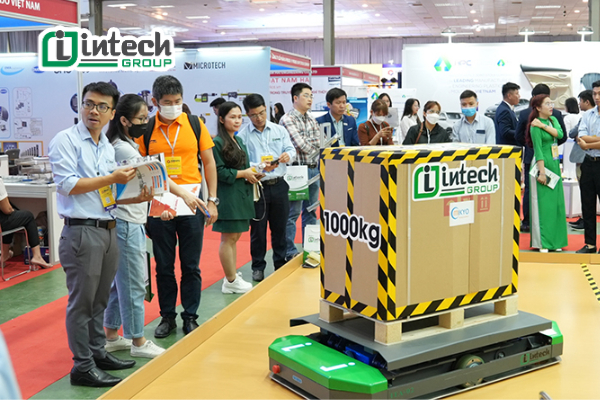
This is an automated version of the traditional forklift, allowing pallets to be moved and arranged without an operator. AGV forklifts are especially suitable for warehouses, distribution centers or manufacturing plants that need to load and unload heavy goods and store them on many high shelves.
AGV Tow Vehicles
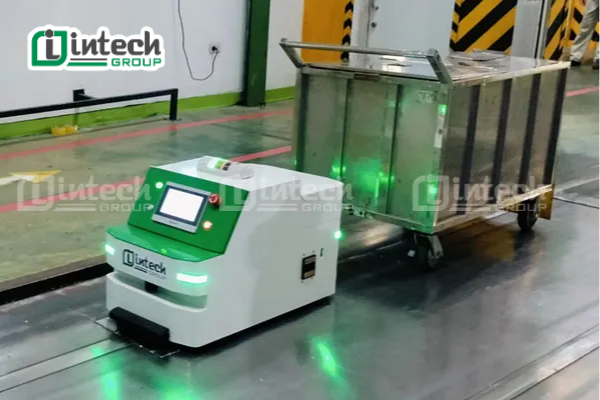
AGV tow vehicles are designed to pull one or more non-motorized trailers, transporting heavy goods over long distances within a factory or warehouse. This type of AGV operates on a fixed route, can stop at multiple points to deliver and receive goods, like a driverless freight train.
Understanding the types of AGV robots helps businesses choose the right automated transportation solution, thereby maximizing the significance of AGV robots in improving efficiency, reducing costs and optimizing the supply chain.
Applications of AGV robots in manufacturing and logistics
Replacing traditional methods such as forklifts, conveyor systems or manual carts, AGV robots help move large volumes of materials repeatedly in receiving and delivery areas and transport components to the assembly line. Some common applications of AGV robots:
Truck loading and unloading
AGV robots can replace the function of forklifts, automatically loading or unloading goods onto trucks without direct labor, reducing the risk of accidents and increasing the speed of goods handling.
Product storage and retrieval
AGV robots easily place products in storage locations or move goods to order fulfillment areas. This makes the process of replenishing goods on shelves or picking stations fast, accurate and safe.
Direct connection to the production center
AGV robots can transport heavy and bulky goods from the warehouse to the assembly line, especially suitable for industries such as automobiles, aviation or mechanical manufacturing.
Distributing materials and components
According to a predetermined route, AGV robots distribute goods, components and raw materials to each production area with the exact quantity, ensuring uninterrupted production progress.
Are AGV Robots Right for Your Business?
Before investing, you need to carefully evaluate whether AGV robots will benefit or hinder your operations. This requires weighing the pros (increased efficiency, reduced errors, safety) and cons (investment costs, maintenance, flexibility). Factors to consider before deploying AGV robots:
-
Business cycle: The level of repeatability and stability of the operating process.
-
Operational goals: Increase productivity, reduce costs or expand scale.
-
Growth potential: AGVs are more suitable for models with large and stable output.
-
Investment capital: Ensure the ability to pay for the cost of purchasing, integrating and maintaining.
Intech provides AGV robot alternatives
Not every business is suitable for applying AGV self-propelled saws. If your operational needs are not compatible with AGV robots, Intech Group suggests alternative solutions that optimize efficiency and cost.
Conveyor System
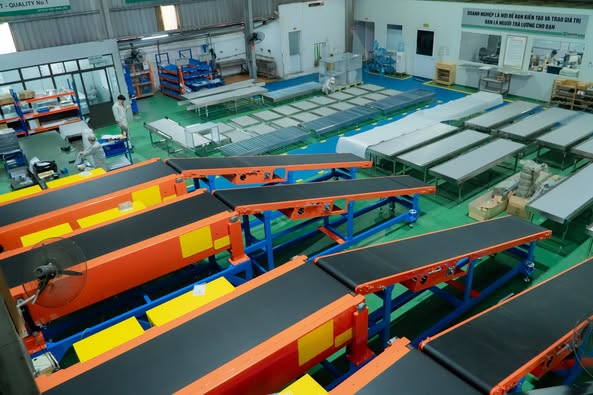
Conveyors are a solution for transporting goods continuously along fixed routes, suitable for production environments with stable material flow. This is the ideal choice when you want to handle large volumes of goods at high speeds, but lack flexibility when changing processes.
Automated Storage and Retrieval System (AS/RS)
AS/RS uses an automated mechanism to move goods into and out of storage locations in a warehouse. This system helps optimize space, increase accuracy and speed of order processing. However, the initial investment cost and installation requirements can be high.
Overhead Trolley System
This solution uses trolleys running on rails suspended above to transport goods. The advantage is that it saves floor space, suitable for warehouses with limited space or need to keep the floor clear.
Autonomous Mobile Robot (AMR)
Among the alternatives, AMR (Autonomous Mobile Robot) is considered the most similar to AGV robots in terms of use. The big difference is that AGVs move along a fixed, programmed route, while AMRs can self-orient themselves thanks to a system of sensors, maps and intelligent algorithms.Điều này cho phép AMR hoạt động linh hoạt hơn để:
-
This allows AMR to operate more flexibly to:
-
Transport inventory between warehouse areas.
-
Support order picking and packing processes.
-
Quickly classify products and inventory.
-
Improve inventory management and visualization.
With many years of experience in the field of automation, Intech Group is ready to advise, design and deploy the optimal AGV robot system for your business. Contact us now via hotline 0966.966.032 - 0983.113.387.
