


AI applications in factories
Why are AI & Machine learning important for manufacturing?
Producing a product can be very expensive when it comes to manufacturing defects and non-conformities or stops and production is a complex process for businesses that don't have the right tools and resources to develop quality products.In the prevailing age artificial intelligence and machine learning have become more common in the production and assembly of items, which reduces costs and production times.In fact, 40% of all potential value that can be generated by analytics today comes from AI and Machine Learning techniques.In which Machine Learning may account for from 3.5 trillion to 5.8 trillion VND in annual value - according to Mckinsey's forecast.
The key point is, the leading growth strategies involve integrating machine learning platforms that generate insights to improve product quality and manufacturing productivity.Machine Learning helps create smarter manufacturing, where robots can place their items with detailed precision, analytics can identify upcoming scenarios, and automated processes can develop error-free outputs.

The amount of data is increasing day by day, so manufacturing enterprises need to take advantage of smarter solutions to make their entire process efficient and scalable.Data helps a lot in terms of automating processes and even predicting and monitoring machine performance.Core algorithms developed through machine learning and AI-enabled products will be a major digital transformation for manufacturers.In general, the industrial manufacturing industry will be willing to develop complex design processes with more sophisticated prototypes.
Data collected from products and processes will be fed into an ML model to further improve the manufacturing process through a Digital Twin continuous feedback loop. In the future, there will be a range of robots and machines that will transform industrial activities, production forces will need to be replenished to work with newly developed equipment, while traditional machines will require makeup to match the industry. Getting accurate actionable insights requires a significant amount of data in real time to understand anomalies before the system fails. Machine Learning is a key element of Predictive Maintenance by identifying, tracking, and analyzing critical system variables in the manufacturing process. Through ML, operators can be warned before the system fails and in some cases without management interaction and avoid costly unplanned downtime.
Data collected from products and processes will be fed into an ML model to further improve the manufacturing process through a Digital Twin continuous feedback loop. In the future, there will be a range of robots and machines that will transform industrial activities, production forces will need to be replenished to work with newly developed equipment, while traditional machines will require makeup to match the industry. Getting accurate actionable insights requires a significant amount of data in real time to understand anomalies before the system fails. Machine Learning is a key element of Predictive Maintenance by identifying, tracking, and analyzing critical system variables in the manufacturing process. Through ML, operators can be warned before the system fails and in some cases without management interaction and avoid costly unplanned downtime.
Overall production process improvement
 |
One of the first things that comes to mind when thinking about AI&ML-based solutions is how they can service day-to-day processes throughout the entire production cycle.Using this technology, manufacturers can detect all kinds of problems on their conventional production methods, from bottlenecks to unprofitable production lines.
By combining machine learning tools with the Internet of Things, companies are taking a deeper look at their logistics, inventory, assets, and chain management.This provides valuable insights, uncovering potential opportunities not only in the manufacturing process but also in packaging and distribution.
A great example of this can be found in Germany's Siemens, which has used neural networks to monitor its steel plants for potential problems that could affect their steel plants.its effectiveness.Through a combination of sensors installed in its equipment and with the support of its own intelligent cloud (called Mindsphere), Siemens is able to monitor, record and analyze every steprelated to the production process.This dynamic is what some call Industry 4.0, a trademark of the age of smarter manufacturing.
 |
New product development
One of the most widely adopted applications of machine learning involves the product development phase.That's because the design and planning stages of new products, and improvements to existing ones, involve a wealth of information that must be considered in order to yield the best results.
As a result, ML solutions can help collect consumer data and analyze it to understand current needs, potential needs, and develop new business opportunities. All of this ends up in better products from the existing catalog as well as new ones that can open up new revenue streams for the company. Machine learning is particularly good at mitigating the risks associated with developing new products, as the insights it provides to the planning stage for better decisions than Coca Cola, one of largest brand in the world, is using Machine Learning to develop products. In fact, the launch of Cherry Sprite is the result of the company's use of ML. The company used interactive soda dispensers where customers could add different flavors to the catalog's base drinks. Coca Cola collected the resulting data and used Machine Learning to identify the most frequent combinations. The result was the discovery of a market large enough to introduce a new beverage across the country.
Production quality control
When used well, Machine Learning can improve final product quality by up to 35%, especially in discrete manufacturing industries.There are two ways ML can do this.First and foremost, find anomalies in products and their packaging.Through in-depth inspection of manufactured products, companies can prevent defective products from reaching the market.In fact, there are studies that speak of up to 90% improvement in defect detection when compared to human inspection.
And then there is the possible improvement in the quality of the manufacturing process.Through loT devices and ML applications, enterprises can analyze the availability and performance of all equipment used in the production process.This enables predictive maintenance, estimating the best time to engage specific equipment to extend its life and avoid costly downtime.
General Electric is one of the biggest investors in the quality control division, especially in everything related to predictive maintenance.It has created and deployed its ML-based tools in more than 100,000 assets across its business units and customers, including the aerospace, power generation, and transportation industries.Its systems work to detect early warning signs of abnormalities in its production line and provide prognosis for long-term estimates of behavior and life.
Minimizing device failures
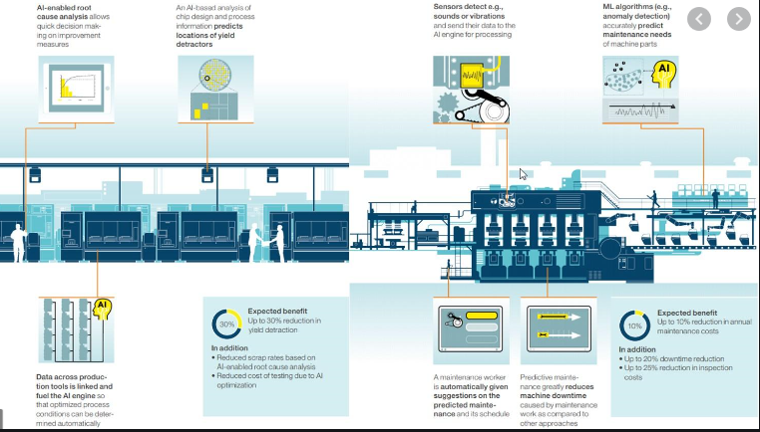 |
- Determining when to perform equipment maintenance is a particularly difficult task with huge stakes.Each time the machine is brought in for maintenance, it is idle and may even require a factory downtime until it is repaired.Frequent repairs mean losses, and infrequent maintenance can lead to even more costly breakdowns.The global cost of equipment downtime alone adds up to $647 billion annually.Look at it another way: The average international cost of said downtime is $5,600 per minute.
- With those costs in mind, it's no surprise that preventing even an unplanned outage can pay for the cost of implementing machine learning.How does machine learning reduce these losses, exactly?
- Machine learning algorithms are great at balancing multiple data sources to predict and determine optimal repair times.This can be done simply by identifying errors and failures as they occur so that they are dealt with immediately - not just once a human discovers them later.
- Additionally, machine learning algorithms use historical data to identify equipment failure patterns, helping them determine when routine maintenance is required.Data can also be retrieved automatically from within the device, eliminating the need for manual checks.Increased speed and efficiency - plus reduced staffing costs - translates to significant ROI for most companies, but the biggest gains come from a change in the way maintenance is conducted.
Predictive Maintenance with Machine Learning
Maintenance costs account for a significant portion of all manufacturing costs.For this reason, predictive maintenance has become a common goal among manufacturers, drawn by its many benefits including significantly reducing the impact of six major losses.While certain manufacturers do perform predictive maintenance, this is typically done using established SCADA systems with thresholds, alarm rules, and coded human configurations.
This semi-manual approach does not take into account more complex dynamic patterns of machine behavior, or contextual data related to the manufacturing process in general.For example, a sensor on a production machine may suddenly increase in temperature.In contrast, Machine Learning algorithms are fed OT data (from production layer: sensors, PLC, Historian, SCADA), IT data (contextual data: ERP, quality, MES, etc.)and production process information that describes the synchronization between machines and production flow rates.
In industrial AI, the process is known as online training, which allows ML algorithms to detect anomalies and check for correlations in the gas looking for patterns across different feeds.The strength of Machine Leaming lies in its ability to analyze huge amounts of data in real time and suggest actionable responses to problems that may arise.The health and behavior of every asset and system is continuously assessed, component degradation is identified before failure, and insights are visualized on a digital twin.
 |
Robots
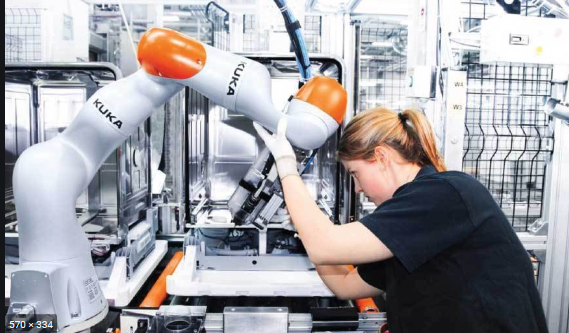
Some of the most famous collaborators for manufacturers getting smarter with machine learning: robots.The use of artificial intelligence in robots allows them to take on routine tasks that are complex or dangerous for humans.These new robots surpass the assembly lines they were previously relegated to, as their ML capabilities allow them to tackle more complex processes than before.
That's exactly what KUKA, a German and Chinese manufacturing company, is aiming for with its industrial robots.Its goal is to create robots that can work alongside humans and act as their cobots.And in that sense, the company is developing its robot - LBR Íiwa.This smart robot is equipped with high-performance sensors that allow it to perform complex tasks while working alongside humans and learning how to improve their productivity.BMW, the famous car brand, is one of its biggest customers and one of the businesses that has discovered that robots can reduce human errors, increase productivity and increase value.throughout the production chain.
