


Factors to Consider When Choosing a Self-Driving Car Battery
03-09-2025 48
Automating the process of dismantling batteries for autonomous vehicles offers a breakthrough solution to the complex and dangerous challenges of handling these batteries. By integrating force control technology, machine learning, and virtual reality, modern robotic systems are capable of performing operations more precisely, safely, and efficiently. This is not only an important step forward for the recycling industry, but also contributes to reducing costs, optimizing resources, and protecting the environment sustainably.
Introduction to Autonomous Robots, Autonomous Guided Vehicles (AGVs)
AGVs (Autonomous Guided Vehicles) are autonomous vehicles designed to transport goods or materials in a specific environment without direct human control. AGVs play an important role in automating transportation and logistics processes in factories, warehouses, distribution centers, and manufacturing facilities.

Outstanding features of AGV robot
Self-direction
AGVs use modern technologies such as sensors, computers, and positioning systems to determine their own travel routes in the working environment.
Automatic operation
AGVs operate completely automatically without human intervention. They can move, turn, stop, and perform tasks according to programming.
Multi-tasking capability
AGVs are programmed to perform a variety of functions such as transporting goods, arranging warehouses, inventory, and other logistics tasks.
Integrated safety system
Sensors and safety systems help AGVs avoid collisions with obstacles, workers, and other equipment in the working environment.
Integrated automatic management system
AGVs are often connected to warehouse management systems (WMS) to optimize operating time and efficiency.
Flexible and diverse design
AGV sizes and designs are customized according to usage needs, meeting diverse applications in production and logistics.
Flexibility and scalability
AGV systems can be easily upgraded or adjusted to meet changing operational requirements, suitable for the evolving working environment.
With outstanding advantages, AGV is gradually becoming the optimal solution for automation, helping businesses save costs, improve efficiency and ensure safety in production.
Batteries / Batteries for Autonomous Robots, Autonomous Guided Vehicles (AGVs)
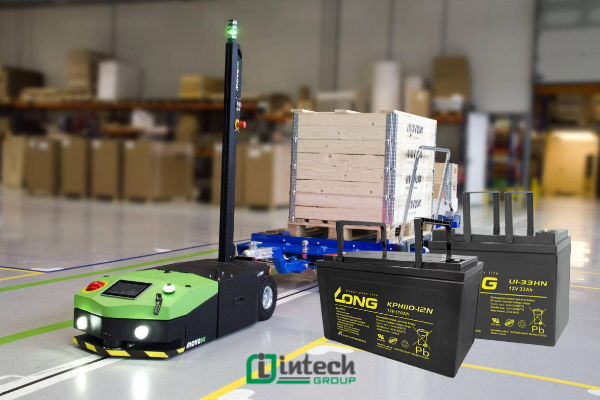
Batteries or batteries are the main source of energy to ensure the operation of AGVs. With the nature of continuous movement and high performance requirements, AGVs often use DC power sources that can provide enough energy for the entire working shift.
Energy Source Options
Currently, dry batteries and lithium batteries (LiFePO4) are the two most popular types. Each type has its own advantages and disadvantages, suitable for different requirements:
- Dry batteries: Low cost, suitable for applications that do not require high charging speed and life.
- Lithium battery (LiFePO4): Outstanding advantages in capacity, life, fast charging ability, and safety, make this type of battery increasingly widely used in AGV systems.
Factors to consider when choosing a battery for an AGV
Voltage
The battery voltage must be compatible with the charging source and the requirements of the AGV. This is an important factor to ensure stability and performance.
Capacity
The battery capacity determines the continuous operating time of the vehicle. Depending on the usage needs, choose a capacity large enough to meet the working time in a shift.
Size and weight
The battery must be suitable for the installation space in the vehicle design. Weight also affects the mobility and operating performance of the AGV.
Life and durability
Choose a battery with a long life to reduce maintenance and replacement costs. Prioritize products from reputable manufacturers to ensure reliability.
Charging speed
AGVs often require fast charging times to ensure uninterrupted operation. Lithium batteries with fast charging capabilities are ideal.
Safety and environmental friendliness
Prioritize batteries with safety features such as explosion-proof, leak-proof, and meeting environmental protection standards.
Performance
Consider the performance of the battery under operating conditions such as uphill/downhill, high temperature, or humid environment to ensure stable vehicle operation.
Cost
Consider the initial investment cost and long-term maintenance cost to choose a solution that fits your budget.
Batteries and batteries are not only a source of energy but also greatly affect the performance, durability, and operating costs of AGVs. Choosing the right type of battery or battery to suit your requirements will help optimize the operating efficiency of the autonomous system, while improving the overall productivity of the business.
EV Growth and EV Battery Recycling Trends
EV Growth
2023 marks a milestone as US EV sales surpass 1 million for the first time, with 1.2 million users choosing EVs. The share of EVs in the US auto market is 7.6%, up 1.7% from 2022. VinFast also recorded a breakthrough with 34,855 EVs sold globally, up 471% year-on-year.
Although EV sales have recently shown signs of slowing down, the industry is still forecast to grow by an average of 18% per year. This strong growth highlights the important role of battery supply in meeting growing demand.
Why is EV battery recycling necessary?
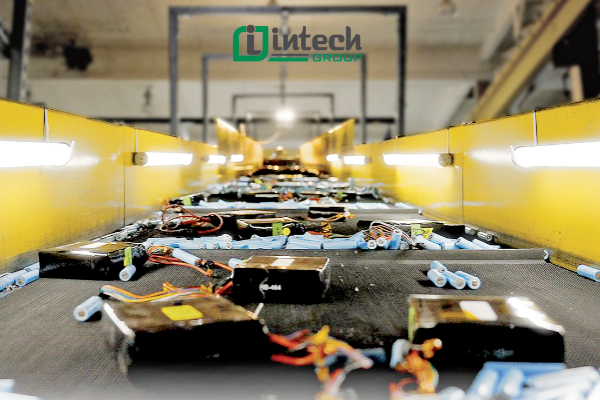
In the context of insufficient supply of raw materials, EV battery recycling is becoming a potential business. The EV battery recycling market in 2022 reached a value of 2.3 billion USD and is expected to grow at a rate of 27% per year, reaching 9.8 billion USD by 2028.
Lithium supply crisis
Lithium for AGVs, considered the “white gold” of the EV battery industry, is scarce, pushing businesses into a race to find supplies. On average, each electric vehicle requires about 8kg of Lithium.
Environmental impact
Lithium-ion batteries, the main component in electric vehicles, contain toxic compounds such as nickel, cobalt, and lithium. When improperly disposed of, they pollute land, water and emit greenhouse gases. Each gigawatt-hour of battery production emits approximately 20,000-30,000 tons of CO2.
Dependent on imported materials
The US currently does not have enough minerals and raw materials to produce EV batteries without importing them. However, recycling can reduce this dependence, making effective use of used resources.
Benefits of EV battery recycling
EV battery recycling breaks down old batteries to recover raw materials such as lithium, cobalt, and nickel. The recycling process does not change the chemical structure of the material, bringing many benefits:
- Reduced production costs: Recycled materials can be used directly, saving costs.
- Increased material efficiency: Improve resource efficiency, reduce waste.
- Limit pollution: Reduce chemical waste and greenhouse gases.
- Stabilize the supply chain: Reduce the risk of dependence on imported raw materials.
With the rapid growth of the electric vehicle industry, developing EV battery recycling solutions not only helps solve the raw material crisis but also protects the environment and promotes long-term sustainability. Recycling is an important key for the electric vehicle industry to develop rapidly in the future.
Difficulties in the process of dismantling electric vehicle batteries
1. The complexity of electric vehicle batteries
Electric vehicle batteries are complex products, including many parts that need to be disassembled such as the electrical system, cooling system, battery controller and individual battery modules. The process of disassembling a battery module requires many detailed steps, from removing the wire connector, battery protection circuit, module bolts, module cover, to removing individual battery components and cutting battery tabs.
2. High cost and manual nature
Currently, the dismantling of electric vehicle batteries is completely manual, accounting for 33% of the cost of battery recycling. The increasing complexity of future battery designs makes disassembly more difficult.
3. Challenges for autonomous robots
While automation is a goal for manufacturers, battery disassembly presents many challenges that robots have difficulty handling. Electric vehicle batteries come in a variety of shapes, sizes, and assembly techniques. In addition, the risk of fire due to short circuits requires highly precise and reliable autonomous systems that include complex manipulation capabilities, tactile feedback, and spatial awareness.
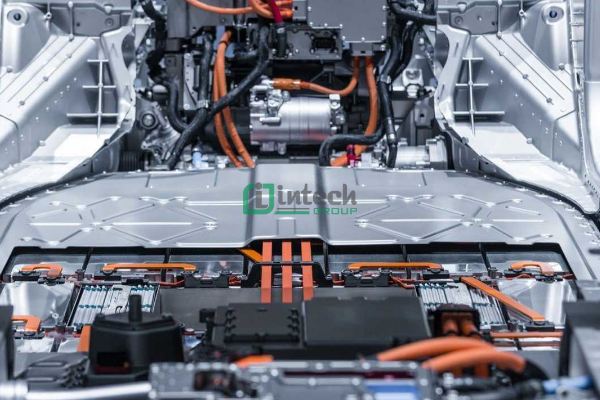
Automation – Solutions for Electric Vehicle Battery Disassembly
According to the University of Chicago's Institute for Computing Machinery: "Battery disassembly is not like simple pick-and-place operations. This work requires a combination of precise motion and force feedback, which is difficult for standard industrial robots to perform."
1. Applying modern technology
Current automation solutions have begun to integrate many advanced technologies:
-
Force Control: Helps robots perform complex disassembly operations.
-
Virtual Reality (VR) and 3D Sensors: Support increased accuracy and spatial awareness.
-
Machine Learning and Human-Machine Collaboration: Robots learn how to perform complex operations from humans.
-
Telerobotics: Allows robots to be operated remotely, minimizing direct risks to workers.
2. Developing Automation Technology
Argonne researchers are developing advanced remote operation technology that combines augmented reality and robotics. A "virtualized device" is created in the operator interface, which simplifies and increases the accuracy of remote operations.
The system integrates the robot's autonomous behavior with manual commands, bringing higher efficiency to the dismantling process. These technologies have been successfully applied in nuclear facilities and have great potential in dismantling electric vehicle batteries.
Machine Learning Applications in Robot Programming
Argonne has developed a robot programming method based on machine learning. The process includes:
- Observing human skills: A skilled technician performs specific dismantling operations.
- Extracting data: Sensors and feedback devices collect motion information, while vision systems provide spatial data.
- Simulation and adjustment: The robot learns from the technician's actions and adjusts itself as it performs.
This method is not only applicable to the dismantling of nuclear facilities but also suitable for the dismantling of electric vehicle batteries.

Electric vehicle battery disassembly is a major challenge, but advances in automation, machine learning and virtual reality are opening up potential solutions. These systems not only reduce costs and risks but also increase efficiency and scalability, creating a solid foundation for the battery recycling industry in the future. Intech Group specializes in providing automation systems, smart warehouses combined with autonomous robots for large and small factories. Customers who need survey and consultation, please contact Hotline 0966.966.032 or 0986.448. 456 for consulting support.
