


What is Metaverse? Things to know about virtual worlds and virtual technology
09-10-2025 59
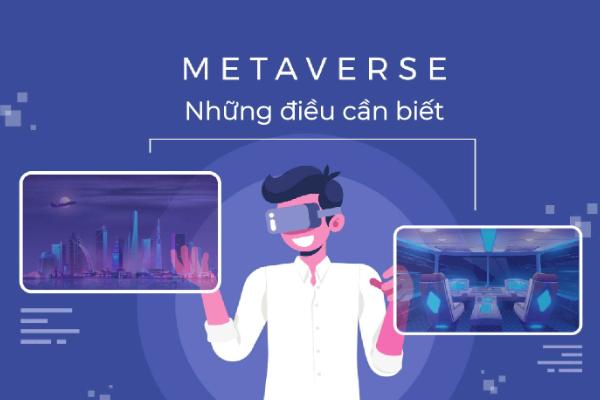
Metaverse is a virtual space built with virtual reality (VR) and augmented reality (AR) technology, where people can interact, work, play and create in a vivid digital environment. This is not just a technology trend but also opens the door to a new world where the boundary between reality and virtuality is increasingly narrowed.
1. Definition of Metaverse
Metaverse is a digital space that combines social media, online games, augmented reality (AR), virtual reality (VR), the Internet, and cryptocurrencies. Metaverse allows users to interact, experience, and participate in virtual worlds through technological devices.
Different from the current digital experience, Metaverse offers a multi-dimensional interactive space. Users do not simply view or browse content but are also immersed and directly participate in the virtual world. This is a perfect combination of the real and virtual worlds, opening up unlimited experience opportunities for users.
2. Metaverse explosion event
Metaverse really exploded in October 2021 when Facebook officially changed its name to Meta to affirm the company's commitment to the Metaverse vision.
At the Connect 2021 conference on October 28, 2021, Mark Zuckerberg – CEO of Meta, announced an ambitious vision for Metaverse. He emphasized that Metaverse will be a breakthrough in the way we communicate, work and entertain.
"In the future, you will be able to teleport as a hologram to your office, attend a concert with your friends or chat in your parents' living room without leaving home," Zuckerberg wrote in the "2021 Founder's Letter".
Metaverse promises to completely change the way people interact with technology. Instead of being confined to a computer screen or smartphone, users can experience a more realistic virtual world full of activities:
- Meet friends and family.
- Study and work remotely.
- Attend virtual events, such as concerts or exhibitions.
- Shop and create content.
- Discover new experiences like never before.
3. What is the origin and characteristics of Metaverse?
3.1 Origin of Metaverse
The term Metaverse comes from the science fiction novel "Snow Crash" by writer Neil Stephenson published in 1992. In this work, Stephenson used Metaverse to describe a virtual universe that is an upgraded version of the Internet.
In the novel, Metaverse is built as a world parallel to real life, where users can:
- Restructure the value system and social norms.
- Free themselves from the economic and cultural rigidity of the real world.
Thanks to its groundbreaking idea, the term Metaverse has been adopted by modern technology experts and developed into a new and potential technology trend.

3.2 Features of Metaverse
Metaverse is built on a modern technology platform and possesses many outstanding features such as:
Immersion - Level of realism
Immersion refers to the ability of Metaverse to reproduce the real world. The higher the level of realism, the more vivid and real-life the user's experience in the virtual space is. This is the core element that helps Metaverse create a feeling of complete immersion for users.
Openness - Openness
Metaverse allows users to connect or disconnect from the virtual space at any time. In particular, Metaverse is an open space without limits, encouraging participants to create content and build virtual worlds according to their ideas.
Sustainability - Sustainability
Metaverse is continuously maintained based on the Internet platform and advanced technologies such as:
- Artificial Intelligence (AI).
- Blockchain.
The Metaverse ecosystem operates independently and is capable of continuous development, even without user interaction. This ensures the sustainability and longevity of the virtual space.
Economic System - Economic System
Metaverse builds an economic system parallel to the real world. Users can:
- Trade assets between the virtual world and real life.
- Accumulate and increase asset value through platforms such as cryptocurrencies and NFTs.
In particular, thanks to the development of decentralized finance based on Blockchain, users can conduct transactions safely and transparently.
4. Some technological terms about Metaverse
4.1 Overview of technological terms related to Metaverse
Metaverse is an extended concept, covering many different technologies that are gradually being applied to life. Currently, some technological terms about Metaverse are often used interchangeably. Many real-world experiences combine different versions of the virtual world and the real world.
For example, Horizon Office requires the use of an Oculus Quest 2 headset to join a virtual meeting, but colleagues without the device can still join via regular video conferencing.

4.2 Technological Terms in Metaverse
Here are some common technological terms related to Metaverse:
Assisted Reality
Assisted reality is a technology that allows users to view a screen and perform hands-free control to interact with the screen.
For example, Realwear devices are a typical practical application of this technology, often used in technical support jobs.
Augmented Reality (AR)
AR uses the real world as a foundation and applies computer vision simulation technologies to real spaces to create new interactive experiences.
For example, retailers use AR to help customers visualize what a sofa will look like in their living room.
Mixed Reality (MR)
MR combines the real world and virtual objects. These virtual objects are capable of interacting and acting like real objects, allowing users to experience a space that combines reality and virtuality.
For example, users can interact with both physical and virtual objects in the same environment.
Meatspace – Real World
Meatspace is a term that refers to the real physical world, where people spend most of their time living and working. This is the opposite concept of the virtual world.
Multiverse – Multiverse
Multiverse refers to many separate virtual universes that operate independently of each other. Currently, Internet technology, video games and social networks have created many “universes” such as: Facebook, Instagram, Twitch, Roblox, Fortnite, Minecraft and Discord.
Integration capabilities in Metaverse: In theory, Metaverse will connect all of these “universes” together, giving users a seamless experience in digital space.
Virtual Reality (VR) – Virtual Reality
VR provides a completely immersive experience in a virtual space. To participate, users need to use VR headsets to immerse themselves in simulated environments.
For example, VR games take players to virtual worlds or simulated training sessions that take place in real-life environments.
5. Is Metaverse the same as virtual reality technology?
Metaverse and virtual reality (VR) are often confused with each other, but in fact, they are not the same.
According to investor Matthew Ball, comparing Metaverse to virtual reality is like considering the mobile Internet as a single application. He emphasized: “Metaverse is a broad concept, similar to how the iPhone and the app store marked a turning point in the mobile Internet.”
Matthew Ball also pointed out that: The mobile Internet has existed for the past 15 years, but has only just entered a period of strong development thanks to the core technologies gradually becoming complete.
Metaverse is also at a similar point, when technologies such as VR, AR, Blockchain and Artificial Intelligence (AI) are increasingly developed, turning experiences that seem like science fiction into reality.
Metaverse is not simply virtual reality technology but also an expanding technology ecosystem, integrating many new technologies such as AR, MR, and Blockchain. Terms such as Assisted Reality, Mixed Reality or Multiverse help us visualize more clearly the development potential of Metaverse in the future.
Understanding these concepts will help businesses and individuals seize opportunities from Metaverse, preparing for major changes in the digital age.
6. Companies Building Metaverse Around the World
Metaverse is predicted to be the next step in the evolution of the Internet, requiring huge technological infrastructure, from computing power, 3D graphics to financial and commercial systems. Because of this huge potential, the world's leading technology companies are all working hard to build and develop Metaverse.
The top 10 technology stocks leading the development of Metaverse include:
- Nvidia Corporation
- Microsoft Corporation
- Roblox Corp.
- Facebook Inc. (now Meta Inc.)
- Unity Software Inc.
- Snap Inc.
- Autodesk Inc.
- Amazon.com Inc.
- Tencent Holdings Ltd.
- Sea Ltd.
In addition to the above “big guys”, many other technology corporations are also actively participating in the race to build Metaverse such as:
- Apple, Intel, Qualcomm, Alphabet (Google)
- Coinbase, Electronic Arts (EA), Samsung, Adobe
- Alibaba, Disney, PayPal and Square

7. Applications of Metaverse in practice
Metaverse is not just a theory but is being strongly applied in many different fields, creating a huge impact on the economy and society.
Metaverse application in 3D interactive experience
Metaverse allows people to meet and hold online meetings in 3D space through augmented reality (AR) and virtual reality (VR) tools.
Effectiveness: Improve the ability to express emotions, create an experience similar to a face-to-face meeting, which is difficult to do with conventional video calls.
For example:
Business meetings can use 3D whiteboards or 3D models to sketch ideas and edit visually.
In online education and training, Metaverse breaks down geographical barriers and is the optimal solution when social distancing occurs.
Applications in art
Metaverse opens up new opportunities for artists and content creators:
- Art performances, 3D painting exhibitions or online chats will become as vivid and realistic as in real life. Street artists or sculptors can deploy digital artworks on the Metaverse platform with high fidelity.
- Advertising and commerce also benefit greatly: Brands can build their brands and introduce products through realistic 3D models, helping consumers experience the products without having to go to the store.
Applications in electronic entertainment
Metaverse is revolutionizing the electronic entertainment industry with games that allow users to interact with the virtual world as if it were real.
AR-VR devices such as virtual reality glasses have created realistic and vivid 3D experiences, bringing players to infinite programmed spaces.
For example: Games like Roblox, Fortnite, and Minecraft are clear evidence of the potential of Metaverse in this field.
Space exploration and future life reconstruction
Metaverse also opens up a further vision in simulating living environments:
- Recreate living spaces on other planets or modern environments in the future, based on scientific and technological research.
- Benefits: Expanding user experiences and supporting scientific research with accurate simulation.
- For example: Based on the Metaverse model, people can experience life on Mars or other harsh environments.
Metaverse is gradually becoming a reality with the participation of large technology corporations around the world such as Meta, Microsoft, Nvidia, and Amazon. Not only limited to the entertainment field, Metaverse also creates breakthroughs in education, art, and scientific research, bringing a deeper and more realistic interactive experience than ever before.
Understanding and applying Metaverse will help businesses and individuals stay ahead of the curve, optimizing competitive advantage in the new digital age.

8. Potential Metaverse Projects in the Future
Metaverse is not only a technology trend but also a large ecosystem that opens up countless opportunities for economic and social development. Based on the current applications and future prospects of Metaverse, potential projects focus on the following main areas:
Development of entertainment applications and highly realistic 3D games
3D entertainment and virtual reality games (Immersive Entertainment) are the most potential development direction of Metaverse.
NFT games and Blockchain-based projects have proven their economic value through the Play-to-Earn model. Players can own, exchange digital assets and convert them to real value.
For example, Axie Infinity, Decentraland and Sandbox have opened a new wave in the global gaming industry.
Future: With the combination of AI, VR and Blockchain, games in Metaverse will bring more realistic experiences and the ability to earn sustainable income.
Improve the quality of education and training
Metaverse opens up huge potential for the field of education and training:
- Visual simulation: Create virtual learning environments that help students experience knowledge vividly.
- Skill training: Simulate work processes, experiments or career training without being limited by space and time.
For example:
- Medicine: Students can practice on virtual anatomical models.
- Engineering: Train engineers with 3D models of machinery and construction.
Promote and market products based on virtual space
Businesses can take advantage of Metaverse to effectively promote and introduce products:
- Virtual space: Build virtual showrooms to help customers experience real products without having to go to the store.
- AI, IoT, Big Data Applications: Analyze user behavior and customize experiences in the Metaverse space.
For example: Luxury fashion brands have successfully tested displaying products through virtual worlds, attracting the attention of many consumers.
Metaverse and Blockchain are creating a virtual economic ecosystem where users can:
- Work, earn money and trade digital assets.
- Convert value from the virtual world to real-world assets.
Potential: Blockchain ensures transparency and security for transactions in the Metaverse, paving the way for the development of digital asset markets such as NFTs.

9. Metaverse Projects in Vietnam
In Vietnam, Metaverse is still new but has recorded developments in areas such as:
- Online games: NFT games like Axie Infinity have affirmed their position in the international market.
- Advertising and marketing: Many businesses are applying Meta (Facebook) virtual platforms to build promotional campaigns and enhance customer experience.
Vietnam has the advantage of young technology human resources, the ability to quickly adapt to new trends. Great opportunities in developing core technology platforms such as AI, IoT and Blockchain to serve the Metaverse ecosystem.
Conclusion
Metaverse is a big step forward in digital technology, opening up many opportunities in the fields of entertainment, education and digital economy. However, the development of Metaverse still depends on platform technologies such as AI, VR, Blockchain and Big Data.
In Vietnam, Metaverse projects are in the early stages but have shown strong growth potential. To be ready for the Metaverse era, investing in creative ideas and core technology is key. Ultimately, no matter how much technology develops, the core value still lies in creativity, new perspectives and people's feelings about life.
See more:
