


What is PLC? Working principle and advice when choosing PLC equipment
03-10-2025 437
In the context of modern industrialization, the emergence of PLC (Programmable Logic Controller) has marked an important turning point in the field of automatic control. PLC not only changes the way control systems are designed, but also improves efficiency and accuracy in production.
So what is PLC, what is its structure and how is it applied? The following article Intech Group will help you better understand this programmable control device.
What is PLC?
PLC (short for Programmable Logic Controller) is a programmable control device used to implement logic control algorithms through programming language. Thanks to its flexible programming capabilities, PLC can perform a series of sequential actions, triggered by input signals from sensors or from conditional factors such as periodic time.
In fact, PLC is often used to replace traditional relay control systems, helping to save space, increase accuracy and ease maintenance and expansion.

Detailed structure of PLC
1. Hardware structure of PLC
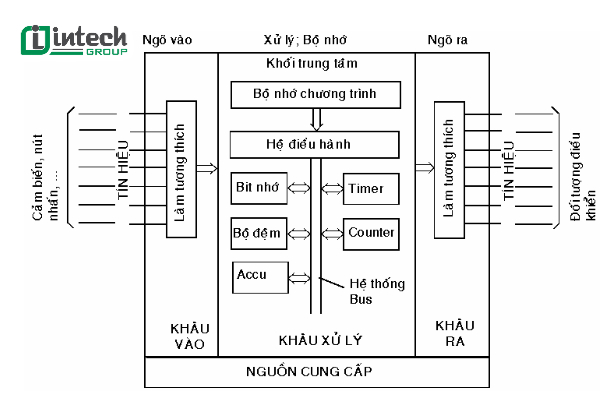
PLC programming controller is made up of many main parts, including:
Central processing unit (CPU)
CPU acts as the "brain" of PLC, responsible for processing all programs and control commands. CPU will perform outputs based on data collected from input signals of the system.
Input/Output Module (I/O Module)
Input Module: Connects PLC to peripheral devices such as sensors, switches, push buttons, etc. to collect data on operating status such as temperature, pressure, speed, flow, etc.
Output Module: Converts control signals from the CPU into digital or analog signals to control output devices such as motors, valves, indicator lights, etc.
Power Supply
The power supply converts AC voltage from the grid into stable DC voltage, providing the necessary energy for the CPU and I/O modules to operate efficiently, continuously and safely.
Programming Device
A device used to connect and program the PLC, usually a computer with specialized software installed by the manufacturer, allowing users to load, modify, and test the control program.
2. PLC programming software
PLC programming software is an indispensable tool in the process of setting up system operations. Each PLC manufacturer develops its own software platform, but the most popular programming methods today include:
Ladder programming language (Ladder Logic)
Ladder Logic is a graphical programming language that simulates traditional electronic relay control diagrams. Operations such as sequence control, timing, measurement, calculation, etc. can all be easily performed through virtual contacts and coils corresponding to memory and I/O pins.
Structured Text language
Structured Text is a text-based programming language with syntax similar to high-level programming languages such as C++, Python or Visual Basic. Structured Text can also be integrated with other languages to build powerful functional blocks.
Function Block Diagram Language
Input data is entered into the function blocks, when meeting the pre-programmed conditions, the system will output the corresponding output control signal. Standard function blocks include: counters, timers, mathematical functions (maximum, minimum, average, ...).
PLC working principle
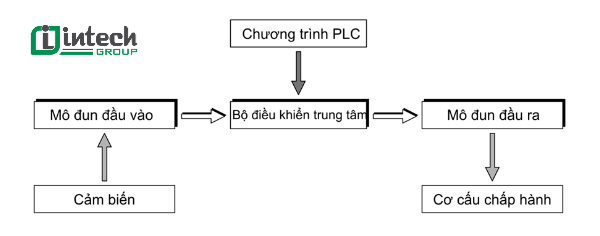
The working principle of PLC (Programmable Logic Controller) is based on a cyclical cycle consisting of three basic steps:
Input status monitoring: PLC continuously collects signals from input devices such as sensors, switches, or digital/analog signals.
Control program processing: Based on the pre-programmed program, PLC processes input data through logic, mathematical functions or control conditions.
Updating and executing output: After processing, PLC sends control signals to output devices such as motors, indicator lights, pneumatic valves, ...
1. Scan Cycle
Each PLC operates in a repeating cycle called the scan cycle. In this cycle, the CPU will perform the following sequence:
- Read and record all input status.
- Process the control program from top to bottom, from left to right.
- Update the control signal to the output after completing the processing.
2. Scan Time
Scan time is the total time required for the PLC to complete a full loop (input → processing → output). This time is usually measured in milliseconds (ms). The shorter the scan time, the faster and more accurately the PLC can respond to system changes. If the scan time is too long compared to the rate of change of the production process, the system may operate inefficiently or have control errors.
3. Memory and storage capabilities
PLC stores all input and output states in its internal memory. In addition, it also stores the control program, intermediate variables, calculation formulas and analog signal values.
The role of PLC in modern production
PLC (Programmable Logic Controller) is a programmable control device that plays a key role in the field of industrial automation
1. Automate production processes and control equipment
PLC systems process signals from input devices and control output devices in real time:
- Input devices: Including sensors, switches, thermometers, relays... used to measure parameters such as temperature, pressure, speed.
- Central processing: PLC will compare input signals with pre-programmed logic condition programs.
- Output devices: When the conditions meet the requirements, PLC sends signals to control devices such as valves, motors, conveyors, indicator light systems, HMI...
Practical example: When the pressure sensor detects that it exceeds the threshold, PLC will immediately send a command to open the relief valve to reduce pressure, helping the system return to a safe state without human intervention.
In addition, PLC is also used to:
- Turn on/off the conveyor belt automatically according to the production cycle.
- Adjust the temperature through the heat exchanger.
- Activate the alarm on the HMI when detecting abnormal parameters.

2. SCADA Connection
Another indispensable role of PLC in modern manufacturing is the ability to connect to SCADA (Supervisory Control and Data Acquisition) systems or production management systems (MMS).
PLC collects data: From equipment and production lines such as speed, quantity, operating status...
SCADA processes and displays: Indicators such as overall OEE performance, trend charts, error warnings, and output reports are presented visually.
Make quick decisions: Visual data helps managers monitor equipment status, detect problems early, make timely decisions to optimize performance and minimize costs.
Integrating PLC and SCADA not only improves monitoring and analysis capabilities, but also contributes to shortening machine downtime, minimizing errors and improving operating quality.
3. Platform for IIoT and Machine Learning in Manufacturing
In the era of Industry 4.0, technologies such as IIoT (Industrial Internet of Things) and Machine Learning are increasingly widely applied in smart manufacturing.
IIoT allows connecting many industrial devices over the network to collect data synchronously.
Machine Learning uses data from PLC to learn, recognize patterns and make intelligent predictions.
Thanks to the data provided by PLC, the system can:
- Predict when equipment maintenance is needed (Predictive Maintenance).
- Analyze the cause of errors and provide optimal solutions.
- Recommend actions to improve productivity and quality.
Tips for choosing the right PLC for manufacturing businesses
Choosing the right PLC (Programmable Logic Controller) is an important step to ensure the performance, stability and scalability of the production system. With so many different product lines on the market, choosing the right PLC depends not only on the brand but also on the actual operating needs.
1. Determine the purpose of use
First, the business needs to determine the purpose of purchasing the PLC:
- If for replacement or backup: Based on the technical information printed on the label of the current PLC device, including the model, electrical parameters and number of I/O. Do not forget to back up the entire old program to ensure that the system restart is not interrupted.
- If for installing a new system: Need to clarify the technical requirements and scale of the production line. At this time, the business needs to choose a PLC with the ability to expand modules, suitable memory and features to accurately meet production needs.
2. Analyze the system structure
Understanding the system structure helps to choose the right PLC, avoiding redundant or missing functions:
- Determine the number of input/output (I/O): Including digital signals, analog signals and special signals (if any). From there, choose the CPU and corresponding expansion modules.
- Requirements for connection to HMI or peripheral devices: Choose a PLC with an extended communication port such as Ethernet, RS232, RS485 or support protocols such as Modbus, Profibus, etc.
- Memory and storage capacity: Depending on the complexity of the control program, choose a PLC with enough memory to smoothly handle logic tasks.

3. Consider power requirements
This is a very important factor, affecting the stability and life of the device:
- Load capacity: Determine the power required to operate the entire control system.
- PLC input voltage: Can be 24VDC or 220VAC - need to ensure compatibility with the existing electrical system.
Output voltage and current: Choose a PLC with parameters suitable for control devices such as motors, relays, electric valves...
4. Evaluate the processing speed of the PLC
Processing speed is a factor that needs to be considered when the system needs to respond quickly:
- Does the machine system operate at high or low speeds?
- Does it require encoder pulse counting or high-speed signal processing?
- Does logic processing time affect product quality?
For systems that require real-time response, it is necessary to choose a PLC with fast processing, low latency and interrupt support.
5. Consider the operating interface
The human operator interface (HMI) is an indispensable tool in modern control systems. Depending on the requirements, businesses can choose:
- Traditional interface: Includes push buttons, indicator lights, simple LED screens.
- Modern HMI interface: Allows displaying machine status, error warnings, part numbers, production processes in real time. In addition, it also supports data entry and direct operation via the touch screen.
The combination of PLC and HMI enhances monitoring and control capabilities - especially important in automated production lines.
Choosing the right PLC for your production system helps your business ensure stable operation, save maintenance costs and increase automation efficiency. Carefully consider the factors of purpose of use, system structure, power requirements, processing speed and operating interface before making a decision.
If your business needs advice on choosing the right PLC, please leave your contact information to receive detailed and optimal support from experts.
See more related content:
