


AI Helps Revolutionize Warehouse Coordination
07-09-2026 75
Artificial intelligence (AI) is reshaping the entire logistics landscape by transforming warehouse systems from a state of passive reaction to one of proactive, real-time optimization.
Entering 2026, delivery speed and inventory data accuracy have become a "vital weapon" for every logistics and retail enterprise in Vietnam. If your warehouse is still operating traditional ways, you are very likely facing three tough challenges:
-
A messy warehouse? You are wasting hours of your staff's time every day.
-
Inaccurate manual forecasting? Stagnant inventory, buried capital, and wasted money.
-
Manual picking/delivery routing? Your business is falling far behind competitors in the market.
It is time to put an end to that waste. The boom of Artificial Intelligence (AI) in 2026 is the "golden key" turning chaotic data into intelligent, absolutely precise operational decisions.
.jpg)
The Agility of the Warehousing Industry
The modern logistics environment is no longer a story of robots or humans alone, but a symbiosis. The biggest challenge today is ensuring that Autonomous Mobile Robots (AMRs), fixed conveyor/crane systems, and workers can collaborate seamlessly without disruption.
This collaboration also validates the successful transformation of traditional businesses from pure robot hardware manufacturers into independent software and artificial intelligence powerhouses.
Core Capabilities of an End-to-End Integrated System
By applying artificial intelligence to warehouse management, the new solution delivers four game-changing core capabilities:
-
Unifying all entities: Perfect synchronization between fixed automation technology, mobile robots (AMRs), and human workflows from the warehouse floor to retail points.
-
Expanding the software ecosystem: Enhancing the orchestration capabilities of existing Dematic software and optimizing real-time data flow.
-
Hardware independence: Allowing businesses the freedom to select, expand, or switch robot and machinery types from various vendors without fear of system conflicts.
-
AI-driven decision optimization: Elevating performance and visual monitoring over complex order fulfillment processes.
Popular AI Technologies in Warehouse Management Systems
Entering 2026, the boundary between traditional automation and smart warehousing is becoming increasingly distinct. While legacy systems operated strictly on fixed programmed scenarios, next-generation AI-integrated warehouse management systems can analyze real-world environments, autonomously understand warehouse layouts, and dynamically adjust behaviors as supply chain demands fluctuate continuously.
Below are the three AI technology pillars serving as the "backbone" in modern warehouse management systems.
1. Machine Learning
No longer limited to static statistics, Machine Learning acts as the central forecasting hub of the warehouse.
-
Accurate demand forecasting: Machine Learning deeply analyzes layers of historical data (sales fluctuations, demand cycles, seasonality) combined with real-time market trends to deliver inventory forecasts with superior accuracy.
-
Space optimization: The system automatically categorizes SKUs and calculates optimal slotting locations based on turnover frequency, minimizing travel distance within the warehouse.
2. Computer Vision – Automated Monitoring and Quality Control
Thanks to the rapid development of recognition algorithms and high-resolution cameras, Computer Vision has transformed standard surveillance cameras into diligent auditors.
-
Digitizing inventory auditing: Automatically recognizing and counting products via cameras or sensors as soon as goods pass through warehouse gates, eliminating manual barcode scanning.
-
Real-time Quality Assurance (QA): Instantly detecting dents, packaging damage, or identifying packaging errors before shipments are dispatched.
3. Robotics AI: The Generation of Agile Mobile Robots
The evolution from Automated Guided Vehicles (AGVs following fixed paths) to Autonomous Mobile Robots (AMRs) is the clearest testament to the power of AI in the warehouse robotics segment.
-
Swarm coordination: Under AI orchestration, robots no longer operate in isolation but coordinate seamlessly to divide tasks ranging from picking, transport, and sorting to packaging support.
-
Autonomous navigation: Instead of relying on magnetic tape or floor lines, AI-integrated robots self-locate, map the warehouse, and proactively evade obstacles safely.
The Future of Automation is "Freedom of Choice"
The future of automation lies in flexibility. AI applications provide customers with the capability to orchestrate all robots, systems, and personnel through a single AI-powered layer. This translates to higher productivity, smarter decisions, and the freedom to scale their robot fleets on their own terms.
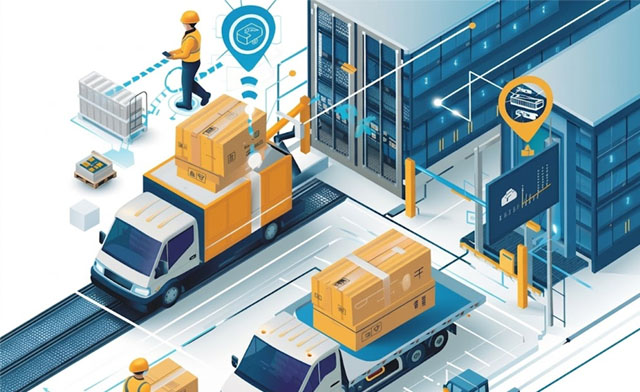
Insight from technology experts: For businesses struggling with fragmented investments across disparate robot systems, this unified solution is the "golden key" to optimizing operational costs and preparing for complex omnichannel retail models in the future.
Real-World Example of AI Application in Warehouse Management
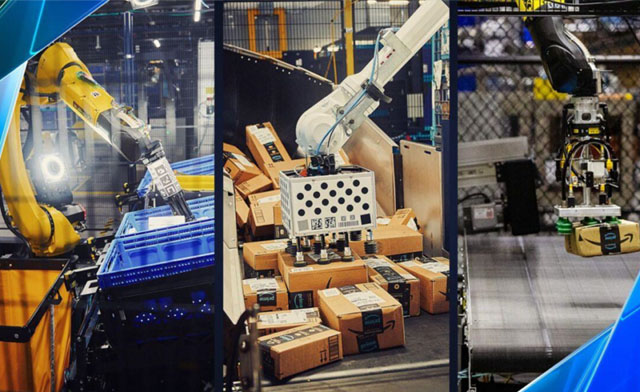
At Amazon's most advanced fulfillment centers, Sparrow—a smart robotic arm—is taking center stage. Unlike traditional industrial robots running on rigid programs, Sparrow possesses "divine vision" powered by advanced Computer Vision combined with AI.
This AI robotic arm boasts extraordinary capabilities:
-
Limitless recognition: Automatically identifying and analyzing the shapes, sizes, and materials of millions of distinct products.
-
Precision pick and place: Automatically sorting and picking items from dynamic storage totes without requiring prior human pre-sorting.
-
Swarm collaboration: Coordinating seamlessly in real time with smart conveyor systems and autonomous mobile robots (AMRs) throughout the warehouse.
Amazon Has Leveraged AI to Analyze Customer Behavior
The power of Amazon's AI lies not only in its hardware (Robotics) but also in its software (Predictive Algorithms). By analyzing purchasing behavior, real-time consumer trends, and seasonal factors, AI can accurately predict which items will be "hot" in specific regions.
From there, the system automatically redistributes goods to satellite warehouses closest to customers before orders are finalized. This data-driven approach helps:
-
Minimize delivery times to the absolute lowest levels (measured in hours).
-
Optimize warehouse fill rates and reduce unnecessary holding costs.
