


Smart Warehouse Solutions for the E-commerce Industry
07-09-2026 62
Smart automated warehouse systems are no longer merely a technological option; they have become a prerequisite for optimizing operating costs and elevating a business’s standing within the global supply chain.
In the era of the E-commerce boom, the race for market share is no longer confined to marketing strategies; warehouse processing speed has been prioritized at the top by many businesses. The exponential growth of online transactions, coupled with the pressure for express delivery, is forcing traditional warehouse management models into a passive position when facing labor shortages, missed defective items, and wasted dead space. At this point, the Smart Automated Warehouse System is no longer just a technological choice, but has become a prerequisite condition to optimize operational costs and elevate a business's standing in the global supply chain.
By deeply integrating smart equipment—from autonomous AGV/AMR robots and high-speed sorting conveyor systems to Manufacturing Execution Systems / Warehouse Management Systems (MES/WMS)—how can enterprises master digitized data and achieve breakthrough productivity? Let us solve the dedicated smart warehouse challenge for the E-commerce industry in the detailed article below.
1. Challenges in E-Commerce Warehouse Management
Entering the 2026 landscape, where delivery speed, data explosion, and facility costs dictate business survival, these challenges need to be clarified with real-world, deeply technical pain points:
Pressure from Personalization Trends and Ultra-Complex SKU Management
The rapid growth of Direct-to-Consumer (D2C) transactions and personalized shopping trends have pushed Stock Keeping Unit (SKU) quantities to grow exponentially. Fragmented storage that is inconsistent in size and shape easily plunges traditional warehouses into a "space crisis," creating logistics bottlenecks. Relying solely on lean manual labor for inventory counting prevents businesses from tracking inventory data in real time. This directly leads to severe discrepancies between the displayed quantities on E-commerce platforms and actual warehouse stock, causing overselling or mass order cancellations.
The "Ultra-Fast Delivery" Race
In reality, customer expectations no longer stop at same-day delivery, but have shifted toward express delivery within a few hours. In the e-commerce sector, the order fulfillment phase is the core factor determining competitive advantage.

The delivery time challenge lies in the biggest bottleneck: manual picking, sorting, and end-of-line packaging processes. When orders pour in heavily during Flash Sale hours, staff constantly moving between the wide aisles of traditional racking systems to locate items slows down order processing speeds, extends dispatch lead times, and increases error rates, directly damaging brand reputation.
>> Explore now: The Pallet Shuttle system (including heavy-duty racking systems, guide rails, and automated Shuttle robots for lifting/lowering pallets) is best applied in downstream segments of E-commerce warehouses and Central Distribution Centers. For items with a low SKU count but extremely high inventory volume per SKU (e.g., diapers, milk, beverages, cosmetics, etc.), goods are stored as full pallets at high density using Pallet Shuttles for broken-case picking areas.
.jpg)
Challenges of Operational Costs and the ROI Problem
As industrial real estate becomes increasingly expensive, lease/purchase costs for warehousing have turned into a massive financial burden. To accommodate massive inventory volumes, horizontal warehouse expansion is no longer an economically viable option. Many businesses attempting aisle expansion for forklifts and manual handling labor end up severely wasting vertical overhead space. Companies face a tough dilemma: How to minimize real estate costs and liberate lean workforces while maintaining 24/7 operational productivity and heading toward a sustainable "Green" supply chain.
2. Smart Warehouse Solutions for E-Commerce Warehouses
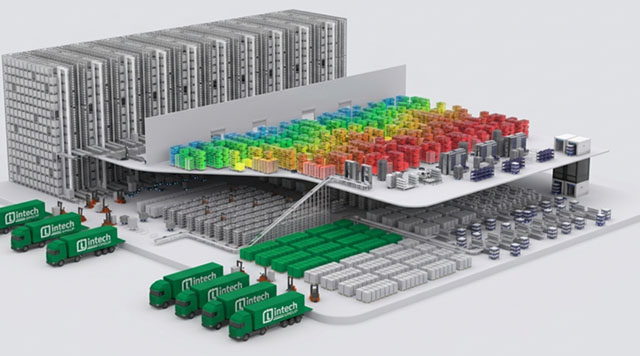
Optimizing an E-commerce Warehouse requires a synchronized ecosystem combining management software and automated hardware equipment. In this year's logistics landscape, with fulfillment speeds and real estate cost pressures reaching fierce levels, the technologies mentioned act as the "golden key" to completely resolve bottlenecks. Below are detailed insights into each component and technology application specifically designed for E-commerce warehouses:
-
Warehouse Management System (WMS)
WMS warehouse management software acts as the "brain center," coordinating and controlling the entire material flow from receiving, sorting, and storage to end-of-line packaging and dispatch. Applied technologies and automation typically utilize Real-time Data, Location Optimization Algorithms, or WCS/WES middleware integration to translate digitized software commands into direct control instructions for Robots (AGV/AMR) and smart sensor conveyor systems.
-
Collaborative Robots (Cobots)
Unlike traditional industrial robots that must operate inside safety cages, warehouse Cobots are designed to work safely alongside lean warehouse personnel in Pick-and-Place, packaging, or palletizing stages.
Applied Technology & Warehouse Automation:
- Artificial Intelligence Vision (AI Vision Camera): Integrated smart industrial cameras help Cobots identify package shapes, orientation, dimensions, or apply labels with absolute precision, eliminating defective item leakage.
- Force and Collision Sensors: Automatically stop immediately upon detecting obstacles or human contact, ensuring maximum occupational safety.
- Flexible Articulated Joints: Allow delicate handling of fragile or sensitive items like electronic components or cosmetics without causing packaging deformation.
-
Automated Guided Vehicles (AGV or AMR Robots)
Robots completely replace traditional manual handling methods and human-driven forklifts that require wide aisle space. AGV/AMR vehicles liberate labor by automatically transporting Pallets or SKU racks continuously 24/7.
Applied Technology & Automation:
- SLAM Natural Navigation (LiDAR) & Laser: Enables robots to map out 3D facility layouts autonomously and determine the most optimal path without relying on fixed infrastructure.
- Magnetic Line Guidance with RFID Positioning: Ideal for fixed routes, offering high economic efficiency and absolute stability through continuous magnetic field sensors beneath the chassis.
-
Radio Frequency Identification (RFID)
In tech warehouses, radio frequency technology plays a vital role in smart warehouse digitization. Eliminating time-consuming manual item-by-item Barcode scanning, RFID enables accurate batch identification of item locations and status instantly as they pass through control gates.
Applied Technology & Automation:
- Smart RFID Chips & Location Tags: Embedded or affixed directly under warehouse floor surfaces or integrated into Pallets/totes, allowing AGVs and AS/RS systems to scan stop codes and turn angles automatically.
- Antennas & Radio Readers: Integrated at inbound/outbound gates, allowing real-time movement tracking of thousands of packages simultaneously without needing to orient code labels toward cameras.
-
Automated Storage and Retrieval System (AS/RS)
The AS/RS automated warehouse model is the ultimate high-speed, high-density storage solution for today's expensive industrial real estate. The system completely eliminates overhead dead space by utilizing high-density racking reaching close to the ceiling.
Warehouse Applied Technology:
- High-Speed Stacker Cranes or In-Rack Shuttle Robots: Move multi-directionally along precise mechanical guide rails to automatically locate and pick Pallets or plastic totes, retrieving them down to end-of-line connecting conveyors.
- Inverter Integration: Dynamically adjusts motor speed based on actual payload, allowing smooth acceleration/deceleration, preserving fragile product condition, and saving 20% to 40% in energy consumption.
-
Internet of Things (IoT)
In modern warehouses, the connected ecosystem turns all hardware devices into intelligent entities capable of continuous communication and data sharing.
Applied Technology & Automation:
- Smart Sensor Network: Obstacle, temperature/humidity, and pneumatic pressure sensors continuously gather floor-level operational data and send it to central controllers (PLC/MCU).
- Predictive Maintenance: IoT constantly monitors performance and mechanical wear levels of bearings, belts, and robot batteries. The system triggers warnings before breakdowns occur via Engineering Change Orders (ECO), preventing abrupt line stoppages.
-
Advanced Analytics Technology
An integrated deep analytics software platform (typically an advanced WMS/MES module) ensures precise inventory levels and optimizes inventory turnover across vast E-commerce SKU ranges.
Checkweigher Systems & Real-Time Monitoring Sensors: Positioned directly on sorting conveyor lines. As items pass through, the system automatically verifies actual weight against software data. In case of discrepancies (underweight/overweight), pneumatic cylinders immediately reject the item for manual inspection.
AI Quality Inspection Algorithms via AQL Statistical Standards: Replaces subjective manual sampling with objective, digitized data, automatically pushing quality reports to the operating system in real time.
Amidst the strong shift toward digitization, integrating these 7 components builds a high-speed, high-density automated warehouse model. While initial investment costs are higher than traditional warehousing, enterprises quickly achieve rapid ROI by cutting real estate lease expenses, optimizing 24/7 productivity, and professionalizing order packages before delivery to consumers.
3. Benefits of Building Smart Warehouse Solutions for E-Commerce Warehouses
In today's logistics environment—where SKU ranges are booming and hourly express delivery expectations have become standard—adopting technology is no longer just a cost optimization choice, but a core business survival strategy. Here are the key advantages when considering investment in a smart warehouse:
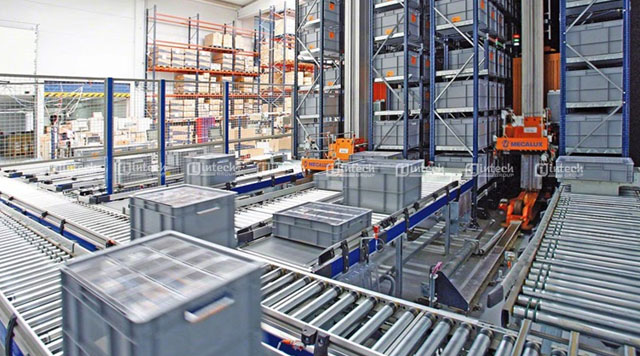
Warehouse model applying modern warehouse management technology
-
Increased Efficiency and Space Optimization
Traditional E-commerce warehouses rely on wide aisles for hand pallet jacks and manual handling, leading to massive overhead space waste. However, Smart Solutions utilizing high-speed, high-density storage models eliminate dead space. By fully tapping into ceiling height, companies optimize floor area, increase storage capacity by 2 to 3 times on the same footprint, and minimize rising industrial leasing costs.
-
Effective Inventory Management
Manually tracking tens of thousands of E-commerce SKUs of varying sizes and types during daily operations frequently causes inventory discrepancies, capital stagnation, or supply chain disruptions. Applying smart warehouse management solutions with automated inventory tracking integrated directly into management systems ensures total stock accuracy. Continuous digitized data optimizes inventory turnover, reduces dead stock rates, and frees up working capital for the enterprise.
-
Enhanced Data Accuracy
When warehouse components rely on paper records or manual data entry, human error, missed defects, and delayed updates create a disconnect between online sales platforms and physical stock. A smart operating warehouse identifies and tracks all material movements in real time. This completely eliminates human error, guaranteeing full transparency from receiving to dispatch.
-
Optimized Order Fulfillment and Delivery Processes
Operational Reality: End-of-line sorting and packaging often turn into critical bottlenecks when order surges hit simultaneously, slowing down Time-to-Market.
Smart Solution: The order fulfillment workflow is automated in a closed loop—from outbound command reception and automatic picking to mechanical routing along high-speed sorting conveyors. Packages are standardized and sealed flat and smooth, accelerating order processing speeds to effortlessly meet same-day or next-day delivery demands.
-
Increased Agility and Rapid Response
During Mega Sale campaigns (11.11, 12.12, etc.), order volumes can spike 10 to 20 times higher than usual, overwhelming lean workforces in traditional warehouses. However, a smart warehouse system featuring versatile automated equipment and robots can easily reconfigure control software to match changing packaging sizes and product types. The system stands ready for 24/7 continuous operation to clear order spikes without relying on urgent temporary hiring.
-
Enhanced Safety and Security
Automation technology combined with obstacle sensors and smart monitoring cameras establishes a safe, closed-loop operational workflow. Robotic equipment handles items gently yet securely, maintaining absolute accuracy and eliminating risks of mechanical impact damage or inventory loss.
-
Optimized Workforce Management
Automation positively transforms workforce structure, shifting human roles from heavy manual labor to system oversight. Implementation shows that a smart system can reduce direct operators from 3–4 workers down to just 1 supervisor, maximizing labor release for lean teams.
Operational reality in traditional e-commerce warehouses: Escalating labor costs combined with managing large manual workforces frequently lead to inconsistent productivity and workplace safety risks.
-
Data Analytics and Forecasting
Legacy warehouse management only records historical data without forecasting demand or bottleneck risks. Smart solutions combining Big Data analytics and Artificial Intelligence (AI) forecast material flow trends, provide early warnings for internal logistics bottlenecks, and automatically suggest optimal warehouse layout arrangements based on rotation frequencies of product groups.
RECOMMENDED LINES, TECHNOLOGIES, AND ROBOTS FOR E-COMMERCE WAREHOUSES
To realize these benefits, a modern E-commerce warehouse requires seamless coordination between management software and automated hardware equipment:

WMS Warehouse Management & MES Execution Software deeply connected to corporate ERP systems ensure real-time data synchronization and smart inbound/outbound scheduling.
AS/RS Automated Storage and Retrieval System: Uses high-speed automated storage robots within narrow, high-bay racking systems. This is the key solution for high-density storage of cartons or pallets in the E-commerce sector.
AGV/AMR Autonomous Vehicles: Fully replace traditional forklifts for internal transport. Magnetic line-following models with RFID positioning offer high cost-efficiency, while SLAM natural navigation (AI Vision + LiDAR) dynamically optimizes paths without causing warehouse congestion.
Automated Sorting Systems: Smart conveyor lines combined with high-speed diverters/sorters (such as Pop-up or Cross-belt sorters). The system automatically scans order barcodes and sorts items with high accuracy by geographic zone or courier unit (GHTK, GHN, Viettel Post, etc.).
Checkweigher & End-of-Line Packaging Conveyor System:
-
Checkweigher & Monitoring Sensors: Installed directly on conveyors to automatically verify order weights against software data. Any item excess or deficit triggers pneumatic cylinders for instant rejection, guaranteeing 100% outbound accuracy.
-
Case Sealers & Automatic Strapping Machines: Seal cartons smoothly without wrinkles and reinforce them with sturdy plastic strapping, handling thousands of packages per hour toward a "Green" and sustainable packaging process.
RFID Identification & AI Vision (Industrial Cameras): AI-powered industrial cameras act as "smart eyes," scanning batch orders simultaneously, auditing quality against objective AQL statistical standards, and automatically updating system reports.
Although initial investment in an automated smart warehouse ecosystem exceeds that of a traditional warehouse, E-commerce enterprises will rapidly achieve ROI within a few years through reduced real estate costs, optimized lean staffing, zero return error risks, and a drastically improved competitive position in the digital economy.
