


What Is a Two-Way Robot Shuttle?
23-10-2026 17
The Shuttle Two-Way is a semi-automated racking system that utilizes a robot capable of moving bi-directionally—forward and backward—along rails, thereby optimizing storage density without the need for forklifts to enter the racking structure.
Shuttle Two Way is a semi-automated racking system using a robot that moves back and forth on rails, helping to optimize storage density without requiring forklifts to go deep into the racks. With a standardized operating process flexibly coordinated via a remote control, this solution brings superior benefits: space maximization, efficiency enhancement, cost saving, absolute safety, and easy scalability.
Join Intech Group in detailed analysis of frequently asked questions regarding technical specifications, practical applications, and important considerations before making an investment decision!
What is a Shuttle Two Way Robot?
Shuttle Two Way is a specialized semi-automated robot researched and developed to transport pallets inside high-density storage racking systems. This device operates on the principle of moving forward and backward on dedicated rail systems to automate inbound and outbound operations within each rack lane.
Shuttle Two Way Robot Technical Specifications
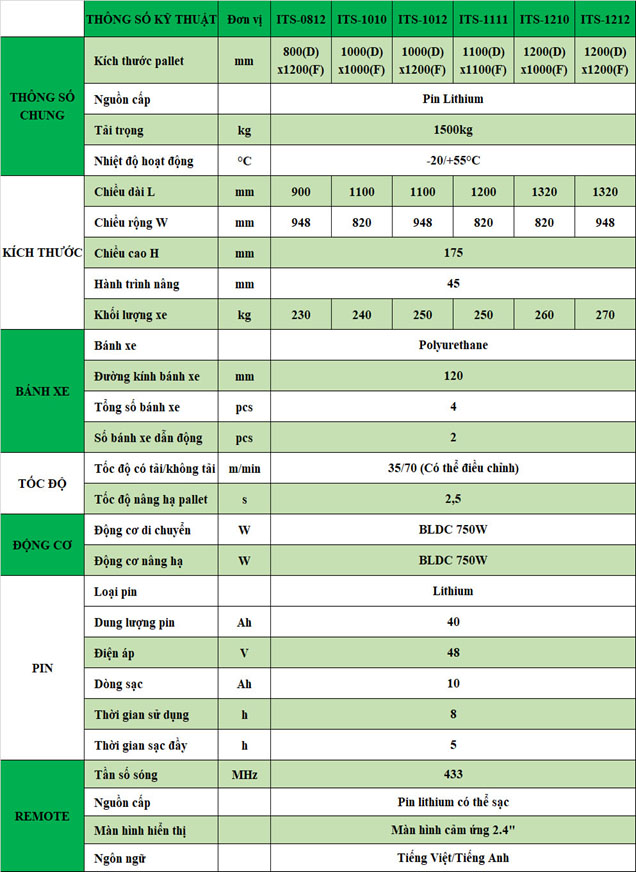
The technical specifications of the Shuttle Two Way Robot include various indicators such as: payload, speed, electrical and battery system, control, and lifting mechanism.
More specifically, the table below fully summarizes the technical specifications of the shuttle two way robot:
Shuttle Two Way Operating Principle
The Shuttle Two Way system operates based on smooth coordination between the forklift and the robot via a remote control. The core principle is to keep forklifts operating only at the lane entrance, while the robot handles all transportation of pallets deep inside the high-density storage racking system.
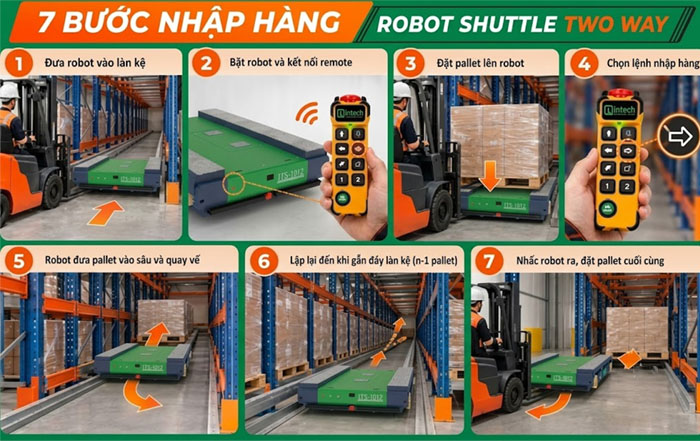
Inbound Process
-
Step 1 (Robot Positioning): The forklift moves and places the Shuttle robot at the exact entrance of the rack lane where the inbound operation needs to be performed.
-
Step 2 (System Startup): The operator turns on the Shuttle robot power and establishes signal connection with the remote control.
-
Step 3 (Placing Pallet onto Device): The forklift moves to the lane entrance position and places the cargo pallet directly onto the robot's surface.
-
Step 4 (Command Activation): The operator selects and activates the inbound command on the remote control device.
-
Step 5 (Robot Transport): The robot automatically lifts the pallet, moves forward/backward along the rails to take the pallet to the deepest empty position inside the rack lane, and then automatically returns to the lane entrance position.
-
Step 6: Continuously repeat operations from Step 4 to Step 5 until the rack lane is almost fully filled.
-
Step 7 (Placing the Final Pallet): When the rack lane has only 1 final position remaining, the operator runs the robot out to the lane entrance so the forklift can lift the robot out. Next, the forklift directly places this final pallet at the lane entrance position to complete filling the entire rack lane.
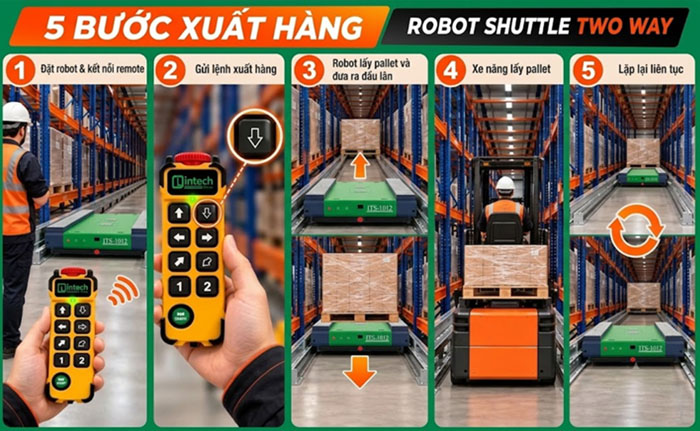
Outbound Principle:
-
Step 1 (Positioning & Connection): The operator places the Shuttle robot at the position of the rack lane to pick goods, then starts the device and establishes signal connection with the remote control.
-
Step 2 (Sending Outbound Command): The operator activates and sends the outbound command to the robot via remote.
-
Step 3 (Robot Retrieving Pallet): The Shuttle robot automatically moves deep inside the rack lane to the position of the required pallet. The robot lifts the pallet and moves backward out to the front of the rack row.
-
Step 4 (Forklift Receiving Goods): The forklift approaches the lane entrance position to lift the pallet just pushed out by the robot, then transports this pallet to the staging area or outbound area of the warehouse.
-
Step 5 (Repeating Process): The above operations are repeated continuously until the required quantity of goods per the order is retrieved.
The Shuttle Two Way system can be designed according to the LIFO (Last In, First Out - inbound and outbound at the same end) or FIFO (First In, First Out - inbound at one end, outbound at the opposite end) principle like all
