


Automation in textile production: Current status and growth solutions
01-09-2025 1153
Tự động hóa trong sản xuất dệt may đang trở thành xu hướng tất yếu khi ngành công nghiệp thời trang đối mặt với áp lực tối ưu chi phí, nâng cao năng suất và đáp ứng nhu cầu thị trường.
With the support of modern technologies such as industrial robots, automated production management systems and artificial intelligence (AI), the textile production process is gradually transforming from manual labor to smart operation. In the following article, Intech Group will provide complete information to help businesses have a clear direction and when investing in automation.
1. What is automation technology?
Automation in English: Automation Industry is the use of modern machinery and control systems such as software, computers, industrial robots, and automatic programming machines to operate electronic devices. When applying automation, the production system will operate automatically, minimizing human labor.
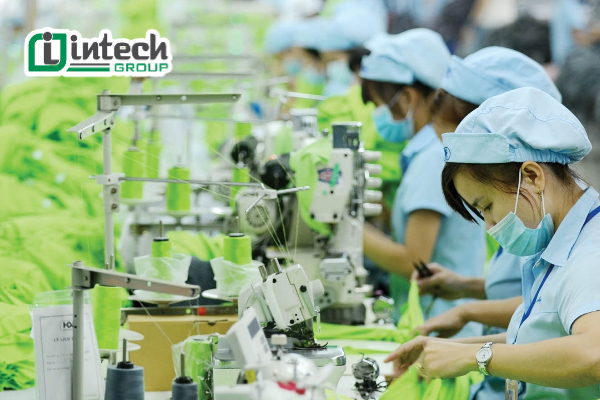
Especially in the textile and garment industry, which is heavily dependent on manual labor and is facing the problem of labor shortage, high labor costs and flexible production requirements, businesses are looking to invest in automatic or semi-automatic equipment at each stage such as fabric cutting, sewing, packaging systems, etc.

2. Current status of automation application in textile and garment production in Vietnam
According to data from the General Statistics Office, in 2023, Vietnam's total textile and garment export turnover is estimated to reach 40.3 billion USD, down more than 9% compared to the previous year. This forces businesses in the industry to seek innovative solutions, in which automation in textile and garment production is becoming an inevitable trend.
Many studies show that the application of modern automation technologies can help increase production efficiency by 30 - 50%, especially in the cutting and fabric preparation stages. At the same time, the product defect rate also decreases significantly, from 20 - 30%, helping to improve quality and reduce error correction costs.
Pioneering businesses such as May 10 have invested in automatic sewing machine systems and have significantly improved production efficiency. Vinatex Group has successfully deployed a smart production management system, helping to optimize costs and improve operational efficiency.
In addition to robots and AI in cutting, sewing, and packaging, smart management software such as ERP and CRM are also being put into operation to more closely control the supply chain and production process.
However, a recent survey on the level of readiness to access Industry 4.0 shows that Vietnamese textile and garment enterprises are still at a low average level, with an average score of 2.59/5. Specifically:
-
In terms of automation level: The yarn industry scored 3.3 points, dyeing 2.9 points, sewing 2.7 points and weaving the lowest with 2.2 points.
-
In terms of readiness to access technology: Yarn leads with 3.02 points, sewing 2.85 points, dyeing 2.3 points and weaving 2.2 points.
-
Regarding technology management capacity: The garment industry has the highest score of 3.11 points, followed by dyeing (2.83), yarn (2.61) and weaving (2.46).
A major obstacle that businesses face is the lack of investment budget for R&D. In particular, small and medium-sized enterprises, which account for the majority of market share in the industry, often have low profit margins and have not accumulated enough resources for long-term investment in technological innovation.
3. Benefits of automation technology in textile production
In the context of the textile industry facing the requirements of high productivity, stable quality and optimal cost, the application of automation has become a trend to help businesses maintain their competitive position. Below are the obvious benefits of applying technology to the production line:
Increase production productivity
Automated machines can operate continuously 24/7 without stopping, surpassing manual labor in speed and durability. An automated production system can complete many times more work than traditional methods, especially in stages such as fabric cutting, sewing, heat pressing, loading and unloading or packaging.
Improve product quality
Automated equipment in textile production is pre-programmed with specific technical parameters, ensuring that each output product has consistent and accurate quality. By minimizing human errors, businesses save significantly on costs due to defective, damaged products, or remanufacturing costs.
Reduce labor costs
Automation helps reduce the number of direct workers in the production line, thereby reducing personnel costs and related benefits. Employees have the opportunity to access and master technology, improve their qualifications, and switch to supervisory or technical roles.
Improve competitive position
Automation helps businesses produce at a faster speed, with more stable quality, and at lower costs, three key factors to dominate the market. In addition, the system also supports the collection and analysis of machine operating data, helping managers make quick decisions, optimize performance, and improve order fulfillment, adapting to the flexible manufacturing trend in the 4.0 era.
4. Application of automation technology in textile production
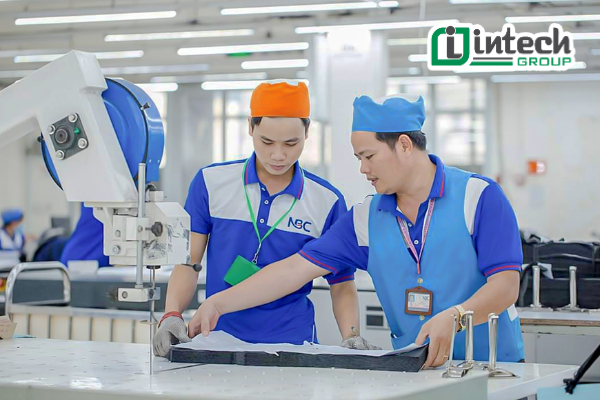
Below are the most prominent applications of automation technology in textile production, from design, fabric cutting, sewing to quality control and packaging.
CNC cutting knife
CNC cutting knife (Computer Numerical Control) is an ideal device for processing heavy and multi-layer textile materials with high precision. The machine uses a variety of designed cutting heads, which can be flexibly changed to serve many purposes such as cutting, marking or creating fabric grooves. The CNC cutting machine allows cutting up to 200 layers of fabric/time, self-adjusting cutting force, integrating vacuum suction and sewing point identification. Thanks to this application, businesses can save 10-15% of raw materials compared to manual methods.
Laser cutting technology
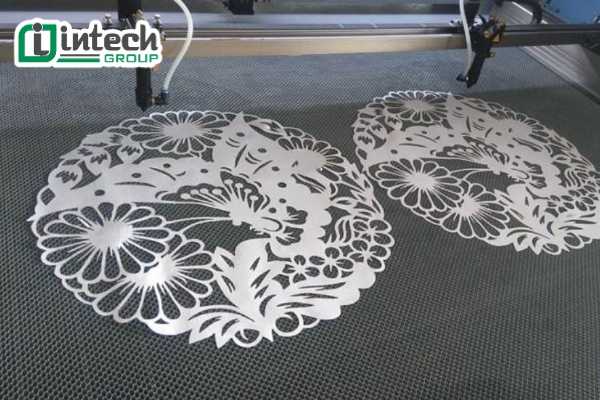
Laser cutting machine is an advanced cutting solution, especially suitable for cutting each layer of thin fabrics such as polyester, nylon or other synthetic fibers. With the ability to produce smooth, sharp and fray-resistant cuts, laser technology is highly regarded in the production of high-end fashion and fine garments.
Laser cutting machines can also create special pattern effects on the surface of fabrics. When combined with an automatic conveyor, the equipment can continuously cut from large rolls of fabric, thereby significantly improving productivity.
Designing patterns with CAD/CAM technology
CAD/CAM software such as Optitex, Gerber AccuMark or Lectra are digital design technologies that create 3D models to help visualize realistic products, automatically adjust sizes for many sizes, optimize pattern arrangement, save fabric, and simulate fabric movement on the body. After designing, digital data is transmitted directly to the CAM machine to automatically cut the fabric, ensuring high accuracy and shortening production time.
Automating the sewing process with smart sewing machines and robots
The garment sewing process is being increasingly automated thanks to the application of the following industrial machines:
- Automatic sewing machines can program seam patterns, detect errors and self-adjust.
- Sewing support robots perform operations such as folding fabric, attaching buttons, and making buttons to reduce repetitive operations.
- The automatic continuous sewing system completely processes details such as collars, pockets, and sleeves without manual operations.
Quality inspection with sensors and AI
Quality is a vital factor in the textile industry. Automatic inspection technology helps ensure consistency, speed, and accuracy:
- Smart sensors continuously monitor thread tension, seam density, needle spacing, etc.
- AI cameras and computer vision detect small errors such as stains, color deviation, pinholes, etc.
- Laser measuring equipment accurately checks the size of finished products.
Packaging and shipping automation
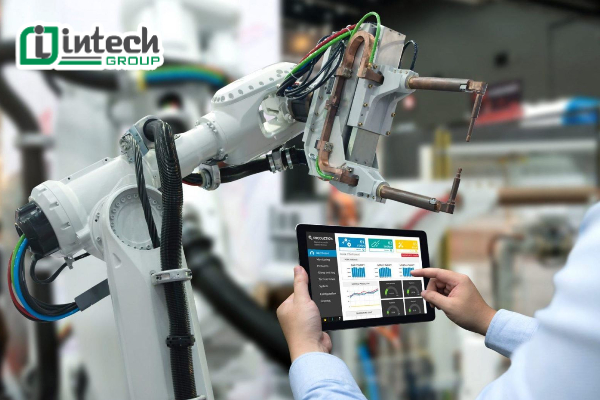
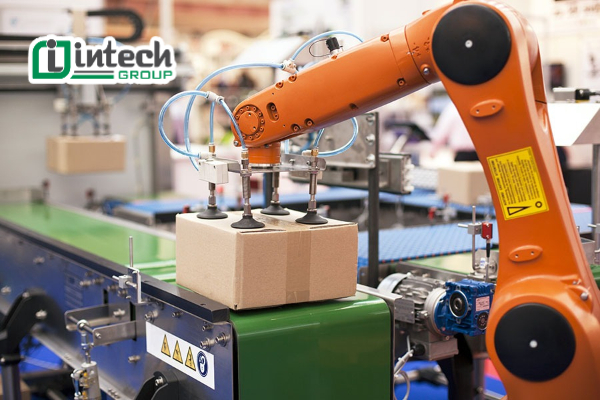
The final stage is also heavily automated with folding machines, robotic loading and unloading stations and automatic packaging machines according to the correct model, size, color, AGV self-propelled vehicles transporting goods between workshops, AS/RS warehouse management system storing, picking and exporting goods accurately and quickly.
5. Automation solutions in textile production from Intech Group
As a pioneer in the field of industrial automation in Vietnam, Intech Group has been providing many specialized automation solutions specifically for garment factories. The following are outstanding solutions implemented by Intech Group, contributing to the modernization of the textile and garment production process:
Garment industry hanging conveyor system
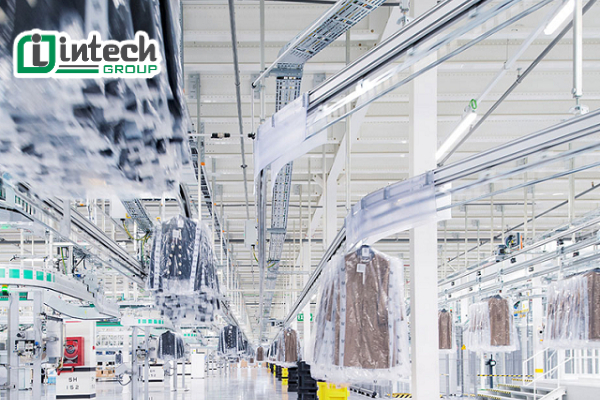
One of the most effective solutions for automation in the textile industry is the garment hanging conveyor system designed and installed by Intech.
- Easy to modify to suit any changes or scale expansion, move semi-finished products between stages accurately, automatically and continuously.
- Easy to control quality, classify, and pack goods in garments.
- High hanging design, saving factory space.
- Easy to integrate with production management software, allowing real-time monitoring of product status and progress.
Automatic conveyor system
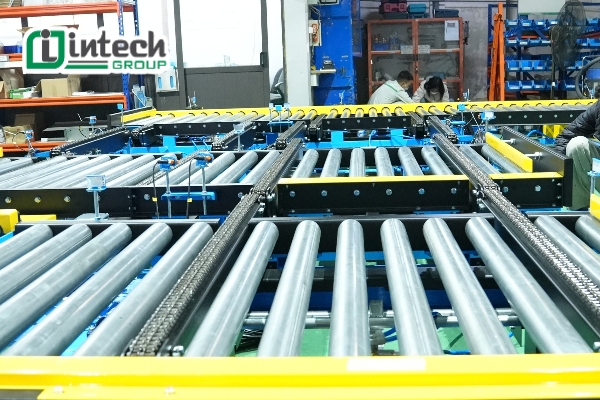
In addition to the suspension system, Intech Group also provides a variety of industrial conveyors suitable for each production requirement in the garment industry:
- Inclined conveyors, roller conveyors, PVC plastic conveyors, vertical conveyors, chain conveyors used in the stages: inspection, classification, packaging, transporting raw materials between lines and floors.
- Flexible design, customizable size, speed and length according to factory layout.
- Minimize dependence on labor, reduce risks due to incorrect operations and increase synchronization of the entire chain.
AGV Automated Guided Vehicle
AGV (Automated Guided Vehicle) is an internal transportation automation solution that many textile factories are choosing to replace traditional transportation methods.
Intech Group's AGV stands out with its ability to operate independently, find its own way or follow a predetermined route, automatically transport raw materials, semi-finished products, and finished products between production areas and warehouses, operating continuously 24/7, suitable for large-scale factories or shift production. AGV combined with central management software has become a smart transportation arm, ensuring that raw materials are always supplied promptly.
Automatic warehouse management system
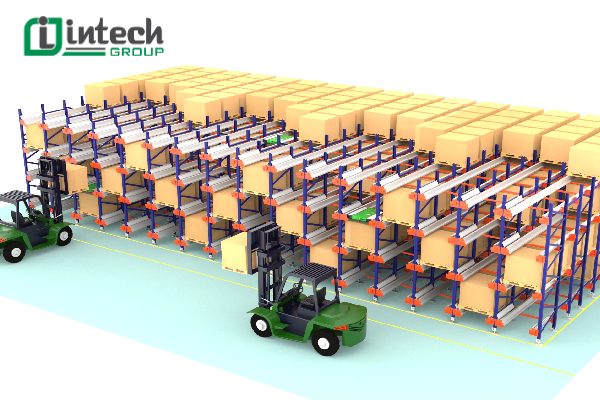
Effective warehouse management is a vital factor for textile and garment enterprises with large output and many continuously circulating orders. Intech Group provides an automated warehouse management system (AS/RS) that helps businesses accurately locate goods using barcodes or RFID, automatically import and export goods using robots or autonomous vehicles, warn of minimum inventory, support production planning and optimize storage space, and improve warehouse capacity.
With experience in implementing hundreds of factory automation projects, Intech Group is committed to providing comprehensive, flexible and cost-optimized solutions for textile and garment enterprises. Intech Group accompanies the Vietnamese textile and garment industry on the digital transformation journey, providing advanced technology solutions, supporting businesses to optimize processes and affirm their position on the global textile and garment map. Contact us immediately via Hotline 0966.966.032 - 0983.113.387 for advice and support.
