

Just In Time Model – Lean production model in supply chain
18-10-2025 479
The Just In Time (JIT) model in modern manufacturing focuses on eliminating waste and optimizing processes. Many businesses adopt JIT to improve responsiveness to customer demand and reduce costs and risks.
Let's join Intech Group to learn about JIT, its advantages and disadvantages and the implementation process of this model in the following article.
What is Just In Time?
Just In Time (JIT) production is a management philosophy designed to eliminate all forms of waste in the production process. The Just In Time (JIT) model focuses on producing the right quantity of products needed and combining the components at the right place at the right time. JIT helps optimize the production and supply process, ensuring that each step in the supply chain takes place continuously and efficiently.
In a JIT system, the flows of raw materials, goods and products are planned in detail step by step to ensure that the next process can be performed as soon as the current process is completed. This means that no items are left idle, no workers or equipment have to wait to start operating.
Each stage in the production process produces only the amount of product needed by the next stage. Processes that do not add value should be eliminated. The JIT system ensures that only what customers demand is produced when they need it.

History of the JIT Model
History of the JIT Model
The Just In Time model was first applied by Ford in the 1930s, as a pioneer in the application of the production line. However, it was not until the 1970s that the JIT production process was perfected and widely applied by Toyota Motors. Taiichi Ohno, one of the main developers of JIT at Toyota, is considered the father of this philosophy. He developed JIT as a means to quickly respond to customer requests and minimize waste.
The Purpose of Just In Time
The Just In Time (JIT) model aims to minimize non-value-added activities and eliminate inventories in the production line area. The specific goals of JIT include:
-
Optimizing the production process to reduce product completion time.
-
Ensuring that goods are delivered to customers on time.
-
Increase the efficiency of machinery and equipment.
-
Reduce the space required for warehouses and production lines.
-
Improve quality control processes to minimize product defects.
-
Reduce production costs and increase profits.
Benefits of JIT
The Just In Time (JIT) model brings many benefits to manufacturers, including:
-
Minimize inventory and capital congestion: Helps optimize inventory levels.
-
Reduce warehouse space: Minimize the necessary storage space.
-
Increase product quality: Improve production processes to improve product quality.
-
Reduce scrap and defective products: Minimize the rate of scrap in the production process.
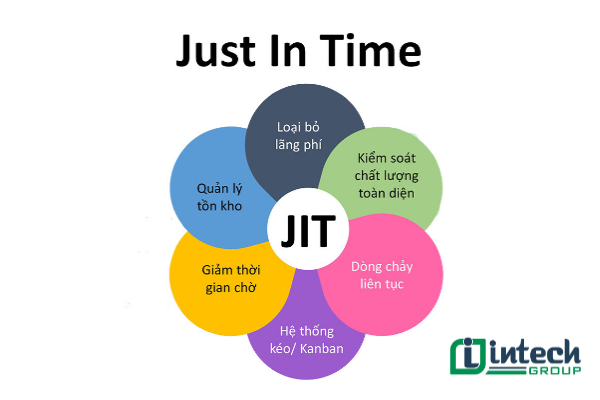
Increase productivity by reducing waiting time: Improve labor efficiency and reduce downtime.
Flexibility in changing production processes and product designs: Easily adjust production processes according to market demand.
Workers are deeply involved in improvement: Encourage creativity and worker contribution to the production process.
Reduce indirect labor: Optimize labor resources.
Reduce customer pressure: Respond quickly and effectively to customer needs.
Conditions for applying Just In Time
To effectively apply the Just In Time model, businesses need to meet the following conditions:
Suitable for repetitive production activities: JIT works best in a production environment with repetitive processes.
Use small batches: JIT encourages the use of small batches, helping to better control quality and reduce damage when errors occur.
Continuous production process: The flow of “goods” in the production and distribution process is planned in detail to ensure continuity, no workers or equipment have to wait.
Check quality immediately: Workers in the next process are customers of the previous process and are responsible for checking the quality of the product before performing their work.
Strengthen cooperation between manufacturers and suppliers: Close coordination between stakeholders is very important for JIT to operate effectively.
What is the Just In Time principle in production management?
Just In Time (JIT) is a production management method based on 4 principles: “Right product – right quantity – right place – right time”. This model helps businesses eliminate waste, optimize processes and improve production efficiency. With JIT, all stages in the production and supply chain have added value.
The output of each stage is provided exactly at the time needed for the next stage, ensuring no excess inventory, no waiting time between stages and maximum utilization of machinery and human resources in the factory. Thanks to that, Just In Time helps businesses maintain a continuous workflow, improve productivity and maximize operational efficiency.
The relationship between JIT - Kanban - Kaizen
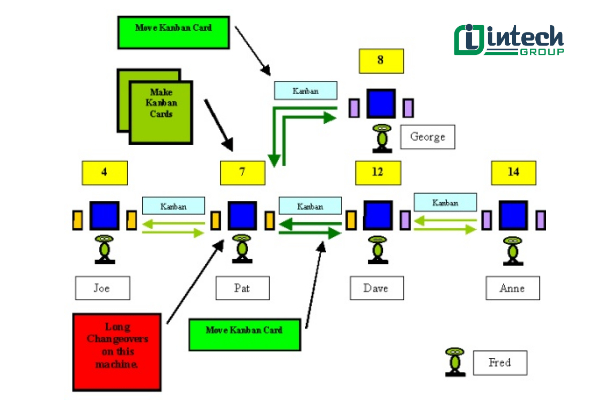
Just In Time does not operate independently but is often combined with Kanban and Kaizen to optimize the entire production process. Kanban is a flexible production scheduling system, developed by Toyota, which helps coordinate production according to actual demand. When applying Kanban in JIT, businesses can accurately determine the time of each production cycle, control reasonable inventory levels and ensure on-time supply, helping to optimize inventory management and cut costs.
Kaizen aims to eliminate waste, optimize each stage in the production process, improve product quality and ensure the system operates more efficiently every day, helping businesses continuously improve, adapt to changes and enhance competitiveness.
When combined with Kanban and Kaizen, this model brings outstanding efficiency in production and supply chain management, helping businesses increase efficiency, reduce costs and improve product quality.
Model References in Some Large Enterprises
Samsung's Just In Time Model
Samsung's Just-in-Time (JIT) model is a production management method that optimizes processes, minimizes waste, and increases efficiency. In the JIT system, Samsung focuses on providing the right product at the right time, in the right quantity that customers require, helping to reduce inventory and storage costs. This model includes the following highlights:
-
Pull system: Using a pull system in production, helps maintain a continuous workflow and minimize unnecessary inventory.
-
Stable and fixed production level: Each operation is carefully coordinated, to avoid shortages in the system, good forecasts with a specific schedule are needed.
-
Reduce inventory: Strictly control and minimize inventory levels, many commonly used domestic components have inventory levels up to zero when applying the JIT model.
-
Applicable to small batches: Applied to the production and distribution process of product lines, because the input components are small-sized components such as chips, circuit boards, panels, speakers, etc., the model can be used to divide the input components into smaller parts so that they can be integrated into the production process.
-
Multi-functional workers: Samsung focuses on training multi-functional workers, capable of performing many different operations from machine operation to quality control and maintenance.
-
Minimizing waste: JIT requires minimizing all forms of waste in production such as excess inventory, product defects, waiting time and redundant processes.
-
Technology Application: Invest heavily in technology to support JIT, from accurate inventory management systems to automation and quality control technologies
Continuous Improvement (Kaizen): Kaizen is an indispensable element in JIT, encouraging every employee to contribute to detecting and fixing small problems as soon as they arise.
By applying JIT, Samsung has been able to increase production flexibility, reduce operating costs and respond promptly to market requirements, contributing to strengthening its competitive position in the high-tech market.
Improving the production process through the use of Kanban not only helps to control inventory (Smart Warehouse Model) effectively but also optimizes the entire production process. Using Kanban is the best way to ensure that goods are always supplied at the right time and in the right quantity, helping businesses operate more effectively in the Just In Time model.
Reference:
