


Magnetic line guidance solution for AGV self-propelled vehicles
05-08-2025 232
Magnetic line guidance solutions for AGVs are increasingly being used in factories, smart warehouses and automated logistics systems. This is one of the most popular navigation methods, helping AGVs move accurately along a predetermined route thanks to signals from magnetic lines attached to the floor.
Intech Group will help you better understand AGV self-propelled vehicles and popular line navigation solutions for self-propelled vehicles today.
Introduction to AGV
AGV (Automated Guided Vehicle) is an automated vehicle designed specifically to transport goods, raw materials, semi-finished products and finished products in industrial environments. AGV robots operate fully automatically through guidance technologies such as magnetic lines, lasers, or optics, helping to optimize the flow of movement in factories and warehouses.
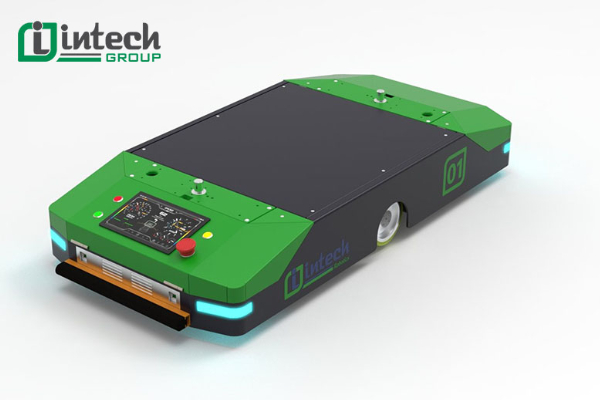
Benefits of AGV in manufacturing
Using AGVs in smart manufacturing systems brings many benefits such as:
Optimizing labor costs: Robot AGV can transport large volumes of goods without direct supervision, thereby minimizing dependence on manual labor.
Improving productivity and accuracy: AGVs can operate continuously 24/7 with high stability, ensuring accurate transportation, minimizing errors and interruptions in the production line.
Increasing safety and automation: AGVs are programmed with safety sensors, helping to avoid collisions and are suitable for the Smart Factory model.
Magnetic line guidance solution for AGV vehicles
In modern AGV systems, choosing the right guidance solution plays a key role in ensuring performance, accuracy and flexibility in operation. The most advanced and popular magnetic line guidance solutions for AGVs today.
1. Wire guidance
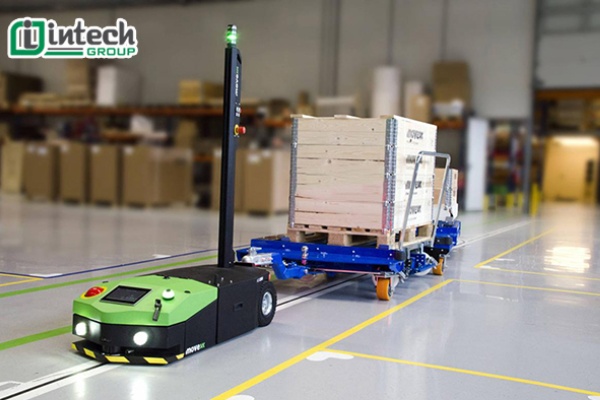
Metal wires are buried under the factory floor and run through low-frequency alternating current, creating a stable magnetic field. AGVs use magnetic sensors mounted under the vehicle body to detect and track this magnetic signal. In some designs, RFID technology is integrated into the wires to provide more accurate location information to the AGV while it is moving.
2. Magnetic Point Guidance
The magnetic point guidance solution uses magnetic field points about 3 meters apart, fixed under the ground. The AGV vehicle integrates sensors such as: magnetic field sensors, encoders, gyroscopes, etc. These sensors will record magnetic field signals at each point, send them to the MCU central controller to calculate the location and navigate accurately according to the predetermined route.
3. Magnetic line guidance solution
This is a guidance method that uses magnetic tape lines or colored tape reflective optical lines. The line will be glued or attached to the floor according to the desired route of the business. AGV self-driving vehicles use line reading sensors to identify the route and move along the positioning route. The system can combine additional RFID tags to provide information at intersections or stops, helping AGV operate more flexibly and intelligently.
4. Laser Guidance
AGV robot are equipped with laser sensor systems that can transmit and receive reflected signals from reflectors fixed in the operating area. Data collected from the reflected laser will be processed to accurately determine the location and direction of the AGV in three-dimensional space.
5. Natural Navigation (SLAM)
Simultaneous Localization and Mapping is a form of natural navigation that uses LiDAR sensors to scan and map the surrounding environment in real time. Without the need for fixed reflectors or support equipment, AGVs can locate and navigate themselves by memorizing and comparing the scanned map with a reference map. Compared to traditional laser guidance, SLAM saves infrastructure costs and provides higher reliability in flexible manufacturing environments.
6. Camera navigation
This method uses the built-in camera on the AGV to collect images of the surrounding environment. The software system will process the image, map it with the original positioning map, and determine the current location of the AGV. The necessary condition is that the environment must have stable lighting so that the camera can collect accurate data.
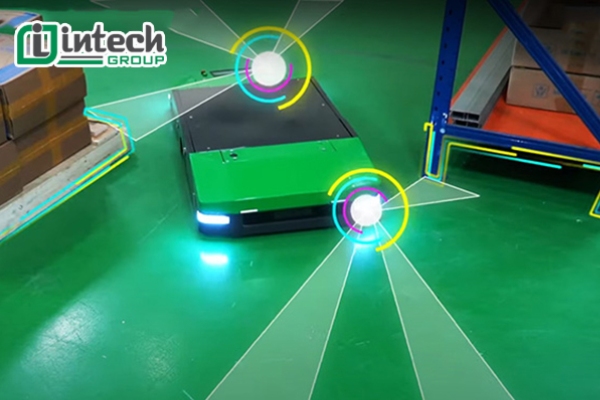
In the current trend of production automation, choosing the right guidance solution for AGV vehicles is a key factor to help businesses improve operational efficiency, minimize errors and optimize costs. Therefore, businesses need to properly assess their needs and operational characteristics to help them deploy an optimal, smarter and more sustainable AGV vehicle system in the era of Industry 4.0. Contact Intech Group for advice on the AGV self-driving vehicle line that suits your business needs today.
