


What is a value chain map? Practical applications in manufacturing
18-10-2025 247
Value Stream Mapping (VSM) is a powerful tool in Lean manufacturing. It helps businesses analyze, design and optimize production processes, thereby eliminating waste and improving operational efficiency.
What is Value Stream Mapping – VSM?
1 - Definition of Value Stream Mapping
Sơ đồ chuỗi giá trị (Value Stream Mapping – VSM) là một công cụ thiết yếu trong quản lý sản xuất và quy trình làm việc. Nó giúp biểu đồ hóa và phân tích quy trình sản xuất hoặc cung ứng hàng hóa và dịch vụ từ điểm khởi đầu đến điểm kết thúc, nhằm tìm kiếm các cách tối ưu hóa hiệu suất và giảm thiểu lãng phí.
VSM, là một trong những công cụ chủ chốt của phương pháp Sản xuất tinh gọn – Lean manufacturing, cung cấp cái nhìn tổng quan về toàn bộ chuỗi giá trị. Nó thể hiện các bước quy trình, luồng thông tin về sản phẩm hoặc dịch vụ, và thời gian thực hiện cho mỗi bước/giai đoạn. Chính vì lý do này, VSM được coi là công cụ hàng đầu giúp các tổ chức nhận diện vấn đề trong quy trình và cải thiện chúng, từ đó nâng cao năng suất và giảm thiểu lãng phí.

2 - The origin of the VSM Value Stream Mapping
The Value Stream Mapping first appeared in 1918 in the book “Installing Efficiency Methods” by Charles E. Knoeppel. Initially, it was called “A diagram showing the flow of materials and information”. Later, this diagram became famous and associated with Toyota’s production system, contributing to the development of the Lean Manufacturing System.
By 1990, this tool had been widely applied globally in many different fields, and the official name “Value Stream Mapping” was popularized.
3 - The importance of VSM Value Stream Mapping in Lean Manufacturing
Value Stream Mapping (VSM) is increasingly becoming an essential element in production management and business management. VSM plays a decisive role in optimizing the process and improving the overall performance of the production system.
Identify and eliminate waste
VSM value stream mapping helps managers clearly identify unnecessary activities, waiting times, and waste in the production process. From there, businesses can focus on eliminating these weaknesses, optimizing the process, saving time, resources, and reducing production costs.
Optimize workflow
Building a Value Stream Mapping provides an overview of the workflow from the beginning to the end of the production process. This helps managers clearly identify the steps that need to be adjusted, optimized, or eliminated to make the process smoother and minimize waiting times.
Improve product quality
In addition to reducing waste, the VSM value stream mapping also supports product quality control. By identifying quality control checkpoints and processes, the VSM tool helps businesses ensure that the final product meets the highest quality standards.
Increased flexibility
The VSM value stream map provides an overview of the entire production system, enabling businesses to identify dependencies between steps and processes. This helps create flexibility in changing or adjusting the production process according to market demand and quickly adapt to changes in any situation.
6 Steps to Build a VSM Value Stream Mapping
Value Stream Mapping (VSM) is an important tool in Lean manufacturing, helping businesses optimize production and supply processes. Below are 6 steps to build a VSM value stream map.
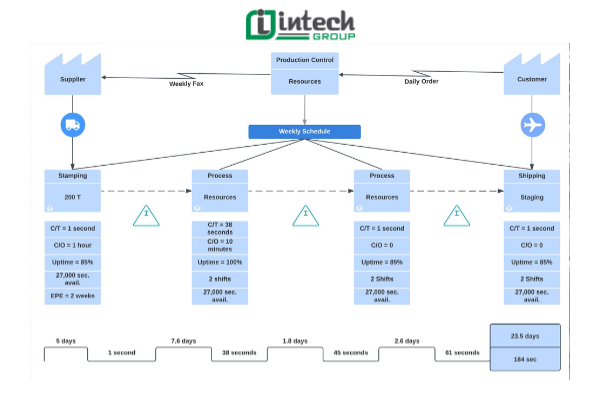
Step 1: Define the Value Chain
The first step in building a value chain map is to clearly define the value chain that the business wants to improve and optimize. The business needs to choose a specific process related to its product or service. Determining the scope of the process, from the starting point to the end point, is important to have a comprehensive view of the process and to detect potential problems such as bottlenecks or waste.
Step 2: Draw the current VSM value chain map
In this step, the business needs to map the current process to evaluate performance and clearly identify problems. Form a VSM team with members representing the stakeholders. This team should include a mentor and senior manager with experience in Lean Manufacturing principles. Then, list all the tasks, including the time and cost of each task, along with the waiting time between tasks. This will help the business have a comprehensive picture of the process.
Step 3: Assess the current situation
After building and applying the VSM value chain map, the business needs to specifically analyze each activity in the process to determine whether they create added value or not. Do these activities bring benefits to customers?
Step 4: Draw the future value chain map
After eliminating waste and errors, the business should create a simulation diagram of the future VSM process that they want to achieve. Ask questions like “What will your competitors do to streamline the process the most?” The business can consider initiatives such as digitizing the management process through ERP software or MES systems to solve the difficulties that traditional management encounters.
Step 5: Develop a plan and implement improvements
After determining the goals, the business needs to develop a specific plan to implement the future value chain map. Lean Manufacturing tools such as Kaizen, 5S, Kanban and Just In Time can be applied to optimize the process. It is important that the plan is effectively implemented to achieve the goal.
Step 6: Evaluate the effectiveness and continuously improve
Finally, the business needs to evaluate whether the Value Stream Mapping method is suitable and achieves the goal. Evaluation criteria include:
Does the VSM value stream map convey the desired business goals?
Is there a connection between the company and customers in the VSM value stream map?
Are the lean activities from the VSM method effective and have they become part of the corporate culture?
Application of VSM Value Stream Map in Enterprises
Value Stream Mapping (VSM) is a useful tool in Lean manufacturing to help analyze and optimize processes. Although VSM is commonly associated with manufacturing environments, its applications have expanded to many different areas. Below are the main applications of VSM in various industries.

1 - Applications in Manufacturing
VSM is a key tool for analyzing manufacturing processes, helping to identify waste, improve processes, and increase efficiency. Businesses use VSM to:
Identify production process steps: VSM helps record and analyze each step of the process to detect non-value-added activities.
Reduce production time: By optimizing process steps, businesses can shorten production time and increase productivity.
Continuous improvement: Use VSM to monitor and improve production processes over time.
2 -Applications in Supply Chain
In the supply chain, VSM helps businesses:
Optimize supply processes: VSM allows businesses to analyze the flow of goods from suppliers to customers, thereby improving delivery times and reducing costs.
Effective inventory control: VSM helps identify bottlenecks in the supply chain, thereby helping to reduce inventory and improve the flow of goods.
3 - Applications in Services
VSM is not only applied in manufacturing but also in the service industry. Specifically:
Improving customer experience: VSM helps analyze customer service processes to identify inefficiencies, thereby improving service quality.
Optimizing internal processes: VSM can be used to analyze work processes in service businesses, helping to improve performance and reduce customer waiting times.
4 - Applications in Healthcare
In the healthcare industry, VSM is applied to:
Improving medical examination and treatment processes: VSM helps identify steps in the medical examination process, thereby improving waiting times and quality of medical services.
Optimizing drug and medical equipment management: VSM allows medical facilities to analyze drug and equipment flows, thereby managing inventory more effectively.
5 - Applications in Software Development
In the field of software development, VSM helps:
Optimizing the development process: VSM can be used to analyze the software development process, helping to detect problems and improve work performance.
Improving product quality: By analyzing the steps in the development process, the development team can improve the testing process and minimize software errors.
6 - Applications in Administration and Office Processes
VSM is also applied in administrative and office processes to:
Increase work performance: VSM helps analyze internal processes, thereby optimizing work and minimizing wasted time.
Improve information management: VSM allows businesses to identify steps in the document and information management process, thereby improving work efficiency.
Conclusion
If your business is having difficulty exploiting the Value Stream Mapping diagram, contact our production management experts for support and advice. Contact Hotline 0966.966.032 - 0986.448.456.
See more:
