


What is Reorder Point? How to calculate Reorder Point (ROP) accurately and effectively
14-10-2025 134
Integrating reorder points and safety stocks into your replenishment calculations helps you effectively manage both current inventory and forecast future order quantities.
What is Reorder Point?
Reorder Point (ROP) is the minimum inventory level that, when reached, a business needs to place additional orders to maintain sufficient inventory. This is an effective inventory management method, popular in businesses, to avoid shortages or surpluses of goods. When inventory reaches the ROP point, businesses need to quickly replenish to ensure continuous supply for production and meet market demand.

The importance of Reorder Point in warehouse management
Reorder Point plays an essential role in warehouse management, helping businesses maintain a balance between meeting customer demand and minimizing inventory costs. To accurately determine ROP, it is necessary to consider factors such as the speed of goods consumption, supply time from suppliers, and fluctuations in customer demand. Setting ROP correctly helps minimize costs and optimize warehouse performance.
Benefits of Reorder Point Management
Effective management of ROP helps businesses avoid two main problems:
- Stock shortages: If ROP is set too low, businesses are likely to run out of stock, leading to loss of customers.
- Excess inventory: If ROP is too high, inventory will be redundant, increasing unnecessary storage costs.
- Therefore, understanding and optimizing Reorder Point is an important factor to maintain warehouse performance and increase business profits.
How to calculate Reorder Point (ROP) accurately and effectively
Reorder Point (ROP) is an important tool in warehouse management, helping businesses balance the risk of stock shortages and storage costs, ensuring that the supply of goods is not interrupted during the production process. Below are the main factors that need to be calculated to determine the correct ROP:
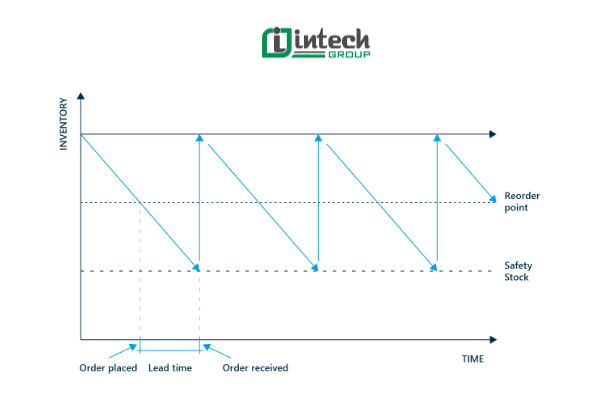
Safety Stock
Safety Stock is the minimum amount of inventory needed to hedge against risks associated with demand fluctuations and unstable lead times. To determine the appropriate level of safety stock, businesses need to consider:
- Demand fluctuations: Changes in customer demand, especially during peak seasons.
- Lead time fluctuations: Sometimes, delivery times from suppliers can be extended due to factors such as weather or transportation problems.
- Priority of goods: Some essential items require higher stock levels to avoid affecting the production chain.
Lead time from suppliers
Lead time is the time between placing an order and receiving the goods at the warehouse. This is an important factor in determining ROP because businesses need to ensure that when inventory reaches the ROP level, new orders have been placed and will arrive in time. To determine effective lead times, it is necessary to:
- Analyze the average lead time from previous orders.
- Consider the stability of the supplier, ensuring that they can maintain consistent delivery times.
Expected Demand
Expected demand is the amount of goods that a business predicts will be consumed in a specific period of time. To accurately calculate this demand, businesses often rely on:
- Historical sales data: Past consumption trends will help predict future demand.
- Demand forecast analysis: Apply forecasting models based on customer behavior, seasonality, and market factors.
- Master Production Schedule (MPS): Helps plan accurately for the types of goods needed in each period.
Reorder Point (ROP) Calculation Formula
Reorder Point (ROP) is an important method to help businesses maintain inventory at an optimal level, meeting consumption needs without causing interruption to production. The formula for calculating ROP is as follows:
Reorder Point (ROP) = Safety Stock + (Time to receive raw materials from suppliers x Average daily consumption)
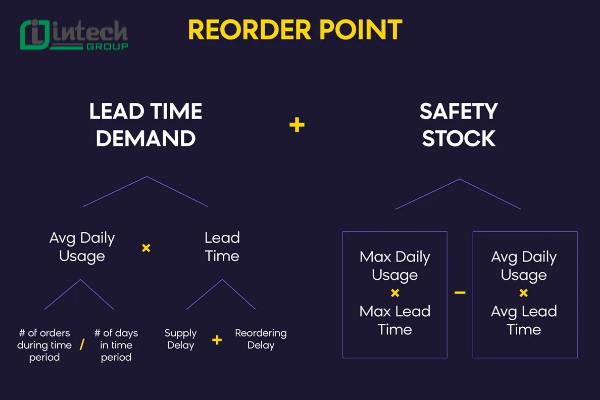
Công thức tính Reorder Point (ROP) chính xác
Example of calculating the exact reorder point (ROP)Suppose that company A produces household plastic products with the following parameters:
- Average daily consumption: 500 products
- Safety stock level in warehouse: 100 products
- Delivery time from supplier: 4 days
Applying the formula, the reorder point (ROP) of company A will be:
This means that when the inventory level drops to 2100 products, company A needs to immediately place an additional order to ensure that there is no interruption in the production process and to meet the market demand.
The importance of determining the Reorder Point in manufacturing
Reducing inventory costs
According to research by Dr. Thomas W. Gruen and Dr. Daniel Corsten from the University of Colorado, manufacturing companies lose an average of 4% of their annual revenue due to stockouts. On the contrary, storing too much inventory also causes unnecessary maintenance costs. Determining the Reorder Point (ROP) helps businesses avoid this situation, optimize production costs and preserve profits.
Maintain stable inventory levels
Inventory planning plays an important role in the success of manufacturing businesses. Storing too much inventory causes expensive storage costs, while inventory shortages affect the ability to meet customer needs and can damage reputation. By accurately determining the ROP point, businesses can easily balance inventory levels, optimize order quantities to match actual needs.
Ensure production progress and customer needs
When maintaining stable inventory levels, businesses can implement production plans on schedule and promptly meet customer needs. This ensures uninterrupted production processes, maintains customer trust and strengthens reputation in the market.
Determining the effective Reorder Point helps businesses not only control inventory but also optimize costs and maintain stability in the production process.
One of the most popular inventory control strategies is the reorder point. Based on the desired resupply time and the required safety stock level, manufacturing software can accurately calculate the quantity of goods to order to optimize inventory. Setting up the reorder point helps businesses free up capital and maintain the most efficient import and export operations.
If you need help calculating the reorder point, you can refer to the formula provided above. This article also provides some flexible techniques that are easy to customize according to your business model. Find this article useful? Don't forget to follow our website for more useful information!
Reference:
